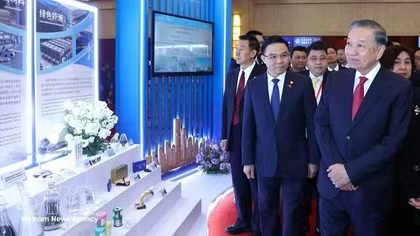
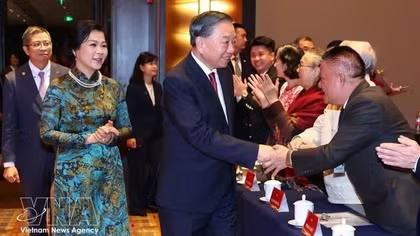
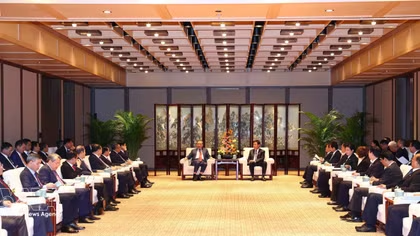
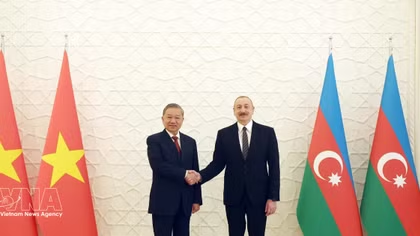
Vietnam has officially begun preparations for its third APEC host year in 2027, following the handover of the host role in Shenzhen, China, with a focus on strengthening economic resilience, promoting innovation and advancing shared prosperity across the region.
A moment of honour and responsibility
Established in November 1989, the Asia-Pacific Economic Cooperation (APEC) is an open economic forum designed to promote economic initiatives, trade and investment among member economies on a fully voluntary basis. Today, APEC comprises 21 economies, accounting for about 60% of global GDP and nearly half of world trade.
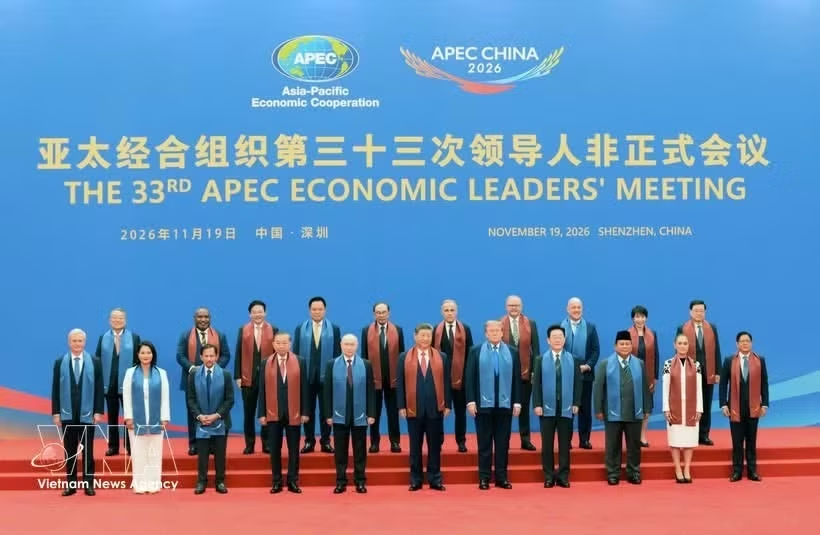
According to Minister of Foreign Affairs Le Hoai Trung, the 33rd APEC Economic Leaders’ Week in Shenzhen, China, was a success, with member economies finding common ground amid profound transformations in the global economy. For the first time in four years, leaders from all 21 economies attended. This provided a favourable foundation for Vietnam as it prepares to assume the host role.
Vietnam joined APEC in 1998. Having hosted the forum in 2006 and 2017, it will take on the role for the third time in 2027. According to Deputy Minister of Foreign Affairs Nguyen Minh Vu, Vietnam is among a small number of economies to have hosted APEC three times. This standing has been built on its own contributions to the forum.
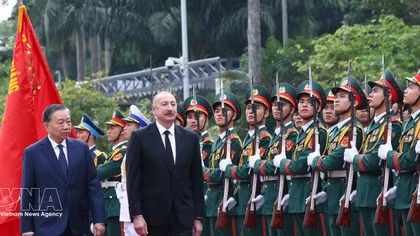
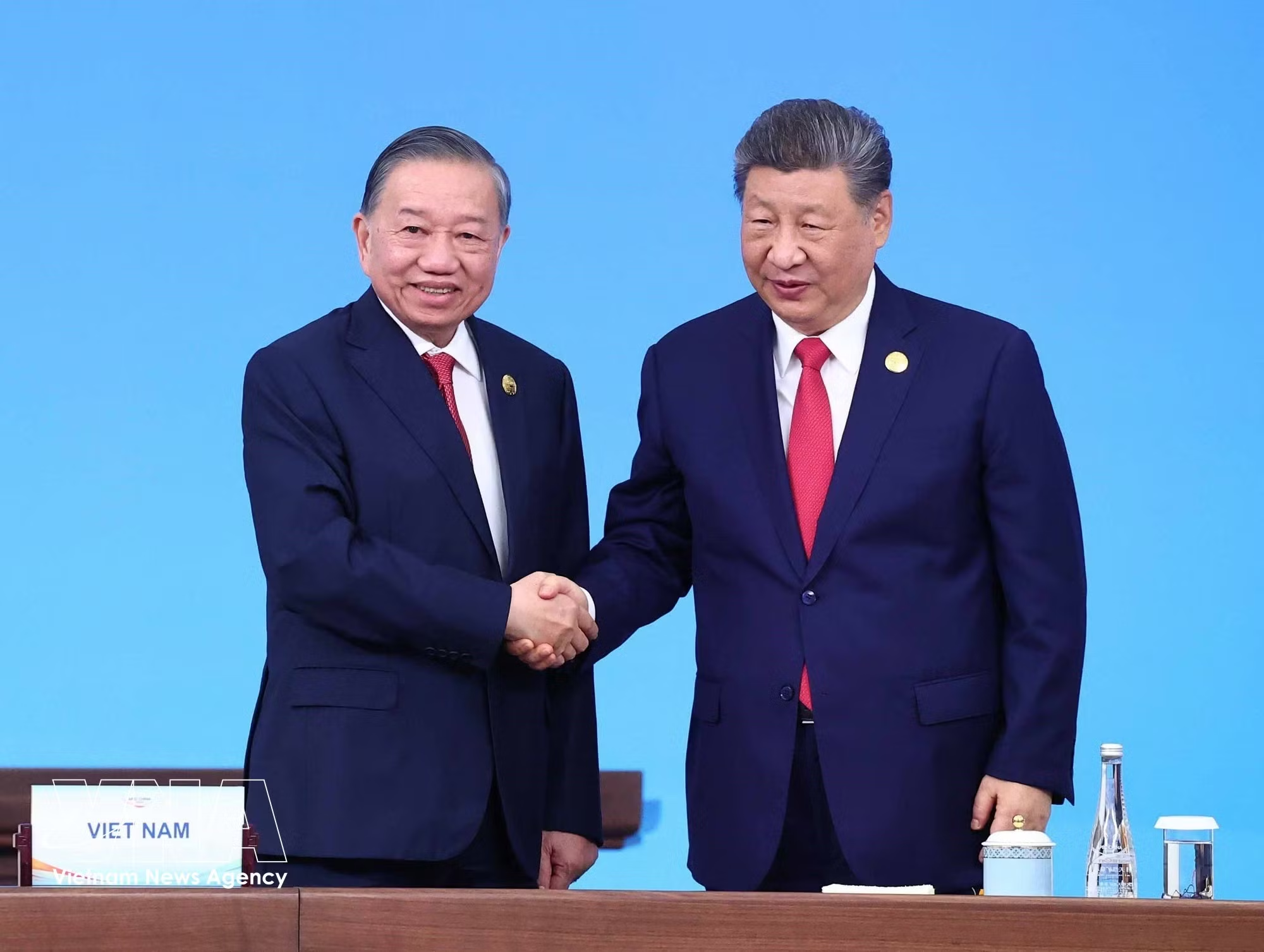
Trung said that during APEC Year 2026, Vietnamese ministries and agencies actively proposed initiatives, participated in drafting documents, and chaired and coordinated numerous APEC cooperation mechanisms. At the Economic Leaders’ Meeting, General Secretary of the Communist Party of Vietnam Central Committee and President To Lam was the first leader to speak after the host economy.
In his remarks at the handover ceremony, General Secretary and President To Lam reaffirmed that Vietnam is a responsible member and trusted partner, expressing confidence in APEC’s resilience, having weathered the 1997-1998 financial crisis, the 2008 recession and the COVID-19 pandemic. On this basis, Vietnam proposed the theme for APEC Year 2027: “Building a New Era of Resilience, Innovation and Shared Prosperity”.
Three major priorities: From theme to action
Following consultations with member economies, Vietnam proposed three priorities: enhancing economic productivity; promoting regional trade and investment; and strengthening economic resilience and dynamism and improving people's quality of life.
According to Trung, the theme and priorities received an enthusiastic response because they both build on APEC’s long-term objectives and address emerging trends. The continuity is clear: China's APEC Year 2026 focused on “openness, innovation and cooperation”, while the 2027 theme places innovation alongside resilience and shared prosperity.
Regarding the first priority, putting productivity first is a deliberate choice. Trade liberalisation remains fundamental, but growth can no longer rely solely on market expansion. Technological capacity, workforce quality and digital connectivity are increasingly decisive factors. Artificial intelligence (AI) offers opportunities to transform production and business models, while also posing challenges related to technological gaps and workforce skills.
Professor Carl Thayer of the Australian Defence Force Academy at the University of New South Wales said that linking digital transformation with workforce skills training, support for small and medium-sized enterprises (SMEs), and efforts to narrow the digital divide demonstrates that Vietnam’s priority is aligned with the broader direction of regional cooperation.
On the second priority, if productivity concerns the quality of growth, trade and investment concern the space in which growth takes place. This has been APEC’s founding mission, reflected in the 1994 Bogor Goals, the 1995 Osaka Action Agenda and the Putrajaya Vision 2040. However, today's environment is more challenging. Global economic uncertainty, strategic competition, shifts in trade policies and supply chain disruptions are putting pressure on multilateral cooperation.
For Vietnam, trade and investment are at the heart of its national interests. Ambassador Bui The Giang, former Deputy Head of Vietnam’s Permanent Mission to the United Nations, said that for many years, Vietnam's total trade in goods and services had been equivalent to nearly twice its GDP. An economy with such a high degree of openness understands the value of facilitating trade, maintaining stable supply chains and keeping markets open.
About the third priority, while the first two priorities focus on growth drivers and opportunities, the third addresses a fundamental question: what is development for, and whom does it serve?
General Secretary and President To Lam underscored the goal of strengthening economic autonomy and resilience while unlocking the potential and creativity of all economic actors.
“Quality of life” is also reflected in the goal of expanding business opportunities and creating jobs for people across the region. For most people, APEC is not experienced through high-level declarations, but through their jobs, incomes and personal opportunities. Professor Carl Thayer noted that digital technologies can serve a range of common needs, from commercial transactions to healthcare and adaptation to demographic changes. These are issues closely connected to individual households, including older people, whose share of the population is growing in many regional economies.
From priorities to results: The host economy's challenge
According to Minister Trung, at the 33rd APEC Economic Leaders’ Week, leaders adopted important documents on regional connectivity and cooperation in digital and emerging technologies. They also agreed to continue advancing cooperation on artificial intelligence and the Free Trade Area of the Asia-Pacific (FTAAP) agenda.
Professor Carl Thayer said the APEC Trade Digitalisation Cooperation Framework (2027-2030) and the APEC Connectivity Blueprint provide a basis for Vietnam to incorporate follow-up work into the agenda for its host year.
However, he also pointed out that APEC operates on the principles of consensus and voluntary commitments, with no enforcement mechanism. The value of its documents depends on the extent to which individual members implement them. The host economy can convene meetings and shape the agenda, but outcomes remain subject to collective decisions by member economies.
The experience of 2017 offers a case in point. After the United States withdrew from the Trans-Pacific Partnership (TPP), Vietnam and its partners continued to advance negotiations. Negotiating efforts under the framework of APEC 2017 in Da Nang helped the remaining 11 countries reach agreement on the core elements of the pact, which was subsequently signed as the Comprehensive and Progressive Agreement for Trans-Pacific Partnership (CPTPP).
The lesson is the importance of early preparation and persistent efforts to narrow differences. According to Deputy FM Vu, Vietnam has assembled experienced multilateral diplomats, particularly those who participated in APEC 2017, to form the core of the team responsible for APEC Year 2027.
Equally important is providing clear direction for Vietnam’s initiatives. Ambassador Giang outlined three principles: safeguarding national interests on the basis of compliance with the United Nations Charter and international law; taking into account the interests of all 21 partner economies to enable them to leverage one another's strengths; and pursuing rapid but sustainable, high-quality development.
These three principles also provide the clearest interpretation of the host year's theme of “resilience, innovation and shared prosperity”.
Professor Carl Thayer observed that Vietnam’s advantage lies in aligning APEC's cooperation agenda with its domestic development priorities. In concrete terms, what Vietnam proposes to the region is also what it is pursuing at home.
However, opportunities do not automatically translate into benefits. This also depends on business competitiveness, workforce quality, digital infrastructure and the ability to meet increasingly stringent international market standards.
The APEC 2027 journey will span various parts of Vietnam, involving local authorities, businesses and people from all walks of life, before culminating on the island of Phu Quoc, where the Economic Leaders’ Week will take place.
One ocean, one future
In his remarks at the handover ceremony for APEC Year 2027, General Secretary and President To Lam delivered a message about the ability of 21 APEC economies to come together and accommodate their differences within a shared cooperation framework.
The journey towards APEC Year 2027 has begun. It will be a busy year for the host economy, but also an opportunity for Vietnam to translate its standing and credibility into practical contributions to the region while mobilising resources for national development.
“One Ocean, One Future” is Vietnam’s promise to the region and its commitment to action throughout APEC Year 2027.