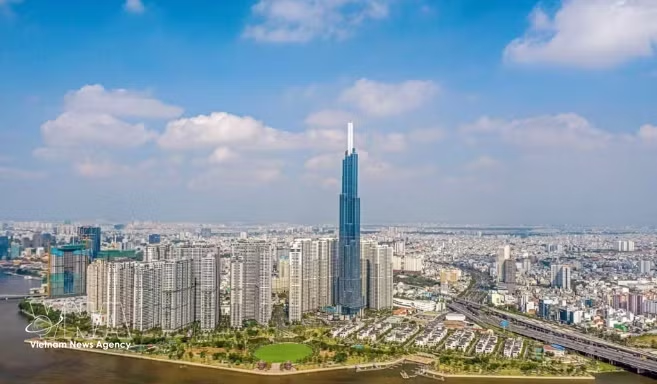
Ho Chi Minh City (VNA) – The Ho Chi Minh City People’s Council, during its sixth session on October 30, approved the city’s master plan for 2025–2050, with a 100-year vision, charting its development into a multi-polar, multi-center megacity with a projected population of more than 27 million by 2050.
The plan covers the entire administrative area of Ho Chi Minh City, spanning approximately 6,772.59 sq.km and comprising 168 administrative units. Its research scope also extends to neighboring localities, including Tay Ninh, Dong Nai, Dong Thap and Lam Dong provinces, as well as relevant maritime areas.
The city’s population is projected to reach around 18 million by 2030 and more than 27 million by 2050. Its workforce is expected to number 8.2 million by 2030, 10.7 million by 2045 and 11.3 million by 2050.
The development vision comprises three stages, progressing from a leading Southeast Asian city to an Asian center for economic, cultural, social, scientific, technological and innovation activities, before becoming a comprehensive, modern and smart global city on a par with the world's leading urban centers.
The plan shifts the growth model from reliance primarily on capital, land and labor towards productivity, science, technology, innovation and high-value services.
The 2026–2030 period will focus on four pillars: breakthrough technologies, innovation, strategic infrastructure and urban services. From 2031 to 2035, the focus will be on boosting the efficiency of core infrastructure and enhancing productivity. This will be followed by a shift toward a knowledge-based economy between 2036 and 2045, leading to sustainable growth and aiming for global-city status beyond 2045.
Reporting to the council, Vice Chairman of the municipal People’s Committee Nguyen Manh Cuong outlined four major development principles: building a people-centered global city; establishing an integrated innovation ecosystem from research to commercialization; developing open, outstanding and internationally competitive mechanisms and policies; and organizing integrated urban spaces supported by modern infrastructure connecting land, sea and air transport.
Under the overall development model, the megacity will comprise five growth poles, namely international financial services at the center; innovation in the East; industry, high technology and logistics in the North; seaports, free trade, international logistics and energy in the South; and urban development, education and healthcare in the West.
Five satellite centers will support them: Con Dao, Long Hai – Ho Tram, Hoc Mon – Cu Chi, Bau Bang, and Tan Uyen – Bac Tan Uyen.
Five strategic connectivity systems will link key economic regions, industrial hubs and logistics networks, while strengthening urban infrastructure and green-blue ecological corridors along the Sai Gon and Dong Nai rivers. The city will also establish 10 development management zones based on their respective functions, land conditions, infrastructure, environmental requirements and local characteristics.
According to Cuong, the master plan aims to shift from a concentrated urban core to an interconnected network of growth poles, prioritizing compact, transit-oriented development (TOD) around transport hubs and redeveloping underutilized areas. Urban space will be organized in three dimensions: above ground, underground, and elevated.
Economically, Ho Chi Minh City will develop 10 industries and sectors across four core groups, with advanced manufacturing, a regional financial center, digital services and AI, and advanced logistics identified as four major high-value-added growth drivers.
The southern metropolis also aims to become a leading cultural and creative center in Vietnam and Southeast Asia, focusing on heritage preservation, cultural industries and grassroots cultural development.
By 2050, it looks to become a leading Asian center for higher education, vocational training, science and technology, with 2 million students and an additional 1,400–2,000 hectares of land allocated for higher education during 2030–2050.
In healthcare, priorities include developing gateway hospitals, specialized medical clusters and medical tourism corridors, while strengthening preventive and grassroots healthcare, digital transformation, adaptation to population aging, and the healthcare – pharmaceutical industry.
The city also aims to build an advanced social welfare system and become one of the world's most liveable cities by 2045.
The plan further seeks to establish the city as a leading Asian innovation hub, and a leading regional center for talent attraction and training, as well as for international knowledge and technology connectivity.
Underground space will be developed around urban centers and transport hubs at three levels: shallow (0–20 meters), deep (20–40 meters), and very deep (over 40 meters). Low- and high-altitude airspace will also be developed as new growth drivers, with security and defense ensured through management zones supported by integrated digital and physical infrastructure.
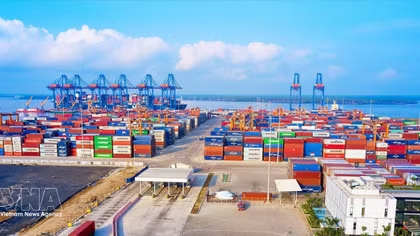
For maritime development, Ganh Rai Bay–Can Gio–Cai Mep and Thi Vai–Vung Tau–Con Dao will form interconnected development areas integrating seaports, logistics, high-tech industries, energy, urban development and marine tourism. The plan also sets out criteria and potential locations for offshore wind power and sea encroachment projects.