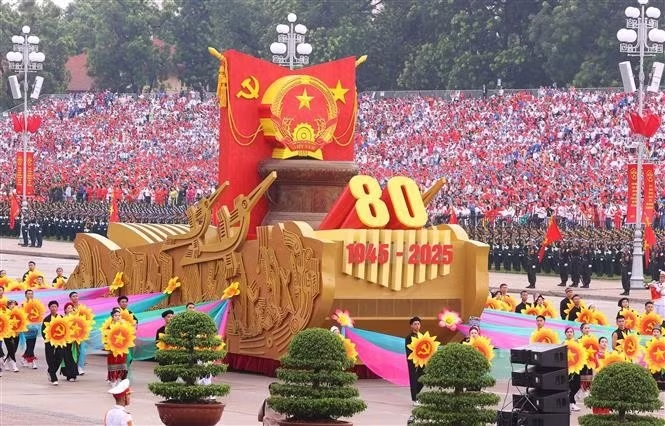
A grand parade took place at the ceremony celebrating the 80th anniversary of August Revolution and National Day at the historic Ba Dinh Square in Hanoi on September 2 morning, stirring deep emotions in the hearts of all Vietnamese people.
The parade comprised military and police formations marching in unison across the historic square, accompanied by large-scale displays of weapons, equipment, aircraft, and naval vessels at sea, set to resounding military music under autumn skies filled with fluttering red flags and yellow stars.
The parade formations included the Honour Guard; 22 army formations; three militia and guerrilla units; 17 police formations; four foreign military units from China, Russia, Laos, and Cambodia; 14 military vehicle and artillery formations; nine special police vehicle formations; the red flag contingent; and 13 mass organisation contingents. Together, they recreated and affirmed the great stature and immense value of the August Revolution and the founding of the Democratic Republic of Vietnam — the first people’s democratic state in Southeast Asia, which shattered the colonial–fascist yoke, abolished feudal rule, and marked a historic turning point - transforming Vietnam from a colony into an independent, sovereign nation; elevating the Vietnamese people from slavery to masters of their own country; and ushering in a new era — the era of national independence and socialism.
The parade began with an aerial salute by the heroic Vietnam People’s Air Defence - Air Force. Leading were Mi-171, Mi-17, and Mi-8 helicopters, carrying the Party and national flags aloft above Ba Dinh Square, symbolising the power of great national unity, pride of the Party and people, and the determination, intellect, and aspiration to build a strong and rising nation in the new era.
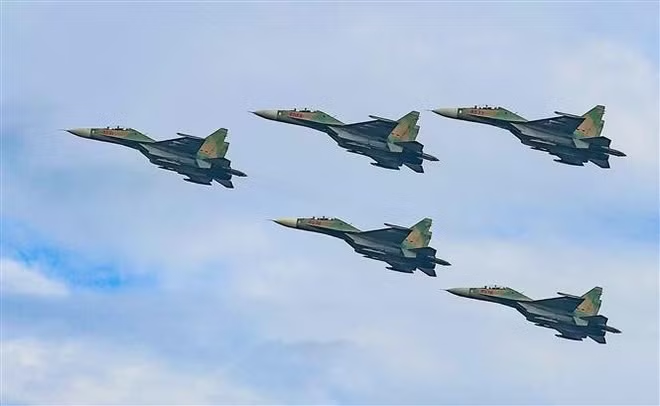
This was followed by formations of Casa C-295 and C212i transport aircraft - the “silent warriors” responsible for coordination, reconnaissance, transport, search, and rescue. Yak-130 and L-39NG aircraft, modern multi-role trainers capable of operating in all weather conditions, day and night, performed roles in training, reconnaissance, and striking aerial, ground, and maritime targets. The final formation featured Su-30MK2 fighters — the pride and mainstay of the Vietnam People’s Air Defence - Air Force, the “steel shield” safeguarding national skies, seas, borders, and islands. Dubbed the “cobra king,” Su-30MK2 is a modern supersonic multi-role fighter, able to operate in all conditions, control airspace, and strike effectively against aerial, ground, and maritime targets.
In the Cam Ranh military base in south central Khanh Hoa province, the naval parade of the armed forces also commenced, broadcast live to Ba Dinh Square.
From the earliest days of relying on small wooden boats to today’s modernisation, Vietnam’s maritime forces have grown strong and advanced. The parade showcased modern warships and submarines capable of long-duration combat in all weather conditions, equipped with missiles, torpedoes, and high-tech weaponry with strong destructive power, long range, multi-target strike capabilities, and effectiveness against surface, aerial, and underwater threats.
Naval parade formations included command vessels; maritime patrol aircraft; anti-submarine helicopters; submarine squadrons; missile frigates; anti-submarine frigates; fast attack missile craft; and naval gunboats of the Vietnam People’s Navy; along with vessels of the Vietnam Coast Guard, Border Guard, and the standing militia flotilla, supported by numerous other modern weapons and equipment. These are the key forces in safeguarding the sacred sovereignty of national seas and islands.
The “A formation” demonstrated the strength and power of the maritime armed forces, with command, combat, transport, and support vessels arranged for maximum combat effectiveness - designed to destroy enemy forces threatening Vietnamese ships, strengthen defence against aerial, surface, and underwater attacks, and firmly protect national maritime sovereignty.
The “V formation” combat formation featured reconnaissance and heavily armed ships, with transport, support, and command vessels arranged for optimal coordination. This configuration enhances observation and early detection, enables destruction of enemy forces, and ensures readiness against surprise attacks from adversaries in all situations.
The “diamond formation” was also deployed, widely used during naval manoeuvres, enhancing command and coordination in combat, protecting key vessels, countering sudden enemy raids from air and sea, ensuring maritime safety, navigating mine obstacles, and hindering enemy tactics.
At Ba Dinh Square, the parade began with a model vehicle bearing Vietnam’s national emblem. Its body design is inspired by the “rowing boat” motif of the Bronze Drum, a symbol of Vietnam’s great national unity and commitment to the socialist path chosen by the Party, President Ho Chi Minh, and the Vietnamese people. It was followed by a formation of 54 talented men and women, representing Vietnam’s 54 ethnic groups, embodying the country’s invincible strength and its victories in the Ho Chi Minh era. They were trailed by formations carrying the Party and national flags, a vehicle bearing President Ho Chi Minh’s portrait, and a model vehicle symbolising the 80th anniversary of August Revolution and National Day of the Socialist Republic of Vietnam.
The military flag bloc, led by Sen. Lieut. Gen. Nguyen Hong Thai, member of the Communist Party of Vietnam Central Committee, member of the Central Military Commission, and Deputy Minister of National Defence, heralded the heroic Vietnam People’s Army and militia self-defence forces.
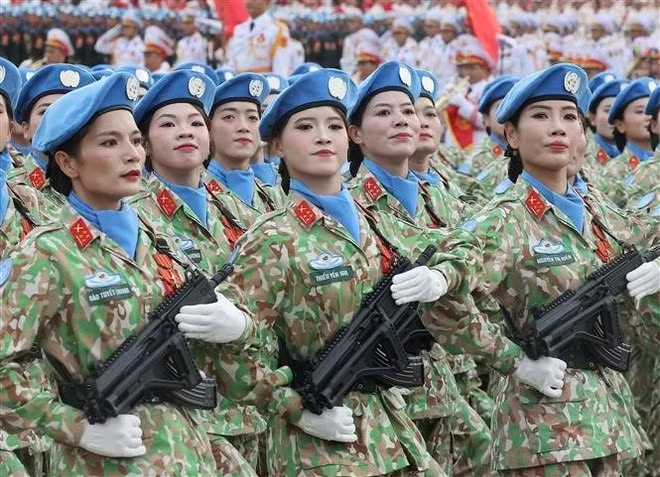
Next came a diverse array of military units: honorary guards from the Army, Navy, and Air and Air Defence Forces; female military musicians; and formations of officers from logistics-engineering and defence industry units, female medical officers, military academy cadets, electronic warfare soldiers, airborne special forces, cyberwarfare units, female peacekeepers, armored and artillery-missile forces, commandos, combat engineers, female communications officers, and chemical defence units. Civil defence and militia forces, including male and female militia representing Vietnam’s ethnic diversity and female guerrilla fighters from the South, projected the image of a revolutionary, disciplined, elite, and modern Vietnam People’s Army ready to fight and firmly protect the Fatherland’s independence and territorial sovereignty.
At the invitations of the Vietnamese Ministry of National Defence, contingents from four foreign armies, including the People’s Liberation Army of China, Russia’s Armed Forces, the Lao People’s Army, and the Royal Cambodian Armed Forces, joined the parade.
The People’s Public Security Force followed, led by a command vehicle headed by Maj. Gen. Le Van Sao, Deputy Commander of the Mobile Police. This unit represented Vietnam’s public security forces as it marched into the square.
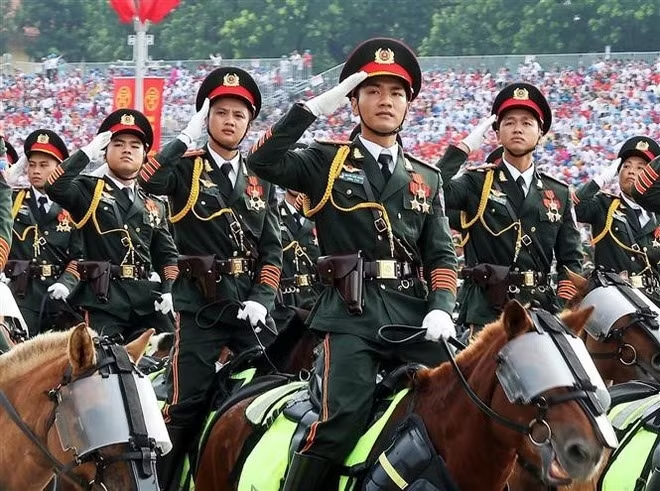
A Public Security banner, symbolising honours bestowed by the Party and State, preceded formations of male people's security officers, male people's police officers, male bodyguards, airborne public security officers, female traffic police, fire and rescue units, cybercrime and high-tech crime divisions, riot police, female special forces, UN peacekeeping officers, logistics and technical support troops, reserve mobile police, police academy cadets, grassroots security forces, and mounted police. The contingent underscored the force’s modernisation and readiness to counter threats, from hostile forces to organised crime, to safeguard the socialist Vietnamese Fatherland, the peaceful life and happiness of the people.
This year’s parade was a rare spectacle, only the second in 40 years to feature heavy vehicles, artillery, and large-scale military equipment, with the last in 1985.
The army’s mechanised formations rolled out an impressive arsenal: tanks, armored vehicles, domestically produced model cars, towed artillery, self-propelled guns, multiple rocket launchers, surface-to-surface missile systems, anti-ship missile vehicles, radar and missile systems developed in Vietnam, mobile air-defence guns and missile batteries, air-defence missile units, unmanned aerial vehicles, mobile communications and electronic warfare vehicles, chemical defence units, and engineering corps equipment.
The Public Security Force joined the parade with their own specialised vehicles, including traffic command cars, escort and protection units for Party and State leaders and foreign dignitaries, counter-terrorism vehicles, mobile command centres, armored and bulletproof carriers, amphibious combat vehicles, multipurpose tactical support trucks, riot-control units, and fire and rescue vehicles. It was followed by the Red Flag formation.
After the marching contingents, various types of weapons, equipment, and specialised vehicles advanced rhythmically past the grandstand, demonstrating the mobility, modernisation, and high combat readiness of the People’s Army and the People’s Public Security Force of Vietnam. Many systems, such as missile complexes, UAVs, and combat vehicles, have been researched, designed, manufactured, and developed domestically. Other equipment, including missiles, tanks, armoured vehicles, and rocket artillery, has been upgraded and modernised to enhance combat performance.
A highlight was Truong Son missile system, produced by the Viettel Military Industry and Telecoms Group (Viettel). The complex consists of a command vehicle, radar vehicle, launcher vehicle, transporter-loader vehicle, and a variety of anti-ship missiles with different ranges. It is capable of conducting sea surveillance, target acquisition, information processing, and missile strikes under modern warfare conditions, serving as a key component of Vietnam’s coastal defence system.
In addition, Viettel developed a UAV complex, including reconnaissance UAVs for high-precision detection and identification of targets, and tactical combat UAVs capable of effectively striking ground targets. The upgraded S-125-VT air defence missile system, also developed by Viettel, featured in the parade, with improved mobility, extended range, and enhanced combat effectiveness to meet current operational demands.
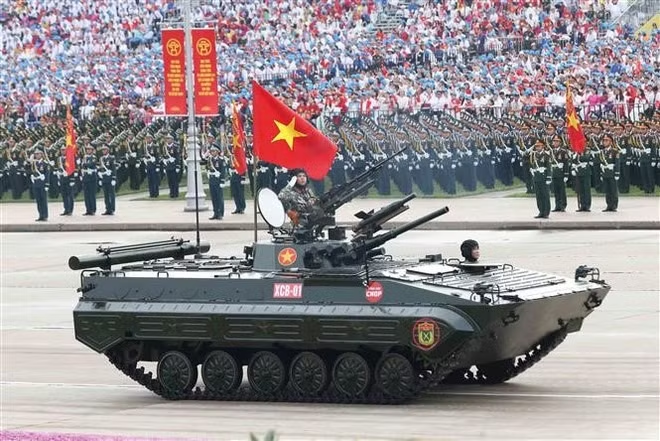
Among the modern combat vehicles were armoured vehicles produced by the General Department of Defence Industry, led by the XCB-01 infantry fighting vehicle equipped with a 73mm smoothbore gun, 12.7mm anti-aircraft machine gun, 7.62mm machine gun, and B72 anti-tank missiles. There were also UAV carrier vehicles for kamikaze drones, military communications vehicles at strategic and operational levels, electronic warfare vehicles, and transport trucks towing long-range 130M46 and 152D20 artillery pieces assembled domestically.
In the formation of specialised vehicles of the People’s Public Security Force, upgraded and modernised escort vehicles were presented, ensuring technical performance, safety, speed, and compliance with green transition criteria.
Armoured anti-ballistic vehicles for special police units, with high mobility and survivability, also took part in the parade. These vehicles are capable of overcoming obstacles, traversing deep water, withstanding multiple types of ammunition, and continuing to move even when tyres are punctured. Their modern combat capabilities support missions such as counter-terrorism, hostage rescue, and suppression of dangerous criminal groups.
After passing through Ba Dinh Square, the contingents split into different directions, marching along major streets in downtown Hanoi amid the warm welcome of tens of thousands of people and international visitors.