Vietnam, China promote development strategy connectivity, substantive cooperation

China will work with Vietnam to closely follow high-level common perceptions, deepen development strategy connectivity, and promote substantive cooperation across fields.

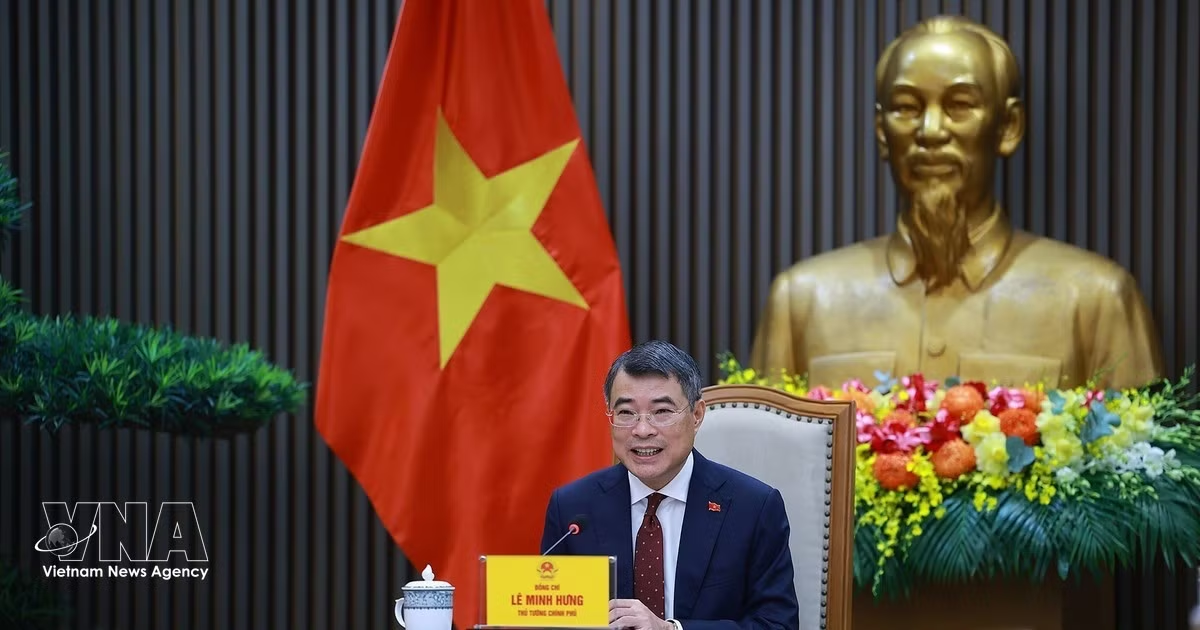
vnanet-vna-potal-thu-tuong-le-minh-hung-dien-dam-voi-thu-tuong-trung-quoc-ly-cuong-8826625.jpg
Prime Minister Le Minh Hung holds phone talks with Chinese Premier Li Qiang on June 15. Photo: VNA

Vietnam consistently consider the development of ties with China as a consistent policy, an objective requirement, a strategic and natural choice, and a top priority in Vietnam’s foreign policy of independence, self-reliance, multilateralisation and diversification, said Prime Minister Le Minh Hung during his phone talks with Chinese Premier Li Qiang on June 15.

In an atmosphere of friendship, trust, substance, and openness, the two cabinet leaders expressed their pleasure in holding the first phone call following the first session of Vietnam’s 16th National Assembly, which completed the Government leadership elections and appointments.

Premier Li warmly congratulated PM Hung on being elected as Prime Minister of Vietnam. He also expressed appreciation for and highly valued the important contributions made by PM Hung to China–Vietnam relations in various previous positions.

PM Hung highly valued the view of China’s Party and State leadership on prioritising the development of relations with Vietnam in its neighbourhood diplomacy.

The leaders appreciated the positive progress in relations between the two Parties and the two countries over recent times, particularly in the urgent and timely development and implementation of action plans and programmes to realise the important common perceptions between the countries’ top leaders.

They agreed to maintain regular, sincere and trust-based exchanges and close coordination to further concretise high-level agreements and the outcomes of General Secretary of the Communist Party of Vietnam Central Committee and State President To Lam’s very successful recent state visit to China, as well as General Secretary of the Communist Party of China Central Committee and President of China Xi Jinping’s 2025 state visit to Vietnam.

Regarding future cooperation, PM Hung proposed that the two sides further strengthen strategic trust, well organise high-level exchanges and contracts as well as existing cooperation mechanisms, including the 3+3 Strategic Dialogue mechanism between the foreign affairs, national defence and public security ministers.

They will promote infrastructure connectivity and the development of a multimodal transport system, with priority given to railway cooperation and connectivity with other countries and regions; and advance bilateral trade in a balanced and sustainable manner, soon operationalise smart border gate models, and develop cross-border economic cooperation zones to facilitate trade, investment, and sectoral cooperation.

He also expressed the desire to expand cooperation in science and technology, education, high-quality human resource training, health care, especially traditional medicine; strengthen cultural and tourism cooperation; and effectively implement the Vietnam–China Tourism Cooperation Year 2026–2027; while further enhancing existing local-level cooperation mechanisms, especially between border provinces, and expanding cooperation among regions with strong potential.

Premier Li affirmed that China always regards Vietnam as a priority in its neighbourhood diplomacy policy. China will work with Vietnam to closely follow high-level common perceptions, deepen development strategy connectivity, and promote substantive cooperation across fields.

Agreeing with PM Hung’s proposals, he stated that China is ready to promote railway cooperation between the two countries and strengthen connectivity with other countries and regions; advance industries and agricultural trade, inspection and quarantine cooperation. The country will encourage reputable and capable enterprises to expand high-quality investment, especially in science, technology and innovation; enhance cooperation in energy security and power connectivity; effectively implement the China–Vietnam Tourism Cooperation Year 2026–2027; and strengthen people-to-people exchanges and social welfare cooperation projects.

The leaders also exchanged views on international and regional issues of mutual concern, affirming close coordination to ensure the success of the APEC Years 2026 and 2027 hosted by China and Vietnam, respectively. They also agreed to better control and properly handle differences, maintain peace and stability at sea, and strengthen a favourable environment for each country’s development./.
VNA
en.vietnamplus.vn

Other News

Vietnam to remain active player in shaping ASEAN's future: minister

Vietnam to remain active player in shaping ASEAN's future: minister

Entering a new era of national development with the aspiration of building a strong and prosperous country, the mindset of "growing alongside ASEAN" will guide Vietnam’s more proactive, positive, and substantive contributions to the ASEAN Community and the co-creation of the region’s shared future, noted Minister of Foreign Affairs Le Hoai Trung.

Thailand's parliamentary leader concludes official visit to Vietnam

Thailand's parliamentary leader concludes official visit to Vietnam

Thailand attaches great importance to its Comprehensive Strategic Partnership with Vietnam, and the two countries share a solid foundation of friendship, many common strategic interests and significant potential for cooperation, said President of the National Assembly and Speaker of the House of Representatives of Thailand Sophon Zaram.

33rd Diplomatic Conference wraps up in Hanoi

33rd Diplomatic Conference wraps up in Hanoi

Foreign relations are no longer viewed simply as relations with the outside world but as an integral component of national comprehensive strength and a responsibility shared by the entire Party, people, armed forces and political system.

Vietnam, Laos step up cooperation in social sciences

Vietnam, Laos step up cooperation in social sciences

Against the backdrop of complex and rapidly evolving regional and international developments, cooperation in social sciences and political theory between the Vietnam Academy of Social Sciences and the Lao National Academy of Politics and Public Administration is expected to provide solid scientific evidence and databases to support the formulation of orientations, policies and strategies for socio-economic development.

Party Statutes must be practical, future-ready: Top leader

Party Statutes must be practical, future-ready: Top leader

Party General Secretary and State President To Lam said the current Party Statutes remain fundamentally valid but must also respond to emerging issues such as administrative apparatus restructuring, the two-tier local administration model, decentralisation, control over the exercise of power and digital transformation.

Politburo member and Permanent member of the Party Central Committee’s Secretariat Tran Cam Tu (centre) and leaders of the Ministry of Foreign Affairs at the plenary session on Party and people-to-people diplomacy on August 5, part of the 33rd Diplomatic Conference. (Photo: VNA)

Party, people-to-people diplomacy urged to contribute more effectively to national development

Party diplomacy has made breakthroughs in expanding and deepening relations with political parties around the world, helping consolidate political foundations and orient State-level relations. Meanwhile, people-to-people diplomacy has seen positive changes in its thinking, content and methods, with an expanding network of partners and more active and substantive participation in regional and international people-to-people mechanisms.

NA Chairman urges 'revolution' in legal information access

NA Chairman urges 'revolution' in legal information access

NA Chairman Tran Thanh Man said the requirement that “every citizen live and work in accordance with the Constitution and the law” remains hollow unless people can fully access, understand, and actually use the rules that govern their lives.

National Assembly approves Nguyen Tien Hai as Minister of Home Affairs

National Assembly approves Nguyen Tien Hai as Minister of Home Affairs

The NA held a secret ballot on the appointment and later adopted a resolution approving Nguyen Tien Hai as Minister of Home Affairs. The resolution was passed with 483 votes in favour out of 484 deputies participating in the electronic vote, accounting for 96.60% of those present.

Institutional reform key to unlocking new development model: experts

Institutional reform key to unlocking new development model: experts

Resolution No. 19-NQ/TW, adopted at the third plenum of the 14th Party Central Committee, identifies breakthroughs in institutions and reforms as the starting point for renewing Vietnam’s development model, alongside reforms in national governance, organisation and operations to build new development capacity.

Lawmakers discuss customs reform linked to digital transformation, risk management

Lawmakers discuss customs reform linked to digital transformation, risk management

Continuing the agenda of its ongoing first extraordinary session, the 16th National Assembly (NA) on August 3 heard proposals and verification reports on two bills, including the Law amending and supplementing several articles of the Law on Customs, and the Law revising Article 6 and Appendix IV on the list of conditional business lines under the Law on Investment.

First extraordinary session of 16th National Assembly opens

First extraordinary session of 16th National Assembly opens

The first extraordinary session of the 16th National Assembly (NA) kicked off in Hanoi on August 3, with lawmakers set to consider and decide on a series of items, including 15 draft laws, four draft normative resolutions and a range of major issues concerning national development.

Over 43,000 legal normative documents reviewed

Over 43,000 legal normative documents reviewed

As of July 30, ministries, agencies and localities had conducted a preliminary review of more than 43,000 legal normative documents nationwide, identifying provisions that need to be amended, supplemented, replaced or annulled.