Vietnam welcomes Russia's visa-free policy for Vietnamese citizens

Vietnam welcomes Russia’s visa exemption policy under Decree No. 730, signed by Russian President Vladimir Putin on October 12.

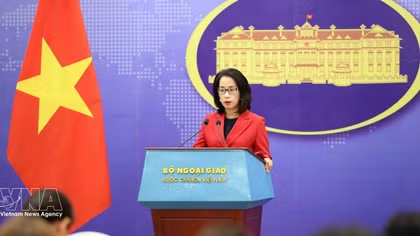
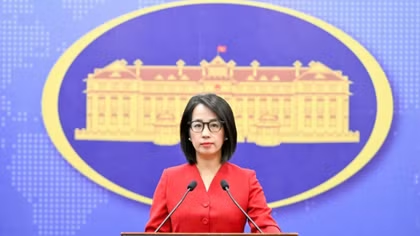
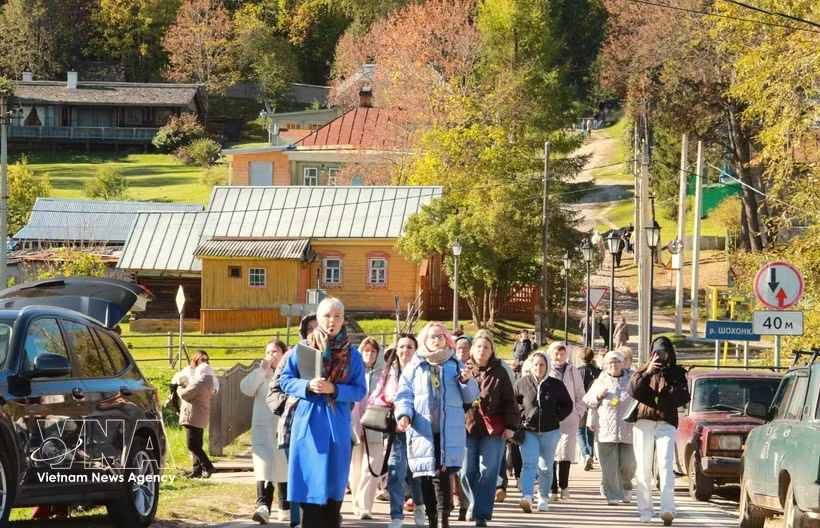
Hanoi (VNA) – Vietnam welcomes Russia’s decision to waive visa requirements for Vietnamese ordinary passport holders from October 15, 2026, Spokesperson of the Ministry of Foreign Affairs Pham Thu Hang said at the ministry’s regular press briefing on October 15.
tai-xuong-16.png
Tourists enjoy Russia’s golden autumn. (Photo: VNA)

The move follows a joint statement issued during the state visit to Russia by General Secretary of the Communist Party of Vietnam Central Committee and President To Lam, his spouse and a high-level Vietnamese delegation, which outlined measures to further deepen the two countries’ Comprehensive Strategic Partnership in the new phase.

The statement highlighted both sides' efforts to expand labour cooperation, enhance tourism links through increasing regular and charter flights, simplify entry and exit procedures for Vietnamese citizens travelling to Russia, and work towards visa-free travel for ordinary passport holders.

In this context, Vietnam welcomes Russia’s visa exemption policy under Decree No. 730, signed by Russian President Vladimir Putin on October 12, Hang said.

Regarding Vietnam’s pilot visa exemption scheme for Chinese tour groups visiting Khanh Hoa province, she said there have been many developments regarding immigration procedures and visa exemptions between Vietnam and other countries recently. The Vietnamese Government issued Resolution No. 325/NQ-CP on October 12, granting visa-free entry to eligible Chinese ordinary passport holders during the Vietnam–China Tourism Cooperation Year 2026–2027.

The policy is effective from October 12, 2026, to December 31, 2027. It applies to Chinese citizens holding valid ordinary passports, excluding those holding Hong Kong and Macao Special Administrative Region passports, travelling in groups of at least two under package tours organised by Vietnam's international travel companies.

The scheme is restricted to Khanh Hoa province. Tourists must enter and leave Vietnam through Cam Ranh International Airport on direct flights from mainland China, using the same border gate for both entry and departure.

Hang said the pilot scheme is a concrete step to implement the important common perceptions reached by the senior leaders of the two Parties and countries, including the launch of the Vietnam–China Tourism Cooperation Year 2026–2027, during General Secretary and President To Lam’s visit to China in April 2026.

The policy is intended to further facilitate travel by Chinese tourists to Vietnam, and boost people-to-people exchanges and tourism cooperation, thereby helping strengthen the social foundation of bilateral ties and bring practical benefits to the people of both countries.

Like other pilot policies, Vietnamese authorities will monitor and assess the implementation and results of this pilot scheme to inform any adjustments in line with practical conditions, the Spokesperson added./.
VNA
en.vietnamplus.vn

Other News

Swiss President Guy Parmelin's Vietnam visit to advance bilateral ties

Swiss President Guy Parmelin's Vietnam visit to advance bilateral ties

The visit is expected to further consolidate the bilateral relationship and advance cooperation in key areas, particularly trade and investment, science and technology, innovation, finance and sustainable development. The two sides will also exchange views on regional and international issues of mutual concern.

Vietnam elevates ties with Denmark, EU and Belgium: Spokeswoman

Vietnam elevates ties with Denmark, EU and Belgium: Spokeswoman

Vietnam and the EU officially upgraded their relations to a Comprehensive Strategic Partnership during President of the European Council António Costa’s visit to Vietnam in January 2026. Vietnam is the EU’s first comprehensive strategic partner in Southeast Asia and the only ASEAN member with all cooperation pillars in place with the bloc.

Vietnamese Party, State facilitate more substantive defence ties with Cambodia: Top leader

Vietnamese Party, State facilitate more substantive defence ties with Cambodia: Top leader

Top leader To Lam called on the Vietnamese and Cambodian defence ministries to enhance information sharing and support each other in maintaining political stability and national security. He also urged more effective coordination in border management and protection, facilitation of border demarcation and marker planting and the legal formalisation of achievements already made.

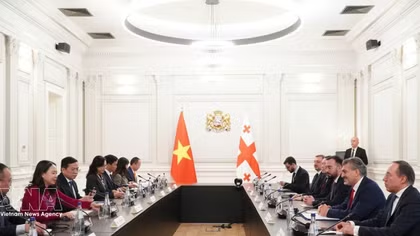
Vietnamese Vice President meets with Georgian leaders

Vietnamese Vice President meets with Georgian leaders

Kavelashvili said Xuan's visit is expected to consolidate political trust, deepen mutual understanding and propel ties across all levels and sectors. He welcomed the strides in the bilateral relationship, particularly continued meetings and conservations between leaders and consultation mechanisms between agencies of the two countries.

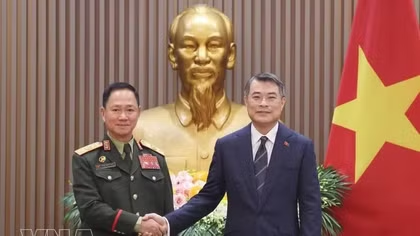
Defence, security cooperation is an important pillar of Vietnam–Laos ties: PM

Defence, security cooperation is an important pillar of Vietnam–Laos ties: PM

Expressing his pleasure at the positive development of the special relationship between Vietnam and Laos, the PM highlighted defence and security cooperation as an important pillar of the bilateral ties. He praised the two defence ministries and armies for implementing high-level agreements, strengthening mutual trust and helping maintain a peaceful and stable environment conducive to socio-economic development.

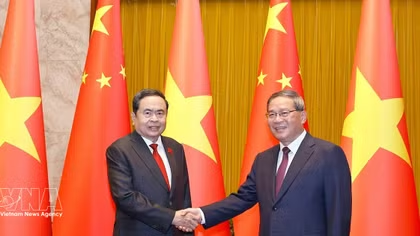
NA President meets with Chinese Premier in Beijing

NA President meets with Chinese Premier in Beijing

China always considers Vietnam a priority in its overall neighborhood diplomacy, and stands ready to push for deeper and more substantive ties between the two Parties and countries, said Premier of the State Council of China Li Qiang.

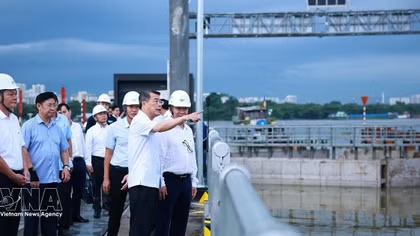
PM orders power plan overhaul to meet double-digit growth

PM orders power plan overhaul to meet double-digit growth

Securing adequate power supply is an urgent priority and a prerequisite to successfully achieve socio-economic development goals 2026, a foundational year for accelerating progress, with breakthroughs to follow in 2027 and the goals for the full term to be delivered, said Prime Minister Le Minh Hung.

Vietnam, China step up legislative cooperation, experience sharing

Vietnam, China step up legislative cooperation, experience sharing

Vietnamese National Assembly (NA) President Tran Thanh Man and Chairman of the Standing Committee of the National People’s Congress (NPC) of China Zhao Leji called for more balanced and sustainable trade, high-quality investment, modern and coordinated railway connectivity, and stronger cooperation in science and technology.

Top leader pledges support for firms, presses tech self-reliance

Top leader pledges support for firms, presses tech self-reliance

The country needs more firms that master technologies, build trusted brands and run production networks able to compete globally. Progress over the next five to 10 years must show up in productivity, job quality and market position, said top leader To Lam.

Vietnam, China to boost legislative, people-to-people exchanges

Vietnam, China to boost legislative, people-to-people exchanges

To further consolidate the three pillars of political, material and social foundations underpinning ties between the two Parties and countries, NA President Man proposed maintaining exchanges at all levels, strengthening national defence-security ties, and supporting each other’s development and international standing.

NA President visits Beijing legislative liaison station

NA President visits Beijing legislative liaison station

Praising the model of bringing legislative work closer to grassroots communities, voters and the public in Nanmofang and Beijing at large, National Assembly (NA) President Tran Thanh Man said Vietnam attaches importance to legislative work in building a socialist rule-of-law state of the people, by the people and for the people. That includes listening to experts, intellectuals, businesses, voters and the general public, especially those directly affected by policies and laws.