1973 Paris Peace Accords - a decisive victory for Vietnamese diplomacy

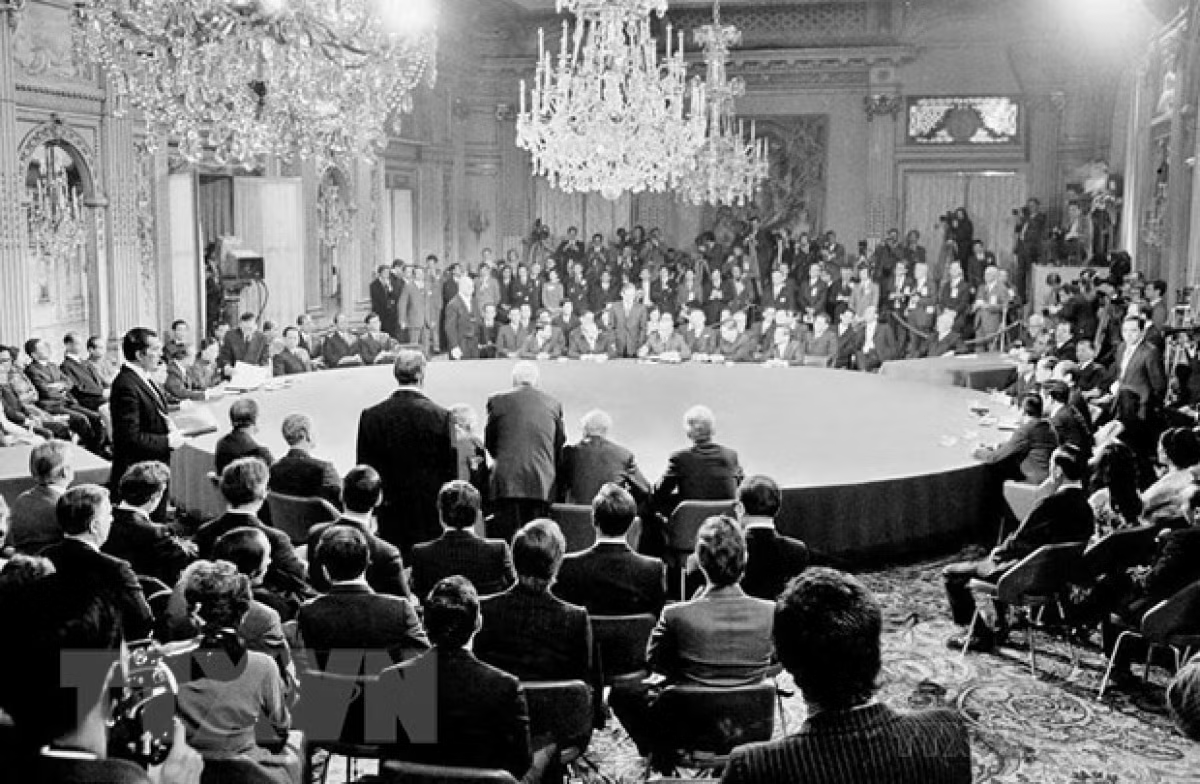
Half a century ago, the Paris Agreement on Ending the War and Restoring Peace in Vietnam (Paris Peace Accords) was signed in Paris, France, on January 27, 1973.

1973 Paris Peace Accords - a decisive victory for Vietnamese diplomacy -0
Four parties had signed the Paris Peace Accords after nearly five years of negotiations. (Photo VNA)

The agreement came as a result of one of the most difficult and lengthy negotiations in the history of international diplomacy, marking an important diplomatic victory and demonstrating the bravery and wisdom of the Vietnamese revolution.

Running for nearly five years from 1968 to 1973, the Paris negotiations on Vietnam involving the governments of the Democratic Republic of Vietnam (North Vietnam), the Republic of Vietnam (South Vietnam), the United States, and the Provisional Revolutionary Government of the Republic of South Vietnam, went through a total of 201 public sessions, 45 high-level private meetings between Vietnam and the US, roughly 500 press conferences, and some 1,000 interviews.

Historical documents highlight that in all public joint sessions, as well as private contacts, during the Paris negotiations, Vietnamese negotiators did not miss any issues concerning the war in Indochina. Their arguments insisted that the US army and its allies in the Asia-Pacific region withdraw from southern Vietnam and respect the civil rights, the basic national rights, and the right to self-determination of the people in southern Vietnam.

Ultimately, the agreement, among provisions, called for the withdrawal of all US and allied forces, a ceasefire to be put in place in southern Vietnam, the reunification of Vietnam through peaceful means without coercion or annexation by either party and without foreign interference, and US financial contributions to healing the wounds of conflict in Indochina.

Vivid memories
1973 Paris Peace Accords - a decisive victory for Vietnamese diplomacy -0
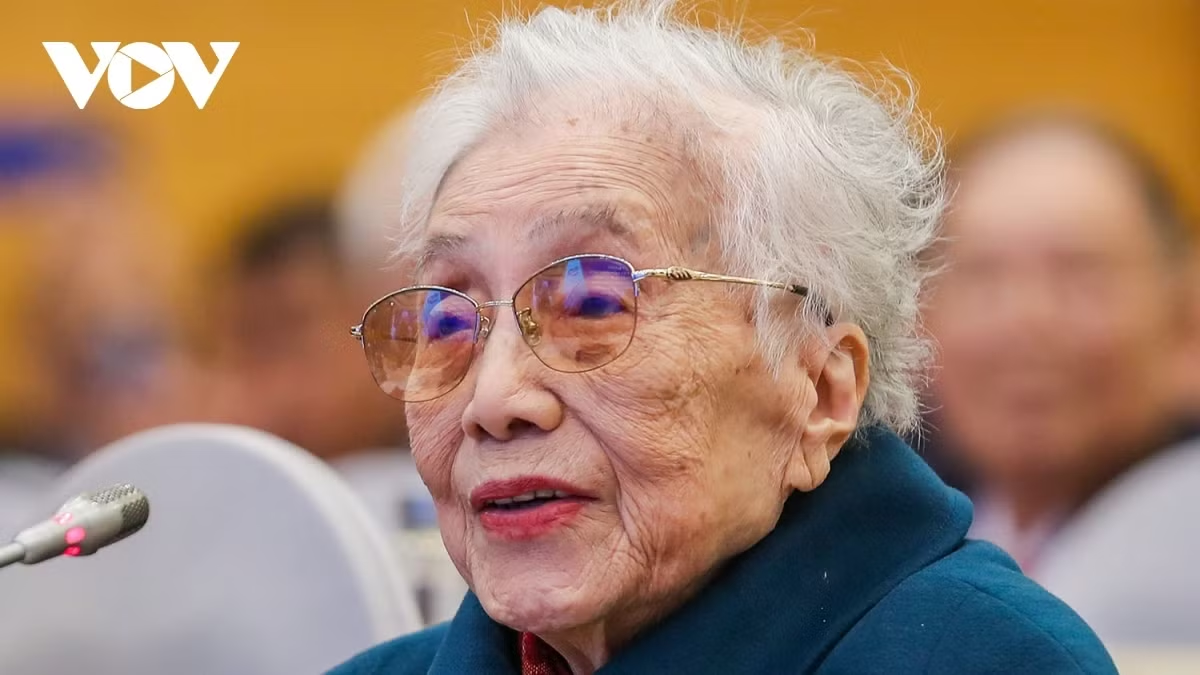
Nguyen Thi Binh, former Foreign Minister and former head of the Delegation of the Provisional Revolutionary Government of the Republic of South Vietnam to the Paris conference.

Nguyen Thi Binh, former Foreign Minister and former head of the Delegation of the Provisional Revolutionary Government of the Republic of South Vietnam to the Paris conference, said at the end of 1968 she received instructions from the Party to participate in the Paris negotiations. After nearly five years of negotiations, she completed her duties as one of the four signatories to the Paris Agreement.

“The Paris Agreement was a decisive victory leading to the liberation of the South and reunification of the country, the result of nearly 20 years of fierce war and arduous struggle of the whole nation,” recalled the 95-year-old politician.

According to Binh, the Paris Agreement represented a victory for Vietnamese diplomacy, a military and political victory and a victory for peace-loving and progressive movements worldwide.

“It is the result of the strong solidarity and support of the world, bringing strength to Vietnam on the battlefield as well as at the negotiating table,” Binh said, adding that the decisive factor behind the success of the Paris Agreement was the ingenious leadership of President Ho Chi Minh and the Party and State leaders.

Journalist Ha Dang, former member of the Party Central Committee and a member of the negotiating team of the Provisional Revolutionary Government of the Republic of South Vietnam, said the US’s signing of the Paris Agreement placed Nguyen Thi Binh in her position as Foreign Minister on a par with then US Secretary of State William Roger. This also showed the US recognition of the Provisional Revolutionary Government of the Republic of South Vietnam.

Incumbent Foreign Minister Bui Thanh Son said throughout the negotiation process, the principle of independence and self-reliance continued to be upheld. The Vietnamese negotiating team, including advisor Le Duc Tho, effectively and creatively applied President Ho Chi Minh’s thoughts of “Keeping calm to respond to unexpected changes” at the negotiating table.

“With sharp thinking, rich experience and tactical skills, Le Duc Tho and the negotiating team excellently turned the victory on the battlefield into victory on the negotiating table. This victory is one of the pinnacles of Vietnamese diplomatic intelligence,” said Minister Son.

Invaluable historical lessons

Half a century after the Paris Agreement was signed, scientific studies and assessments made by Vietnamese and foreign experts show that the 1973 Paris Agreement marked a landmark victory in the history of Vietnamese diplomacy. The agreement also brought about several valuable lessons with profound contemporary significance for the country’s diplomacy, including grasping the situation and seizing upon opportunities.

“First, you need to evaluate the situation, know yourself, and know your enemy. Second, we need to seize opportunities. Third, we need a wise strategy, clearly defining the primary and the secondary. In my opinion, we were very creative in our diplomacy,” stated Binh.
1973 Paris Peace Accords - a decisive victory for Vietnamese diplomacy -0
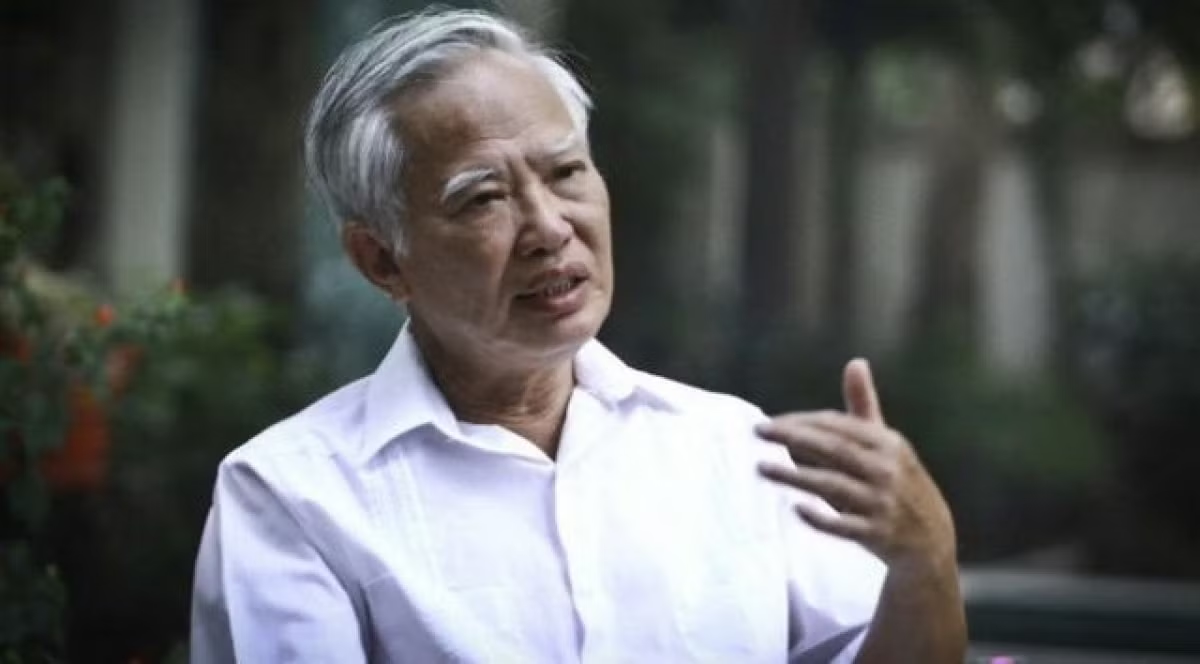
Vu Khoan, former Deputy Prime Minister and former Deputy Foreign Minister.

Former Deputy Prime Minister and former Deputy Foreign Minister Vu Khoan said the agreement offers plenty of lessons for Vietnamese diplomacy, including a lesson about cooperation, consistency, perseverance, and shrewdness.

According to official documents from the Paris negotiations, thousands of rallies and demonstrations against the war and in support of Vietnam broke out in many parts of the world, including in the US. The anti-war and pro-Vietnam movement became a great source of encouragement for the nation both on the battlefield and at the negotiating table, resulting in the Paris Agreement and subsequent victory of the 1975 Spring General Offensive which ultimately liberated the south and reunified the country.

Rallying international support can serve as a lesson for the diplomatic sector which concerns effectively utilising external support and resources for national construction and defence. This lesson is especially meaningful to Vietnam's extensive international integration amid complicated and unpredictable challenges around the world.
VOV

Other News

First working day of Party Central Committee's fourth plenum

First working day of Party Central Committee's fourth plenum

Delegates held group discussions on the CPV Central Committee resolution calling for stronger building and rectification towards a clean, strong and comprehensive Party and political system able to meet the country's development needs in the new era.

Key Party leader hosts Hungarian Workers' Party chief

Key Party leader hosts Hungarian Workers' Party chief

The Communist Party of Vietnam always values its solidarity and friendship with the Hungarian Workers' Party and communist and workers' parties worldwide, which helps build political trust and supports Vietnam's relations with other countries, said key Party leader Tran Cam Tu.

14th Party Central Committee convenes fourth plenum

14th Party Central Committee convenes fourth plenum

In his opening remarks, General Secretary and President To Lam said that the 14th National Party Congress set out major orientations and strategic goals, while the second and third plenums adopted important policies on Party building, personnel, development and national defence. The fourth plenum must focus on creating conditions for effective implementation while preparing the theoretical, organisational and human resources foundations for the country’s long-term development.

Panamanian President's Vietnam visit offers new opportunity to deepen bilateral ties

Panamanian President's Vietnam visit offers new opportunity to deepen bilateral ties

Vietnamese Ambassador to Mexico and Panama Nguyen Van Hai noted that the visit is particularly significant as the first high-level exchange between the two countries in nearly 15 years, following then-President Ricardo Martinelli’s visit to Vietnam in 2012, and came shortly after the 50th anniversary of diplomatic relations in 2025.

Vietnam and Panama can become gateways linking two regions

Vietnam and Panama can become gateways linking two regions

"Panama can serve as a strategic platform for Vietnamese companies seeking greater access to Latin America and the Caribbean, while Vietnam represents an important gateway for strengthening Panama’s engagement with Southeast Asia", Ambassador Nubiela Ayala Modes confirmed.

Localities committed to achieving 2026 growth targets

Localities committed to achieving 2026 growth targets

Localities nationwide hailed effective and flexible directions delivered by the Government so far this year, resulting in positive nine-month socio-economic growth, and reaffirmed their commitment to achieving targets set for the whole 2026 at an online Government-locality conference on October 3.

Creating new drivers for Vietnam-Canada cooperation

Creating new drivers for Vietnam-Canada cooperation

The elevation of bilateral ties to a Strategic Partnership shows that Vietnam and Canada increasingly view each other not simply as trading partners, but as long-term partners in addressing economic, technological and regional challenges.

Top leader asks for sports development to build national strength

Top leader asks for sports development to build national strength

The top leader applauded the efforts of ministries, sectors, localities, social organisations, coaches, athletes, experts in developing physical education and sports in recent times, stressing that Resolution No. 08 has provided an important political foundation for sports development over the past 15 years, while Conclusion No. 70 set important orientations for the new period.

Vietnam mobilises resources to affirm its leadership role in APEC 2027

Vietnam mobilises resources to affirm its leadership role in APEC 2027

PSNews - Vietnam is recognised by its partners as an influential member of the Asia-Pacific Economic Cooperation (APEC) forum, with expectations that it will continue to demonstrate leadership when it hosts APEC for the third time in 2027, according to Standing Deputy Minister of Foreign Affairs Nguyen Minh Vu.

Top Vietnamese leader receives Chairman of Japan Bank for International Cooperation

Top Vietnamese leader receives Chairman of Japan Bank for International Cooperation

General Secretary and President Lam urged JBIC to continue promoting the substantive implementation of projects under the Asia Zero Emission Community (AZEC), and step up discussions on potential cooperation within the framework of the POWERR Asia (Partnership on Wide Energy and Resources Resilience Asia) initiative, including the development of strategic energy reserves.

NA, Government's Party committees meet on legislature's second session agenda

NA, Government's Party committees meet on legislature's second session agenda

National Assembly President Tran Thanh Man coordination must go beyond finishing the agenda to improve the quality of NA decisions and Government enforcement; deal with policies rather than just paperwork, especially in the fight against corruption and other negative phenomena; and pin down final responsibility for each product, not just progress.

Prime Minister receives Cambodian Minister of Inspection

Prime Minister receives Cambodian Minister of Inspection

Prime Minister Le Minh Hung asked the two countries' inspection agencies to build on their achievements by regularly exchanging information and experience, maintaining delegation exchanges, and coordinating inspections in areas related to bilateral economic, trade and investment cooperation.