33rd ASEAN Summit to focus on building resilient, innovative Community

The 33rd ASEAN Summit, slated for November 13-15 in Singapore, will focus on strengthening intra-bloc cooperation and connections, building a resilient and innovative ASEAN Community and sketching out ASEAN orientations for following years.
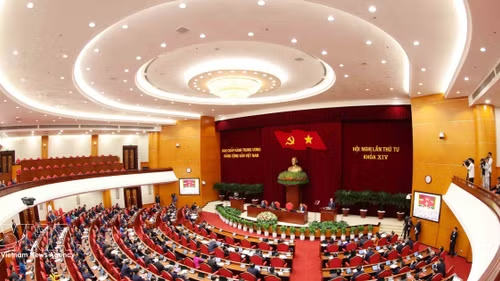
33rd asean summit to focus on building resilient, innovative community hinh 0
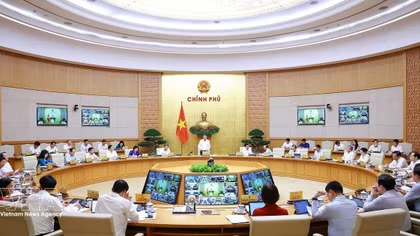
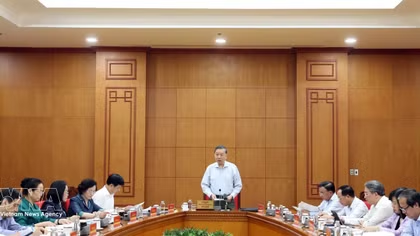
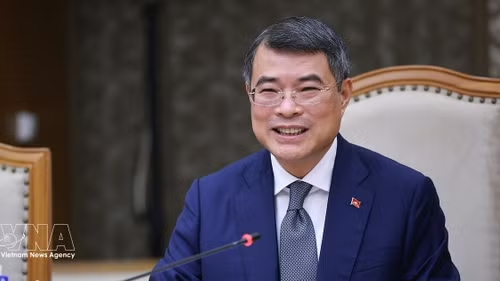
At a meeting preparing for the 33rd ASEAN Summit

Prime Minister Nguyen Xuan Phuc will lead a high-ranking delegation to Singapore to attend the event at the invitation of the host country’s Prime Minister Lee Hsien Loong.

Major events of the summit include the 33rd ASEAN Summit Meeting, the ASEAN Plus 3 (China, Japan, the Republic of Korea) Summit, the East Asia Summit, and seven ASEAN Plus 1 Summits with China, the Republic of Korea, Japan, the US, India, Australia and Russia.

The second high-level meeting will also be held for countries engaging in the Regional Comprehensive Economic Partnership (RCEP).

At the summits with partners, participants will discuss measures to foster collaboration among parties, including enhancing partnership in economy, trade, investment, infrastructure development, responding to changes in global economy, adapting to the Fourth Industrial Revolution, and settling global challenges such as environmental pollution and climate change.

The leaders will also discuss regional and international issues of mutual concern.

The ASEAN Community is based on three key pillars - ASEAN Political-Security Community (APSC), ASEAN Economic Community (AEC), and ASEAN Social-Cultural Community (ASCC). The group’s external relations as well as the target of narrowing down development gap among members have been integrated in the contents of all pillars.

The APSC aims to share common norms of conduct in the region, upholding intra-bloc solidarity and unity, promoting the value of tools and mechanisms to ensure regional security, and promoting common voice in regional and global challenges.

Through existing regional cooperation mechanisms, the APSC contributes to strengthen partnership, dialogue and trust building, reinforcing regional peace, security and stability.

Regarding the AEC, the ASEAN has continued efforts to supervise and evaluate the implementation of the AEC and promote measures for trade facilitation, including increasing intra-bloc trade and investment, developing high quality human resources as well as micro, small- and medium-sized enterprises.

At the same time, the ASEAN has fostered connections with partner economies through the adjustment and upgrading of existing free trade agreements and negotiating for new ones, while narrowing developing gaps among member countries.

The ASEAN Integration Initiative has been sped up, with 13 out of the 26 actions being implemented through 26 projects to enhance capacity and give technical support worth US$9.9 million in Cambodia, Laos, Myanmar and Vietnam.

For the ASCC, the ASEAN has strengthened online supervision of the implementation of the ASCC Blueprint to prepare for the 2025 report. An ASCC special envoy will be sent to ASEAN mission in Jakarta in June 2020 to foster collaboration with other pillars.

Major cooperation objectives of the ASCC is to deal with issues related to the living conditions of people such as natural disaster and climate change response and supporting vulnerable groups. It also helps popularise the ASEAN Community among the people, enterprises and partners.

The ASEAN is to finish the third year of implementing the ASEAN Community Vision 2025 and blueprints for building the three pillars with positive results.

As many as 239 out of the 290 actions in political-security cooperation and 80 out of the 118 priorities in economic affiliations have been conducted, along with all the commitments in socio-cultural collaboration. Economic growth of the association is estimated to reach 5.1 percent in 2018 and 5.2 percent in 2019.

In 2018, upon Singapore’s proposal, the ASEAN has realized its priority in building a resilient and innovation ASEAN through various activities, including the issuance of the ASEAN Leaders’ Vision for a Resilient and Innovative ASEAN.

ASEAN external relations have been promoted, focusing on human resources training, digital economy, infrastructure development, anti-corruption, and cyber security.

So far, 91 countries have sent their ambassadors to the ASEAN, while 53 committees of the ASEAN have been set up in third countries.

ASEAN has pledged to continue promoting its central role in regional cooperation mechanisms that it has launched.
VNA

Other News

National Assembly Chairman urges renovation in leadership, working style

National Assembly Chairman urges renovation in leadership, working style

The NA's Committee for Cultural and Social Affairs has moved fast to reshuffle its organisation after the 14th National Party Congress and the election of deputies to the 16th NA, updating its work agenda to match new directives set out in the resolutions of the 14th National Party Congress and the first Congress of the NA Party Organisation for the 2025–2030 term.

Vietnam treasures ties with Croatia: PM

Vietnam treasures ties with Croatia: PM

Vietnam and Croatia should strive to double bilateral trade turnover from the current level of 161 million USD; study the establishment of a Joint Committee on Economic Cooperation to create a long-term, stable, and effective framework for collaboration, said Prime Minister Le Minh Hung.

President Ho Chi Minh's enduring legacy highlighted at Venezuela commemoration

President Ho Chi Minh's enduring legacy highlighted at Venezuela commemoration

Vice President of the United Socialist Party of Venezuela (PSUV) Jesús Faria expressed deep admiration for President Ho Chi Minh and Vietnam’s indomitable struggle for national independence. He described President Ho Chi Minh as an immortal symbol of 20th-century national liberation movements, whose legacy continues to inspire leftist parties, progressive movements, and peoples across Latin America, including Venezuela.

Vietnam proposes key cooperation orientations at BRICS Foreign Ministers' Meeting

Vietnam proposes key cooperation orientations at BRICS Foreign Ministers' Meeting

Deputy Foreign Minister Nguyen Minh Hang shared Vietnam’s approach to building an independent and self-reliant economy linked to deep international integration, while proposing several key areas for enhanced cooperation between BRICS and partner countries at the Expanded BRICS Foreign Ministers' Meeting that opened on May 14 in India.

Vietnam asks parties to respect its sovereignty over Truong Sa

Vietnam asks parties to respect its sovereignty over Truong Sa

PSNews - The spokesperson stated that the dispatch of personnel by relevant parties to features belonging to Truong Sa without Vietnam’s permission constitutes a violation of Vietnam’s sovereignty under international law. She stressed that such actions run counter to the Declaration on the Conduct of Parties in the East Sea (DOC) as well as ongoing efforts by countries to negotiate a Code of Conduct in the East Sea (COC).

Hanoi to host ASEAN Future Forum 2026 in mid-June

Hanoi to host ASEAN Future Forum 2026 in mid-June

PSNews - Vietnam’s proposals placed the highest priority on ensuring a peaceful and stable environment conducive for continued sustainable development and improving the well-being and happiness of the ASEAN people. They were praised by member states and incorporated into the core contents of the ASEAN Leaders’ Statement on the response to the Middle East crisis.

Vietnam promotes cooperation with United Nations on crime prevention

Vietnam promotes cooperation with United Nations on crime prevention

Vietnam highly values the support of the United Nations Office on Drugs and Crime (UNODC) in strengthening national capacity in crime prevention and criminal justice, drug control, and addressing emerging challenges, particularly cybercrime, said Ambassador Vu Le Thai Hoang.

Party, State leader calls for consolidation of central steering committees on legal, judicial reform

Party, State leader calls for consolidation of central steering committees on legal, judicial reform

Consolidating the central steering committees for institutional and legal reform and for judicial reform is necessary in order to streamline organisational structures without reducing responsibilities, while ensuring clear accountability, measurable outputs and concrete results. Following the restructuring, the body will be renamed the central steering committee for institutional improvement and law enforcement, with the Party General Secretary and State President serving as its head.

Vietnam strives for substantive outcome at NPT review conference

Vietnam strives for substantive outcome at NPT review conference

At the meeting this week, Ambassador Viet briefed the UNGA President on developments during the first two weeks of the conference. He stressed that the current international geopolitical landscape poses numerous complex challenges, while reaffirming Vietnam’s determination, together with other member states, to promote substantive and balanced outcomes at the conference.

Top leader of Vietnam receives Vientiane official in Hanoi

Top leader of Vietnam receives Vientiane official in Hanoi

The host leader stressed that cooperation between localities, particularly between the capitals of Hanoi and Vientiane, plays an especially important role as a pioneering force in effectively implementing the foreign polices of the two Parties and States, while also serving as a bridge between politics and development, as well as between strategy and concrete action.