ASEAN, China to make East Sea region more peaceful, stable

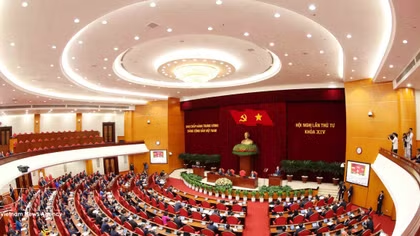
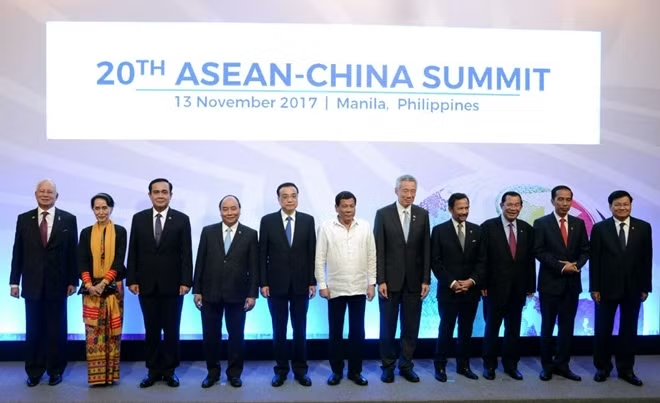
At the just concluded 31st ASEAN Summit in the Philippines, leaders of the ASEAN countries and China agreed to start negotiations to finalize the Code of Conduct in the East Sea, marking a milestone in 15-year efforts to create a legal tool to address conflicts in the region.

Maritime security and safety in the East Sea have been major agenda at regional forums like ASEAN and top priorities of ASEAN’s foreign policy over the last 5 decades. 
ASEAN, China to make East Sea region more peaceful, stable ảnh 1
ASEAN, China to make East Sea region more peaceful, stable

At this week’s Summit in the Philippines, ASEAN leaders reaffirmed their commitment to maintaining and promoting peace, security, and stability; peacefully settling disputes; respecting diplomatic and legal processes; abiding by international law, including the 1982 UN Convention on the Law of the Sea; fully implementing the Declaration on the Conduct of Parties in the East Sea; and promptly finalizing the Code of Conduct in the East Sea.

Strategic maritime area

The East Sea has been a hot topic of debate at regional forums because of growing tensions, unilateral, groundless claims, and grave violations of marine environment.

In the face of increasing threats to peace, security, and stability in the region, the leaders agreed on the importance of greater unity and consensus, more consultation, and maintaining an environment conducive to economic growth and a stable life for all people in the region.

ASEAN and China adopted the Declaration on a Decade of Coastal and Marine Environmental Protection until 2027, which creates a basis for protecting the East Sea’s ecology and biodiversity despite tensions and disputes.

The two sides also agreed to start negotiations on the Code of Conduct in the East Sea, a legally binding document that will prevent conflicts and settle disputes. COC negotiations are to begin next year.

Upholding peaceful co-existence principle

ASEAN’s major achievement has been maintaining peace and stability in the region. ASEAN has served as a mechanism to regulate and minimize bilateral differences.

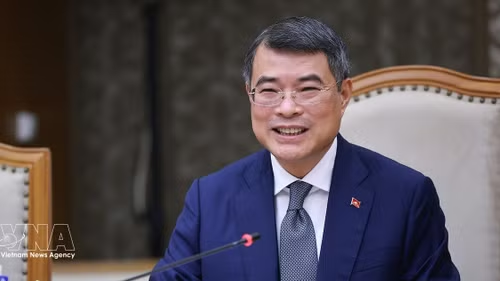
On ASEAN’s 50th founding anniversary, Secretary General Le Luong Minh highlighted ASEAN’s efforts to promote a rule-based regional structure in which all member countries, big or small, co-exist and respect national independence, sovereignty, and territorial integrity under international law.

ASEAN has produced important tools to uphold the principle of peaceful co-existence and peaceful settlement of disputes between member countries and with outsiders. 

The tools including the Treaty on Amity and Cooperation and the Declaration on the Conduct of Parties in the East Sea are an important legal basis for preventing conflicts and building trust, which has been eroded by unilateral acts that violate the principles of peace, stability, dialogue, and cooperation. 

ASEAN has promoted consultation and unity by organizing regular meetings between regional leaders and officials.

ASEAN and China’s agreement to activate COC negotiations reflects ASEAN’s unity and its tireless efforts to promote peace, trust, and cooperation to make the East Sea a region of peace, stability, and development.
VOVWorld

Other News

Amendments to Land Law aim to achieve three key goals

Amendments to Land Law aim to achieve three key goals

The Government has identified three major objectives: promptly institutionalising Party policies on land, private-sector development and national digital transformation; addressing urgent practical obstacles to unlock resources and support the goal of double-digit economic growth; and building a modern, streamlined and effective land management system through stronger decentralisation and administrative reform.

Draft laws must support management reform, stronger decentralisation: PM

Draft laws must support management reform, stronger decentralisation: PM

Participants looked into 11 draft laws and one draft resolution, including laws amending and supplementing several articles of laws on non-agricultural land use tax and corporate income tax; natural resources tax; securities; accounting and independent auditing; the Labour Code; and laws on archives, gender equality, Red Cross activities and employment.

Top Vietnamese leader's New Zealand visit draws media attention

Top Vietnamese leader's New Zealand visit draws media attention

Reports, articles and assessments published on August 12-13 highlighted that Vietnam-New Zealand relations are shifting strongly from high-level political commitments to concrete cooperation programmes, with a focus on trade, investment, education, agriculture, science and technology, defence and security, and climate change response.

Party General Secretary and President meets Vietnamese community in New Zealand

Party General Secretary and President meets Vietnamese community in New Zealand

General Secretary of the Communist Party of Vietnam (CPV) Central Committee and President To Lam described overseas Vietnamese as “ambassadors” who help promote Vietnam's positive image internationally, and urged them to maintain solidarity, preserve national pride and cultural traditions, and make practical contributions to the country's development.

Vietnamese Party leader attends funeral service for top Lao legislator

Vietnamese Party leader attends funeral service for top Lao legislator

The Party leader stressed that the passing of NA President Xaysomphone is a great loss to the Lao Party, State and people, while Vietnam has also lost a great friend and a close, loyal comrade who had always held deep affection for the country, offered valuable support, and worked tirelessly to nurture and consolidate the Vietnam-Laos great friendship, special solidarity, comprehensive cooperation and strategic cohesion.

Singapore remains one of Vietnam's leading important partners: PM

Singapore remains one of Vietnam's leading important partners: PM

Highlighting positive outcomes in Vietnam-Singapore cooperation across all areas, particularly since bilateral ties were elevated to a Comprehensive Strategic Partnership in March 2025, Prime Minister Le Minh Hung proposed that the two sides maintain and step up high-level visits and exchanges at all levels.

Vietnam, Australia hold 8th Foreign Ministers' Meeting

Vietnam, Australia hold 8th Foreign Ministers' Meeting

Australia attaches great importance to its Comprehensive Strategic Partnership with Vietnam and highly values the substantive progress in bilateral relations, said Australian Minister for Foreign Affairs Penny Wong.

Quang Ninh, Bac Ninh urged to embrace modern urban governance

Quang Ninh, Bac Ninh urged to embrace modern urban governance

According to Government proposals submitted to the legislature, Quang Ninh and Bac Ninh cities will be formed based on the respective natural areas, populations and numbers of commune-level administrative units of the two provinces. Both proposals meet all five conditions stipulated in the Law on Organisation of Local Administration No. 72/2025/QH15 and all seven criteria for establishing centrally-run cities under Resolution No. 112/2025/UBTVQH15.

Laos holds State funeral for National Assembly President

Laos holds State funeral for National Assembly President

Xaysomphone Phomvihane was a capable revolutionary intellectual with broad knowledge and a strategic vision. Throughout his career, he remained committed to the Party's ideals and objectives, and demonstrated responsibility, flexibility and discipline in carrying out his assigned tasks.

Prime Minister receives outgoing Israeli Ambassador

Prime Minister receives outgoing Israeli Ambassador

Prime Minister Le Minh Hung asked the Israeli Government to continue creating favourable conditions for Vietnamese people living, studying and working in Israel at a meeting with outgoing Israeli Ambassador to Vietnam Yaron Mayer in Hanoi on August 12.