- 1968 Tet General Offensive and Uprising: A strategic turning point
- Defense intelligence urged to become key force
- Party leader visits General Department of Military Intelligence
- Deputy Minister Bui Van Nam inspects security work for APEC in Ngu Hanh Son
Meanwhile, the US military in South Vietnam suffered heavy losses in the two offensive operations of the Vietnamese revolutionary forces during the 1965-66 and 1966-67 dry seasons, which drove the US political circle in Washington D.C. into confusion and anxiety.
Against this backdrop, the Politburo decided to launch a general offensive and uprising – the highest-ever operational level of the war, to gain a decisive victory in the South battlefield.
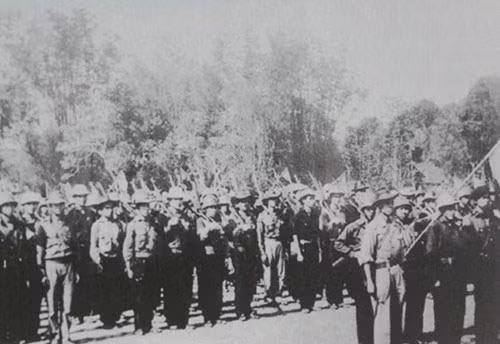 |
| The Police Ministry also reinforced hundreds of police officers of Northern police units, including leaders of departments, and equipment serving security and intelligence operations to Southern security units. |
Before the 1968 General Offensive and Uprising, the Police Ministry (predecessor of the current Ministry of Public Security) and the Security Committee of the South Central Headquarters enhanced its leadership over security work in the South, particularly espionage operations, as well as strengthening and developing covert base networks inside the enemy organization and infrastructure so as to gather intelligence.
The Police Ministry also reinforced hundreds of police officers of Northern police units, including leaders of departments, and equipment serving security and intelligence operations to Southern security units. At the same time, the leadership of the Police Ministry sent specific instructions on security and intelligence operations to the Southern Security Committee, asking Southern security units to continuously study the enemy situation and prepare forces for any possible big opportunities.
In the South, the Southern Security Committee instructed security sub-committees at regional, sub-regional and provincial levels to draw up plans on the deployment of their forces to intelligence operations, in preparation for the General Offensive and Uprising on the eve of the Lunar New Year of 1968. All Southern security forces were requested to quickly open comprehensive and careful investigations into the internal enemy situation, key weapon disposition and make lists of enemy officers to be arrested for information and intelligence about the enemy. After being approved by the region, sub-region or province’s Party committee, these plans became the locality’s resolution on security operations to serve the 1968 General Offensive and Uprising.
In big Southern cities, such as Hue, Da Nang and Saigon, the security and espionage forces actively set up many new intelligence bases working inside important enemy agencies, organizations and units. Meanwhile, clandestine security networks in large cities’ suburban districts effectively supported secret agents of the South Security Committee in gathering intelligence on situations of local enemy units, situations of and enemy-controlled “strategic hamlets” and concentration residential zones, and local people’s readiness to rise up and seize power if and when the occasion arose.
By the eve of the 1968 General Offensive and Uprising, the Southern security and intelligence force had set up hundreds of new clandestine bases and consolidated thousands of existing clandestine ones. Thanks to the clandestine bases, the Southern security and intelligence force collected a good deal of valuable information and documents on the enemy situation, disposition schemes of enemy important targets, enemy spies and reactionaries, helping the South Central Party Committee and South Command draw up plans and direct revolutionary forces to attack the correct targets during the 1968 General Offensive and Uprising.
To ensure smooth communications between the headquarters and clandestine bases and safe transportation of cadres between the liberated zones and enemy-occupied areas, the Southern security and intelligence force actively consolidated communications and liaison networks. The communications and liaison networks set up by the Southern security and intelligence force supported leaders very effectively in leading revolutionary forces during the 1968 General Offensive and Uprising.
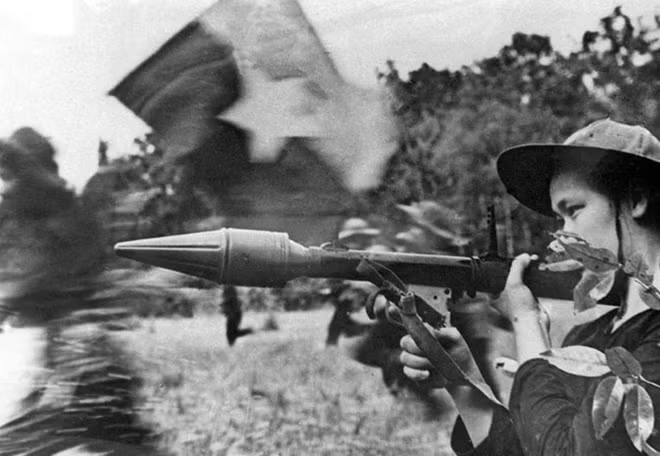
At the same time, security and intelligence officers coordinated closely with armed scouts and sought various creative and flexible methods to secretly transport tons of weapons and medical supplies from the liberated zones to enemy-occupied cities and towns. They also mobilized people in enemy-occupied areas to supply food and vehicles for participating revolutionary forces in the 1968 General Offensive and Uprising.
 |
For anti-spy and security work, our intelligence and armed security forces in coordination with military forces and local people drew plans to protect the transportation route corridor, stores, route marches and the plans for mass uprising to surprise the enemy. In Zones 5 and 9, our intelligence, political security and internal security protection forces enhanced preventive measures and raided enemy spies, underground agents, scouts and reactionary informers.
When our armed forces and people launched the General Offensive and Uprising across the South, some intelligence and security officers were staffed to attacking wings and directions of attack to lead our forces to assault enemy targets. Other intelligence and security officers directly engaged the enemy at key locations of cities and towns. Intelligence and Security Section T4 responsible for Saigon-GiaDinh actively prepared routes toward enemy targets for our forces, and was also tasked to make an explosion as a signal for the general offensive.
Intelligence and security groups in TayNinh, Bien Hoa, Ba Ria, Binh Duong and Thu Dau Mot actively coordinated with our armed forces to attack enemy targets, such as the enemy National Police Bureau, provincial headquarters, provincial radio stations etc. They also led the mass uprising in the province to disintegrate the enemy administrative systems from the provincial level to communal and other enemy organizations while participating in building basic-level revolutionary government structures, conducting ‘agitprop’ among enemy troops, detecting and seizing enemy spies, and expanding the liberated zones.
Our intelligence and security forces also rolled with enemy counter-attacks and protected Party leaders and the Frontline Command. In ThuaThien-Hue province, Intelligence Unit T65 in collaboration with local security forces seized and collected valuable information from documents and enemy officers and officials, and safely took key enemy prisoners of war and important documents to the North for further research.
The Mau Than General Offensive and Uprising in 1968 was a great victory of strategic significance, which marked a milestone in the history of the Vietnamese national liberation war.
In current times, the armed forces and people under the leadership of the Party have attained huge achievements in the national development and defense. The lessons drawn from the Mau Than General Offensive and Uprising remain valuable in the fight against anti-revolutionary forces and in protection of the Party and the socialist Fatherland of Vietnam.
Written by Deputy-Minister of Public Security, Senior-Lieutenant General Bui Van Nam