The US’s The National Interest online magazine on May 28 published an article by former Ambassador and head of the Vietnamese Mission to the UN Nguyen Thanh Chau, which pointed out strategic motivations driving the relationship between Vietnam and the US.
In the article, which was published on the occasion of Prime Minister Nguyen Xuan Phuc’s official visit to the US, the former Ambassador stressed that Phuc’s visit is the third important high-level delegation exchange between the two countries within three recent years.
In July 2015, Party General Secretary Nguyen Phu Trong had a historic visit to the US, which was then reciprocated with US President Barack Obama’s successful trip to Vietnam in May 2016.
The article noted that since the normalization of ties more than two decades ago, Vietnam and the US have created one of the most impressive successful stories in history, given the bitter war that deeply divided the two countries hitherto, and the current fast and comprehensive growth in bilateral cooperation.
Bilateral trade, for instance, has increased one hundredfold in that time span. Last year, the US export to Vietnam grew by 43 percent.
Defence and security ties are expanding in tandem with the overall bilateral relations and the common denominators of regional peace and stability. Cooperation also expands to other regional and global issues such as counter-terrorism, natural disasters, epidemics, cybersecurity and peacekeeping.
Both countries highly value the role of the Association of Southeast Asian Nations (ASEAN) in the region and the association’s centrality in regional structures, including the East Asia Summit (EAS).
The former Ambassador went on to analyze the three major factors driving the Vietnam-US relations, with the first driver being the common understanding that a successful partnership can only be realised with a constructive, balanced, inclusive and open approach.
“The joint statement issued during former US President Barack Obama’s visit to Vietnam in 2016 makes clear that the increasingly enhanced US-Vietnam relations have positively contributed to the joint efforts of the international community in maintaining peace, stability, cooperation, and respect for international law in the region, and building a rules-based region,” he wrote.
Second, in making sense of the geostrategy of the region, both countries have laid emphasis on a sustainable and long-term view of the partnership, according to Chau.
He explained that strategically, Vietnam tends to nurture long-lasting relations with countries and partners.
Drawing on historical lessons—and perhaps for practical reasons—the US is adopting a more nuanced perspective vis-à-vis smaller partners. The Donald Trump administration has now extended an invitation to PM Nguyen Xuan Phuc to visit the US, and pledged that President Trump will come to central Da Nang city to attend the Asia-Pacific Economic Cooperation Leaders’ Week.
These positive signs serve as a testament to continuity instead of disruption in their bilateral ties, Chau commented.
The final geostrategic undertaking that drives Vietnam-US relations is interests that could be national, bilateral and/or regional, depending on areas of cooperation or diversion, according to the former ambassador.
In 2015, Party General Secretary Nguyen Phu Trong and President Obama issued a joint vision statement that says “Looking toward the future of bilateral relations and building on the Comprehensive Partnership.”
Both countries affirm their continued pursuit of a deepened, sustained and substantive relationship on the basis of respect for the UN Charter, international law, and each other’s political systems, independence, sovereignty, and territorial integrity.
He underlined that ideologies remain important, but they are no longer a hurdle in Vietnam-US partnership, noting that the geostrategic rule of the road now is to work together for the guarantee of the shared peace, security and prosperity.
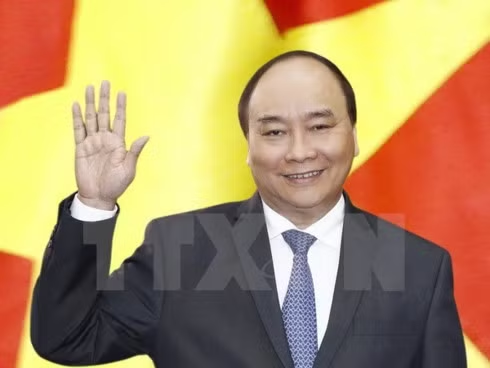 |
| PM Nguyen Xuan Phuc |
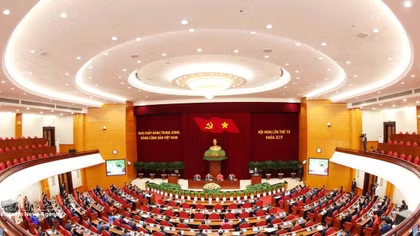
The fourth plenum of the 14th Central Committee of the Communist Party of Vietnam (CPV) continued its second working day in Hanoi on October 6.
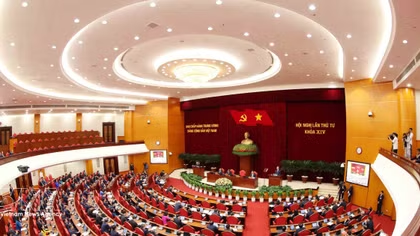
Delegates held group discussions on the CPV Central Committee resolution calling for stronger building and rectification towards a clean, strong and comprehensive Party and political system able to meet the country's development needs in the new era.
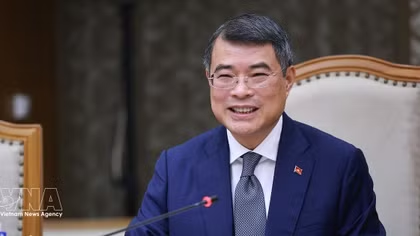
Prime Minister Le Minh Hung will lead a high-level Vietnamese delegation on official visits to Laos and Cambodia from October 8 to 10.
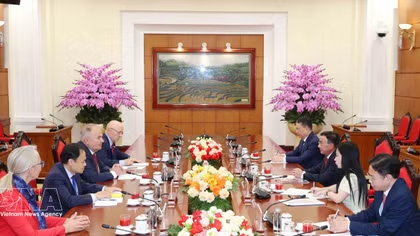
The Communist Party of Vietnam always values its solidarity and friendship with the Hungarian Workers' Party and communist and workers' parties worldwide, which helps build political trust and supports Vietnam's relations with other countries, said key Party leader Tran Cam Tu.
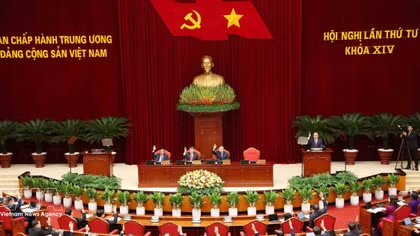
In his opening remarks, General Secretary and President To Lam said that the 14th National Party Congress set out major orientations and strategic goals, while the second and third plenums adopted important policies on Party building, personnel, development and national defence. The fourth plenum must focus on creating conditions for effective implementation while preparing the theoretical, organisational and human resources foundations for the country’s long-term development.
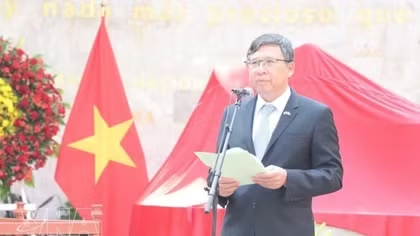
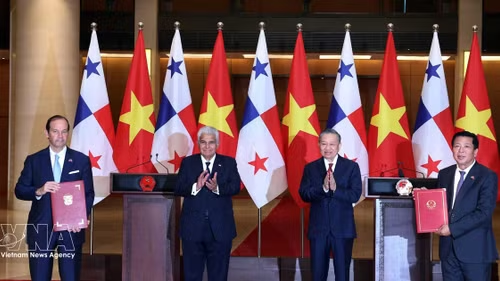
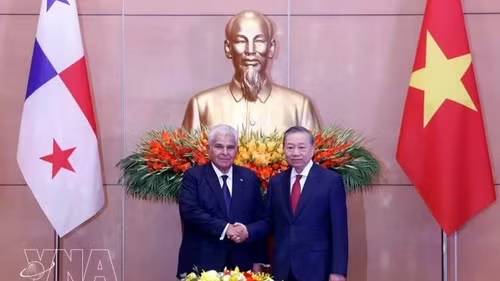
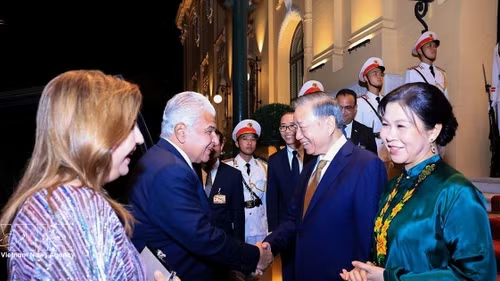
Vietnamese Ambassador to Mexico and Panama Nguyen Van Hai noted that the visit is particularly significant as the first high-level exchange between the two countries in nearly 15 years, following then-President Ricardo Martinelli’s visit to Vietnam in 2012, and came shortly after the 50th anniversary of diplomatic relations in 2025.
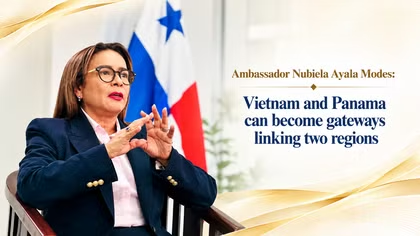
"Panama can serve as a strategic platform for Vietnamese companies seeking greater access to Latin America and the Caribbean, while Vietnam represents an important gateway for strengthening Panama’s engagement with Southeast Asia", Ambassador Nubiela Ayala Modes confirmed.
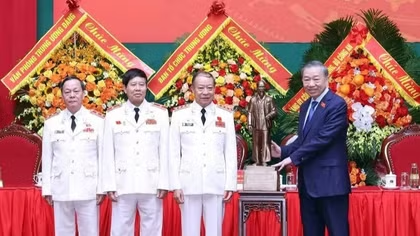
The Vietnam Association of Former People's Public Security Officers must truly serve as a common home that fosters comradeship and solidarity among former public security officers and those who have contributed to the cause of safeguarding security and social order, said top leader To Lam.
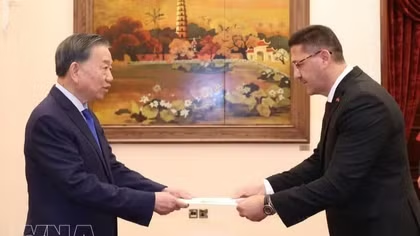
General Secretary and President To Lam receives newly accredited ambassadors
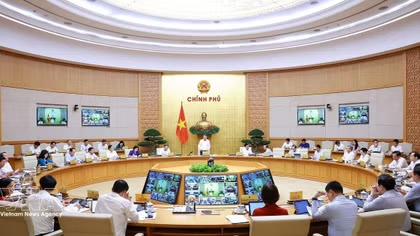
Localities nationwide hailed effective and flexible directions delivered by the Government so far this year, resulting in positive nine-month socio-economic growth, and reaffirmed their commitment to achieving targets set for the whole 2026 at an online Government-locality conference on October 3.
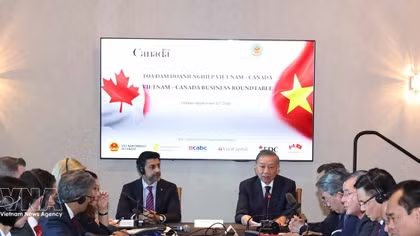
The elevation of bilateral ties to a Strategic Partnership shows that Vietnam and Canada increasingly view each other not simply as trading partners, but as long-term partners in addressing economic, technological and regional challenges.
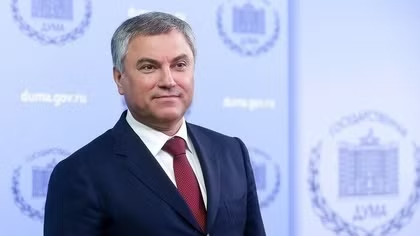
National Assembly President Tran Thanh Man on October 1 sent a congratulatory letter to Vyacheslav Volodin on his re-election as Chairman of the State Duma of the Federal Assembly of Russia.
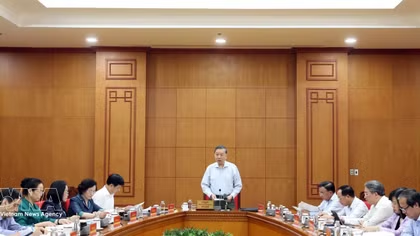
The top leader applauded the efforts of ministries, sectors, localities, social organisations, coaches, athletes, experts in developing physical education and sports in recent times, stressing that Resolution No. 08 has provided an important political foundation for sports development over the past 15 years, while Conclusion No. 70 set important orientations for the new period.
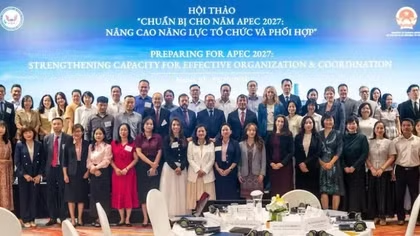
PSNews - Vietnam is recognised by its partners as an influential member of the Asia-Pacific Economic Cooperation (APEC) forum, with expectations that it will continue to demonstrate leadership when it hosts APEC for the third time in 2027, according to Standing Deputy Minister of Foreign Affairs Nguyen Minh Vu.
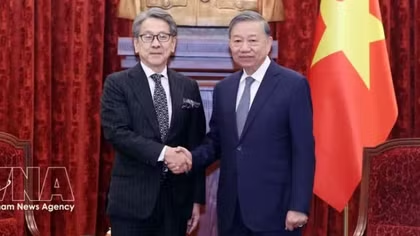
General Secretary and President Lam urged JBIC to continue promoting the substantive implementation of projects under the Asia Zero Emission Community (AZEC), and step up discussions on potential cooperation within the framework of the POWERR Asia (Partnership on Wide Energy and Resources Resilience Asia) initiative, including the development of strategic energy reserves.
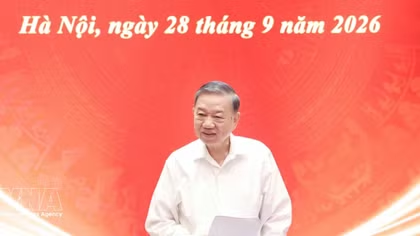
Overhauling the Party’s leadership methods is an objective, inevitable and urgent requirement to elevate the Party’s governing capacity and combat strength and keep the political system effective in the new development era.
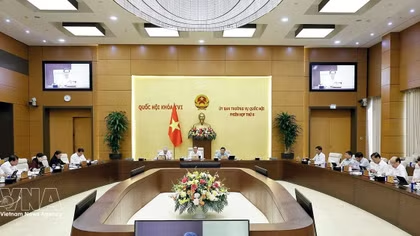
During the session, the NA Standing Committee will give opinions on a number of draft laws, namely the revised Land Law, the revised Housing Law, the revised Law on Real Estate Business, the Law on Legal Normative Documents, and the consolidated Law on the State Budget.
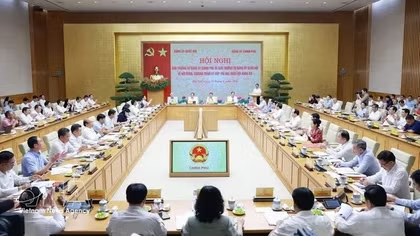
National Assembly President Tran Thanh Man coordination must go beyond finishing the agenda to improve the quality of NA decisions and Government enforcement; deal with policies rather than just paperwork, especially in the fight against corruption and other negative phenomena; and pin down final responsibility for each product, not just progress.
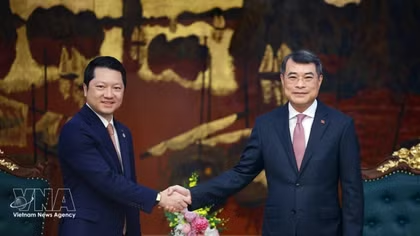
Prime Minister Le Minh Hung asked the two countries' inspection agencies to build on their achievements by regularly exchanging information and experience, maintaining delegation exchanges, and coordinating inspections in areas related to bilateral economic, trade and investment cooperation.
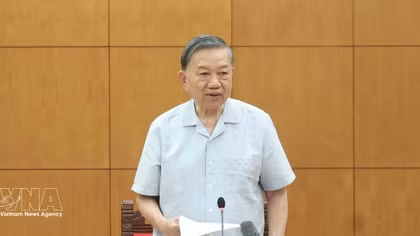
General Secretary and President To Lam demanded a sweeping review rather than piecemeal amendments to individual laws, so that people's rights are protected on a continuing basis.