- Leaders of foreign countries and international friends pay respect to former Party chief Do Muoi
- Party General Secretary Do Muoi’s imprint on foreign policies
- Former Party chief Do Muoi remembered around the world
- Respect-paying ceremony for Party leader Do Muoi in HCM City
- The memorial service of the State funeral for former Party Chief Do Muoi
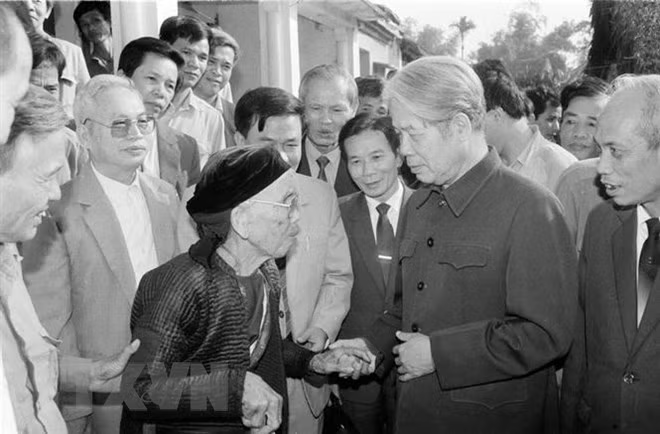 |
| Former CPV General Secretary Do Muoi talks with people in Le Loi commune, Thuong Tin district, Ha Tay province (Source: VNA) |
In the article entitled “Comrade Do Muoi – Talented Leader, Steadfast and Creative Party General Secretary in renovation cause”, the PM recalled that Do Muoi joined the democratic movement and was admitted to the Indochinese Communist Party in 1939.
He was arrested by the colonial French administration and sentenced to 10 years in jail in Hoa Lo prison, Hanoi in 1941. In 1945, he escaped from the prison and joined the uprising to seize power in Ha Dong province. He was appointed as General Secretary of the Ha Dong provincial Party Committee.
During the anti-French resistance war, he held the positions of Secretary of the Ha Nam provincial Party Committee, Secretary of the provincial Party Committee and Chairman of the provincial Resistance and Administrative Committee of Nam Dinh, Secretary of the provincial Party Committee of Ninh Binh, member of the Party Committee of Region 3 in charge of Ninh Binh and Hoa Binh provinces, Vice Secretary of the Party Committee and Vice Chairman of the Resistance and Administrative Committee of Inter-Region 3, Political Commissar of the High Command of Inter-Region 3, Secretary of the Party Committee of the Red River Left Bank Region, Chairman of the Resistance and Administrative Committee and Political Commissar of the Red River Left Bank Military Region. Under his leadership, the armed forces and people of the Red River Left Bank Military Region defeated many military campaigns by the enemy, and conducted a surprise attack into Cat Bi airport in the northern port city of Hai Phong, burning dozens of aircraft of the enemy, contributing to the victory of the nation.
After peace was restored, Do Muoi assumed many leadership positions in ministries, agencies and the government. In his capacity as Deputy Prime Minister and Vice Chairman of the Council of Ministers from 1965 to 1986, he was assigned to take charge of many important tasks, including fighting against the sabotage war by American imperialists, defusing torpedoes at Hai Phong port, and providing supplies for the South.
Following the spring victory 1975, the country faced serious difficulties in socio-economic management. As Chairman of the Council of Ministers from September 1988 to June 1991, Do Muoi, together with the Politburo led by General Secretary Nguyen Van Linh, issued breakthrough policies regarding inflation control, the removal of State subsidy on food trade and export, reform of salary, and banking interest rates.
Do Muoi directed the Council of Ministers to take drastic actions to curb inflation, enhance manufacturing and improve local lives, while gradually renewing planning mechanism and regulating supply-demand at the macro level.
As a result, inflation was reduced from 774 percent in 1986 to 34 percent in 1989 and 14 percent in 1992.
Besides curbing inflation, Do Muoi suggested to the Politburo and CPV Central Committee the eradication of subsidization and trade barriers, which served as the reality basis for the country to build the 1991 Platform on national development in the transition period toward socialism and the 1991-2000 socio-economic development strategy.
He also proposed strongly developing heavy industry towards national industrialization and modernisation, thus building an independent and self-reliant economy.
At the time Do Muoi was elected as CPV General Secretary in June 1991, the Soviet Union and the system of socialist countries in Eastern Europe collapsed, causing hesitation and anxiety among a number of Party members, officials and people and affecting the trust in the path towards socialism.
The CPV General Secretary and Politburo members led the way in maintaining political stability and the resolve to pursue the path of socialism building chosen by the CPV and President Ho Chi Minh.
In order to promote the Doi Moi (renovation) cause and remove difficulties for the country, the Politburo gave the utmost importance to the task of breaking the trade embargo and normalizing ties with China and the US, taking the initiative in joining the ASEAN and expanding ties with countries in international community.
To perform such a great task, Do Muoi led a high-ranking delegation to China from November 5-10, 1991. Both sides issued a joint communiqué affirming that the Vietnam – China high-level meeting marked the normalisation of bilateral ties that suits essential and long-term interests of the two countries’ people, benefiting peace and prosperity in the region.
Following the normalisation of ties with China, Do Muoi directed coordination with the US to handle the issue of US’s missing in action personnel. Vietnam’s goodwill in the issue was recognised by the US side, and on July 11, 1995, US President Bill Clinton announced the normalisation of ties with Vietnam. This was a significant milestone marking the end of the embargo on the country, making it easier for Vietnam to extend international cooperation and pool external resources for national restoration.
General Secretary Do Muoi’s viewpoint of “Vietnam is a friend and trustworthy partner of countries worldwide” has been realised through State and people-to-people diplomacy, bringing about great benefits to the country, lifting the country out of socio-economic crisis and firmly advance on the road of integration and development.
During nearly two tenures serving as CPV General Secretary, Do Muoi and the Politburo maintained the Party’s firm leadership of the country. He himself proposed several initiatives winning wide support of the people such as launching democracy mechanism at the grassroots level and presenting the title of heroic Vietnamese mothers.
As an outstanding disciple of President Ho Chi Minh, he successfully fulfilled tasks in any position. He was an exemplary leader who always kept Party discipline, stayed close to the people and respected and listened to comrades and the people. With dedication to the Party, revolution and nation, he was bestowed many noble distinctions by the Party and State, including the Golden Star Order, the 80-year Party membership insignia, among others.
At the fourth plenum of the eighth Party Central Committee in December 1997, he stepped down from the committee and was made advisor of the Party Central Committee.
During his revolutionary career, he was always present in the toughest areas., He was a man of action and always placed national interests above all.
His example of dedicating the entire life to the country and people is always bright. His name will live forever in the heart of each official, Party member and citizen, PM Nguyen Xuan Phuc wrote in conclusion.