Draft Law on Religion and Belief: milestone in Vietnam’s religious policy

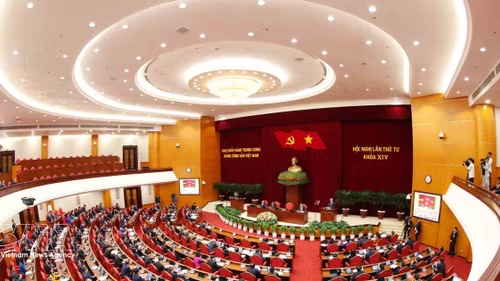
Domestic religious followers have praised the Vietnamese legislative body’s recent discussion and plan to approve a bill on religions and beliefs at the second session of the 14th National Assembly.

Religious dignitaries said the promulgation of such a law at this moment is of particular importance to institutionalize the 2013 Constitution’s provisions on religious freedom and ensure the right to freedom of religion and belief for all. 
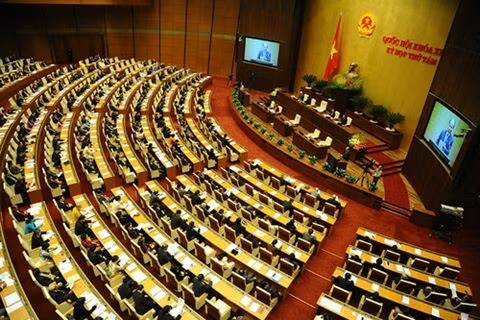
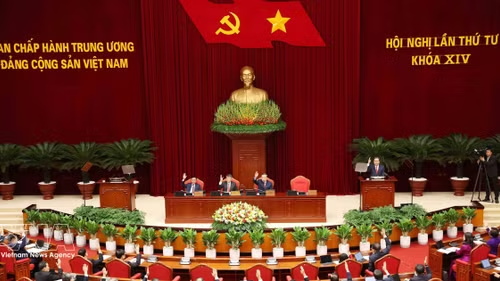
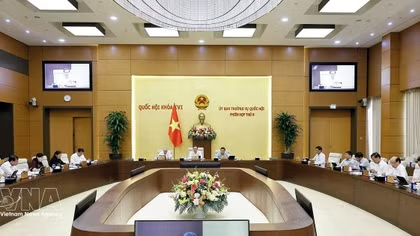
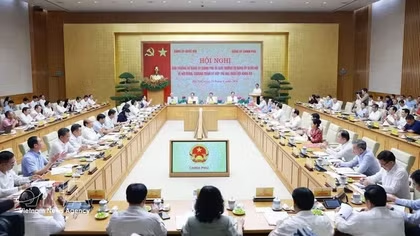
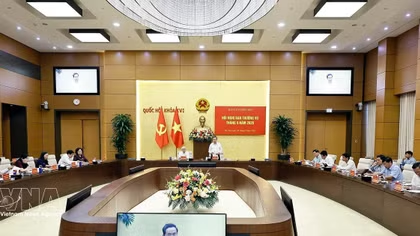
At the 2nd session of the 14th National Assembly.
At the 2nd session of the 14th National Assembly.

Vietnam is a multi-religion, multi-belief country. The Party and State of Vietnam have consistently followed a policy of respecting and ensuring the right to practice religion in Vietnam. There has been a harmony between religions here which reflects the motto “Living good lives with good religions”. The draft law on religion and belief is based on a consistent policy and accommodates today's religious activities.

Respecting religious belief

The bill on religion and belief which will be submitted to the 14th NA session for approval goes beyond the previous Ordinance on Belief and Religion.

The biggest change is in article 6, expanding freedom of religion and belief from “citizens” to “everyone”, including the religious and the non-religious.

Priest Tran Van Huynh, Chief Coordinator and Chief of the Standing Committee of the Cao Dai Bach Y, a sect of Caodaism, and a NA deputy for Kien Giang province, said “In addition to expanding the right to freedom of religion and belief, the bill has interpreted that right as a fundamental human right as set forth in the 2013 Constitution.”

He added  “The draft law has added a new chapter, chapter II on the right to freedom of religion and belief, which demonstrates the Party and State commitment to ensuring freedom of religion and belief for all.”

Most Venerable Thich Thanh Quyet, Deputy Chairman of the Executive Council of the Vietnam Buddhist Shangha and a NA deputy for Quang Ninh province, said the bill has many regulations on registration and notification to set up a religion to replace the ask-give mechanism. It clearly defines the responsibilities of the state to help religious organizations in international integration, thereby building trust between religious followers and the state.

According to Most Venerable Thich Thanh Quyet, this law has broadened the previous ordinance, clarifying the procedures for registering religious activities, and operations, shortening the time needed for recognizing a new religious organization from 23 years to 5 years and loosening the requirements for splitting or merging religious organizations.

or the first time, the right to freedom of religion and belief for foreigners legally residing in Vietnam has been fully recognized. Under the new law, foreigners have the same basic right to practice a religion as any Vietnamese citizen. They are allowed to study at religious establishments in Vietnam, and can be nominated, appointed, or elected to a religious post in Vietnam if they satisfy the set conditions.

Priest Nguyen Van Rien, chief of Phuoc Thanh County, Phu Cuong Roman Catholic Diocese and a NA deputy for Binh Duong province, said “In 2004 we only had the Ordinance on Belief and Religion. Now we are going to have a Law on Religion and Belief.”

Rien said “This is a step toward fulfilling people’s aspirations in line with current trends, meeting the requirements of national reform, and creating conditions for religious organizations to enjoy their legitimate rights.”

Empowering religious organizations in medical, educational sectors and social sponsorship 

The bill extends activities of religious organizations and their affiliates in the fields of health, education, training, and social sponsorship, and creates conditions for religious organizations to be involved deeper in charity work to exercise their responsibilities in implementing major targets of the country.

Priest Nguyen Van Rien said “Pursuant to the 2004 ordinance, educational and charitable activities of religious organizations were activities encouraged by the state. Under the new draft law, they are considered a right. These provisions open up opportunities for religious organizations to participate in education and healthcare in the interest of society. Religious organizations will have more ways to develop medical and educational models for the people, thus reducing social burdens and promoting socialization in the medical and education sectors.”

Superior Buddhist monk Ly Minh Duc, Chief of Som Rong Pagoda in Soc Trang city and a NA deputy of Soc Trang province, said “The draft law on religion and belief will motivate religious followers and dignitaries to embrace the positive aspects of religions and socialism, promote the patriotism of religious followers, and encourage them to resist attempts by hostile forces to distort or abuse religion to sabotage the socialist regime.”

When the bill is approved, it will create a more solid legal foundation for religious activities and encourage religions to contribute more to national development.
VOV5

Other News

National Assembly Chairman urges renovation in leadership, working style

National Assembly Chairman urges renovation in leadership, working style

The NA's Committee for Cultural and Social Affairs has moved fast to reshuffle its organisation after the 14th National Party Congress and the election of deputies to the 16th NA, updating its work agenda to match new directives set out in the resolutions of the 14th National Party Congress and the first Congress of the NA Party Organisation for the 2025–2030 term.

Vietnam treasures ties with Croatia: PM

Vietnam treasures ties with Croatia: PM

Vietnam and Croatia should strive to double bilateral trade turnover from the current level of 161 million USD; study the establishment of a Joint Committee on Economic Cooperation to create a long-term, stable, and effective framework for collaboration, said Prime Minister Le Minh Hung.

President Ho Chi Minh's enduring legacy highlighted at Venezuela commemoration

President Ho Chi Minh's enduring legacy highlighted at Venezuela commemoration

Vice President of the United Socialist Party of Venezuela (PSUV) Jesús Faria expressed deep admiration for President Ho Chi Minh and Vietnam’s indomitable struggle for national independence. He described President Ho Chi Minh as an immortal symbol of 20th-century national liberation movements, whose legacy continues to inspire leftist parties, progressive movements, and peoples across Latin America, including Venezuela.

Vietnam proposes key cooperation orientations at BRICS Foreign Ministers' Meeting

Vietnam proposes key cooperation orientations at BRICS Foreign Ministers' Meeting

Deputy Foreign Minister Nguyen Minh Hang shared Vietnam’s approach to building an independent and self-reliant economy linked to deep international integration, while proposing several key areas for enhanced cooperation between BRICS and partner countries at the Expanded BRICS Foreign Ministers' Meeting that opened on May 14 in India.

Vietnam asks parties to respect its sovereignty over Truong Sa

Vietnam asks parties to respect its sovereignty over Truong Sa

PSNews - The spokesperson stated that the dispatch of personnel by relevant parties to features belonging to Truong Sa without Vietnam’s permission constitutes a violation of Vietnam’s sovereignty under international law. She stressed that such actions run counter to the Declaration on the Conduct of Parties in the East Sea (DOC) as well as ongoing efforts by countries to negotiate a Code of Conduct in the East Sea (COC).

Hanoi to host ASEAN Future Forum 2026 in mid-June

Hanoi to host ASEAN Future Forum 2026 in mid-June

PSNews - Vietnam’s proposals placed the highest priority on ensuring a peaceful and stable environment conducive for continued sustainable development and improving the well-being and happiness of the ASEAN people. They were praised by member states and incorporated into the core contents of the ASEAN Leaders’ Statement on the response to the Middle East crisis.

Vietnam promotes cooperation with United Nations on crime prevention

Vietnam promotes cooperation with United Nations on crime prevention

Vietnam highly values the support of the United Nations Office on Drugs and Crime (UNODC) in strengthening national capacity in crime prevention and criminal justice, drug control, and addressing emerging challenges, particularly cybercrime, said Ambassador Vu Le Thai Hoang.

Party, State leader calls for consolidation of central steering committees on legal, judicial reform

Party, State leader calls for consolidation of central steering committees on legal, judicial reform

Consolidating the central steering committees for institutional and legal reform and for judicial reform is necessary in order to streamline organisational structures without reducing responsibilities, while ensuring clear accountability, measurable outputs and concrete results. Following the restructuring, the body will be renamed the central steering committee for institutional improvement and law enforcement, with the Party General Secretary and State President serving as its head.

Vietnam strives for substantive outcome at NPT review conference

Vietnam strives for substantive outcome at NPT review conference

At the meeting this week, Ambassador Viet briefed the UNGA President on developments during the first two weeks of the conference. He stressed that the current international geopolitical landscape poses numerous complex challenges, while reaffirming Vietnam’s determination, together with other member states, to promote substantive and balanced outcomes at the conference.

Top leader of Vietnam receives Vientiane official in Hanoi

Top leader of Vietnam receives Vientiane official in Hanoi

The host leader stressed that cooperation between localities, particularly between the capitals of Hanoi and Vientiane, plays an especially important role as a pioneering force in effectively implementing the foreign polices of the two Parties and States, while also serving as a bridge between politics and development, as well as between strategy and concrete action.