Following is the full text of the declaration.
“Towards a Dynamic and Prosperous Mekong Subregion
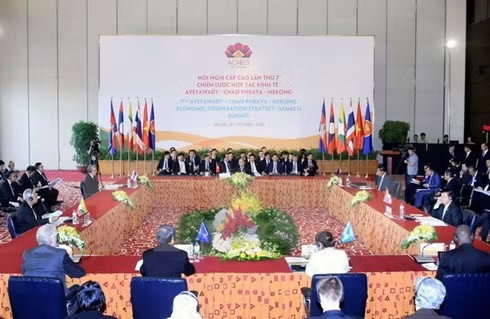
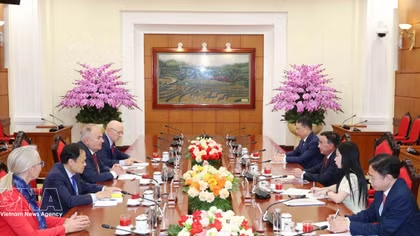
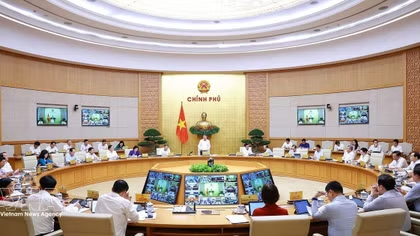
1. We, the Heads of State/Government of the Kingdom of Cambodia, the Lao People’s Democratic Republic (Lao PDR), the Republic of Union of Myanmar, the Kingdom of Thailand and the Socialist Republic of Vietnam gathered in Hanoi, Vietnam for the 7th Ayeyawady – Chao Phraya – Mekong Economic Cooperation Strategy (hereinafter referred to as ACMECS) Summit. The Secretary-General of the Association of Southeast Asian Nations (ASEAN), Under-Secretary-General of the United Nations, Executive Secretary of the ESCAP, the representatives of the Asian Development Bank (ADB) and the World Bank (WB) were also present at the Summit.
2. We recalled with satisfaction that since the establishment of ACMECS, much have been done to strengthen the relations among our five countries based on good neighborliness, traditional friendship, mutual interest and understanding. The five countries have made great strides in promoting economic growth and social progress, improving peoples’ welfare and quality of life, increasing inter-country trade and investment, people-to-people connectivity and carrying out structural reforms toward sustainable and inclusive growth.
3. We expressed our appreciation to the efforts made by the ACMECS Ministers, Senior Officials and working groups in implementing the ACMECS Plan of Action 2016-2018 and welcomed the progress made in eight areas of cooperation. We requested relevant agencies to accelerate the implementation of the ACMECS Plan of Action 2016 – 2018.
4. We held substantial discussions on the global and regional developments and the role of ACMECS in accelerating economic growth, increasing competitiveness of member countries’ economies and promoting sustainable development in the region.
5. We shared the view that ACMECS is entering a new phase of development defined by unprecedented development opportunities as well as emerging challenges. As ACMECS countries are going through a rapid social and economic transformation, it’s imperative for us to forge new growth drivers that capitalize on our strengths and take advantage of new development opportunities.
6. We agreed to deepen our cooperation in the areas of high priority with the aim of: (i) strengthening regional ties so as to facilitate our economies’ participation in the global value chains and improve our competitiveness; and (ii) supporting ACMECS countries in successfully implementing the 2030 Agenda for Sustainable Development. We also agreed to take actions that would strengthen ACMECS.
7. To this end, we pledge to take the following actions:
I. Enhancing regional connectivity:
8. In transport sector, we agreed to:
i. Further coordinate to complete multimodal transport connectivity and make full use of the existing road transportation networks and economic corridors, particularly the East-West Economic Corridor (EWEC), North - South Economic Corridor (NSEC) and Southern Economic Corridor (SEC) .
ii. Mobilize resources for the construction of missing links and improvement of road quality along the economic corridors; jointly construct highways along the SEC , including the Ho Chi Minh City – Phnom Penh Expressway.
iii. Coordinate on the development of new transport routes connecting ACMECS countries, including Ha Tinh (Vietnam) – Khammuane (Lao PDR) – Nakhon Phanom (Thailand) route.
iv. Explore the possibility of implementing “Single Stop Inspection, Single Window Inspection” (SSI/SWI) model at international border check-point s along EWEC and SEC ; and work with the Asian Development Bank (ADB) on the Handbook on the SSI/SWIimplementation.
v. Review the current status of logistics sector and identify ways to improve its competitiveness.
vi. Develop air linkages among major cities, cultural and natural heritage s in ACMECS countries.
vii. Engage business sector in transport infrastructure development .
viii. Strive for the full implementation of the Cross-border Transport Agreement (CBTA) which has been ratified by all A CMECS member countries with its “early harvest” launch date to be on January 1, 2017 .
9. In the trade and investment facilitation sector, we agreed to :
i. Strengthen cooperation among ACMECS countries in harmonizing and simplifying rules and regulations, including cross-border procedures, the procedures for goods-in-transit, the exchange of trade and investment information and developing industrial zones along the EWEC and SEC.
ii. Promote trade and investment among member countries, including cross-border trade, through the organization of trade fairs, exhibitions and other trade and investment promotion activities.
iii. Encourage the use of local currencies for border trade transactions and information sharing on foreign exchange rules and regulations among members.
10 . In the Industry sector, we agreed to:
Enhancing the competitiveness of ACMECS SMEs through promoting the harmonizing standardization, facilitating their access to information, finances, technology and the capacity building as well as enhancing SME cluster development .
1 1 .In tourism sector :
W e noted significant achievements of tourism development in ACMECS countries with 52 million international visitors and around 9 million intra-regional visitors in 2015.
We commended the progress made in implementing the “Five countries, one destination”initiative . In this regards, we welcomed the outcomes of the 15 th Thailand Travel Mart Plus (TTM+) held in June 2016 at Chiang Mai, Thailand and the 12th International Travel Expo (ITE) and the Open ACMECS Ministerial Forum on Responsible Tourism held in September 2016 in Ho Chi Minh City, Vietnam.
We requested relevant agencies to accelerate the implementation of the seven cooperation areas agreed in the ACMECS Tourism Action Plan 2016-2018 .
We also agreed to:
i. Promote green and responsible tourism in ACMECS countries.
ii. Develop various form of tourism products, including Mekong river tourism, land and sea tourism;
iii. Facilitate the participation of tourism agencies and association s in major fairs and exhibitions in the region such as the International Travel Expo (ITE) and the Vietnam International Travel Mart (VITM) , the Thailand Travel Mart Plus (TTM+) , Cambodia Travel Mart.
II. Promoting sustainable development:
12. We reaffirmed our commitment to work together toward green and sustainable development in the region and emphasized the significance of achieving goals and targets set in the UN Agenda for Sustainable Development Goals 2030. To this end, we are determined to strengthen our cooperation in the development of ACMECS smart agriculture, effective environment protection, sustainable natural resources management and efficient utilization of energy.
13. In agriculture sector, we agreed to :
i. Develop cooperation programs on food safety and quality management, mutual recognition of commodity certifications.
ii. Strengthen cooperation in management of cross-border animal epidemic diseases.
iii. Cooperate in developing new varieties as well as indigenous varieties o f crop plants, which are tolerant and adaptable to climate change.
iv. Implement cooperation programmes on water resource management in agriculture and climate resilience agriculture .
v. Encourage and promote the further development of bilateral and multilateral Contract Farming to generate employment and increase the welfare of farmers, increase production as well as contribute to the increase in regional and international trade in agricultural products, and to promote food security and greater investment by private actors.
vi. Promote trade of agricultural products, while encouraging efforts to establish communication channels among ACMECS countries on rice production and trade.
14. In environmental cooperation , we agreed to:
i. Reiterate the commitment to integrate the relevant Sustainable Development Goals into all ACMECS projects on economic development.
ii. Further strengthen cooperation among ACMECS countries on environmental conservation and sustainable use of natural resources of the Ayeyawady, Chao Phraya and Mekong rivers.
iii. Enhance cooperation between ACMECS countries in regional and international institutions, as well as with development partners, to promote green development and address as well as respond to climate change and global warming, and to make joint efforts in preventing illegal trade of timber and wildlife along the borders.
iv. Coordinate in mobilizing resources for and implementing the 2030 Sustainable Development Goals.
v. Strengthen ACMECS’s collaboration with the Mekong River Commission and other regional mechanisms to jointly manage water resources for the sustainable management, development , utilization, and conservation of trans-boundary water and related resources.
III. Increasing operational efficiency of ACMECS
15. We encourage development partners and international stakeholders to participate in ACMECS projects for mutual benefits and for the development of the region.
16. Recognizing that enterprise is the engine of trade, investment and innovation, we pledged to enhance the role of business sector in ACMECS development. We applauded the contributions of the ACMECS Business Advisory Council to our work and encourage d ACMECS Business Council to strengthen its communication with business communities so as to effectively convey their concerns and recommendations.
17. We tasked the Ministers and Senior Officials to further strengthen the coordination among member countries in mobilizing resources for the implementation of ACMECS projects.
18. To enhance the efficiency and effectiveness of ACMECS, we will carry forward ACMECS reforms and improve its coordination with other relevant subregional cooperation frameworks; We tasked the Ministers and Senior Officials to further explore ways to streamline ACMECS operational structure and strengthen the synergy between ACMECS and Cambodia – Lao PDR – Myanmar – Vietnam Cooperation (CLMV).
19. We welcomed the success of the first World Economic Forum (WEF) on the Mekong region, which was initiated and organized by Vietnam to highlight the great potential of the Mekong region to the international business circle. We emphasized the need of strengthening public-private partnership to realize the vision of a competitive, integrated and prosperous Mekong region.
20. We welcomed the Kingdom of Thailand ’s offer to host the Eighth ACMECS Summit and provide a venue for the Ninth CLMV Summit to be chaired by the Kingdom of Cambodia in 2018 . The specific date and venue will be coordinated through diplomatic channels.
21. We expressed our appreciation to the Government of the Socialist Republic of Vietnam for the excellent arrangements of the Summit and the warmest hospitality accorded to all member delegations during the Summit.