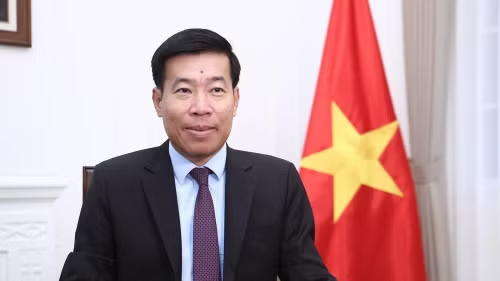
General Secretary of the Communist Party of Vietnam (CPV)’s Central Committee Nguyen Phu Trong will pay an official visit to Hungary from September 8-11 at the invitation of Hungarian Prime Minister Viktor Orban.
The visit holds historical significance as it is the first trip by Vietnamese Party leader to a country in Central Eastern Europe since institutional transformation in the region. It aims to create a new landmark and momentum for the bilateral relationship, while enhancing mutual trust and understanding between leaders and peoples of the two countries.
The visit is also expected to deepen the traditional friendship and multi-faceted cooperation between Vietnam and Hungary, and advance their cooperation framework to a comprehensive partnership in order to make new and more practical changes in bilateral collaboration across various fields and promote Vietnam’s influence in Central Eastern Europe.
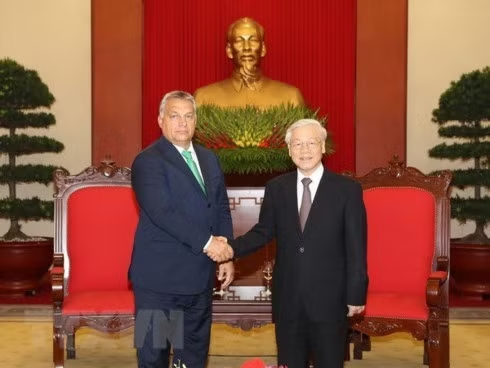 |
| General Secretary of the Communist Party of Vietnam (CPV)’s Central Committee Nguyen Phu Trong (right) receives Hungarian Prime Minister Viktor Orban during the later's visit to Vietnam in September 2017. |
Through the Party leader’s trip, Vietnam wants to affirm its policy of considering Hungary an important and traditional partner in the region and enhance the bilateral relations in the areas of both sides’ potential and strength.
Vietnam and Hungary established diplomatic ties on February 3, 1950. Over the past years, active progress has been made in the bilateral relations, with high political trust and regular exchange of delegations, especially at the high levels, through Party, Government, National Assembly and local channels.
Between 2014 and 2017, Vietnam welcomed Hungary’s President, National Assembly Speaker and Prime Minister. Meanwhile, Vietnamese President, National Assembly Chairperson and Prime Minister also visited Hungary during the period.
The two sides have effectively cooperated with each other at multilateral forums, especially the United Nations (UN) and within the Asia-Europe Economic Meeting.
The Hungarian Government has committed to backing Vietnam’s bid to run for a seat at the UN Security Council for the 2020-2021 tenure. The country has also proposed Mekong-Danube cooperation, effective water resources collaboration, sub-regional connectivity and environmental protection.
With seven meetings, the Vietnam-Hungary Joint Committee on Economic Cooperation has carried forward its role in forging the bilateral cooperation. The two countries have signed many agreements and documents, creating legal frameworks for their affiliation across fields.
Hungary has considered Vietnam the most important partner in Southeast Asia. Over the past years, their economic and trade ties have increased sharply, with two-way trade exceeding 355 million USD for the first time in 2017.
As of April 2018, Hungary had 17 valid projects in Vietnam with total registered capital of 63.56 million USD, ranking 57th out of 126 countries and territories investing in the country.
Besides, the two countries have made strides in cooperation on law-making, justice, national defence-security, health care, education-training and partnership between localities. Education is a traditional cooperation sphere and a spotlight of the bilateral ties in the new period. Over the past years, Hungary is the only country in Eastern Europe to constantly increase scholarships for Vietnam.
Regarding cooperation between localities, Hanoi’s Tay Ho district has set up twinning relationship with 16 districts of Hungary’s Budapest. Besides, Hoi An city of central Quang Nam province and the Mekong Delta city of Can Tho have also established ties with Szentendre and Kaposvar cities of Hungary.
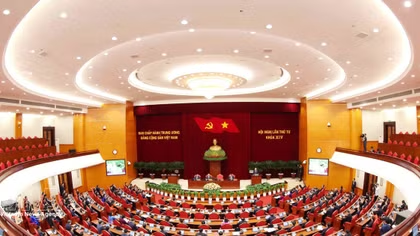
The fourth plenum of the 14th Central Committee of the Communist Party of Vietnam (CPV) continued its second working day in Hanoi on October 6.
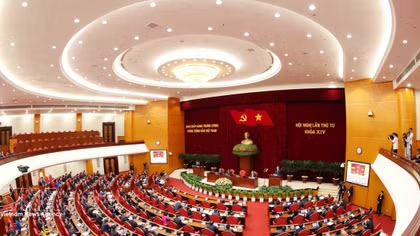
Delegates held group discussions on the CPV Central Committee resolution calling for stronger building and rectification towards a clean, strong and comprehensive Party and political system able to meet the country's development needs in the new era.
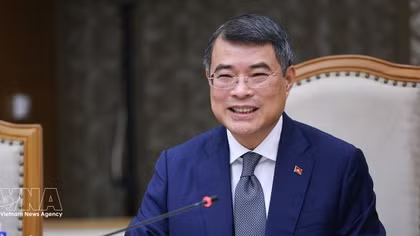
Prime Minister Le Minh Hung will lead a high-level Vietnamese delegation on official visits to Laos and Cambodia from October 8 to 10.
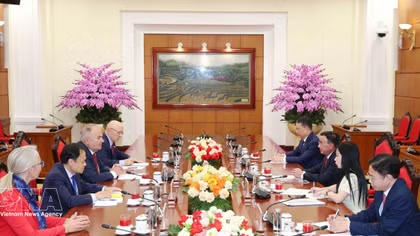
The Communist Party of Vietnam always values its solidarity and friendship with the Hungarian Workers' Party and communist and workers' parties worldwide, which helps build political trust and supports Vietnam's relations with other countries, said key Party leader Tran Cam Tu.
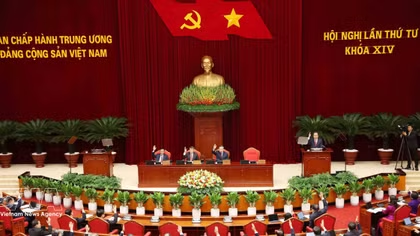
In his opening remarks, General Secretary and President To Lam said that the 14th National Party Congress set out major orientations and strategic goals, while the second and third plenums adopted important policies on Party building, personnel, development and national defence. The fourth plenum must focus on creating conditions for effective implementation while preparing the theoretical, organisational and human resources foundations for the country’s long-term development.
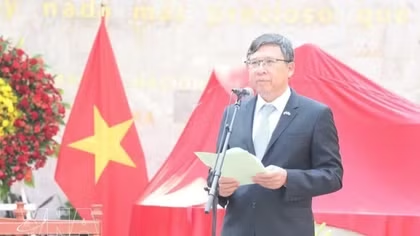
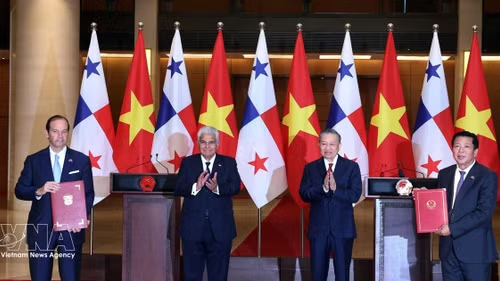
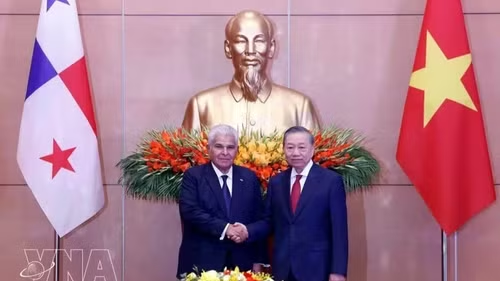
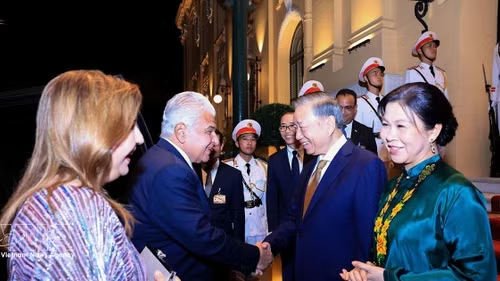
Vietnamese Ambassador to Mexico and Panama Nguyen Van Hai noted that the visit is particularly significant as the first high-level exchange between the two countries in nearly 15 years, following then-President Ricardo Martinelli’s visit to Vietnam in 2012, and came shortly after the 50th anniversary of diplomatic relations in 2025.
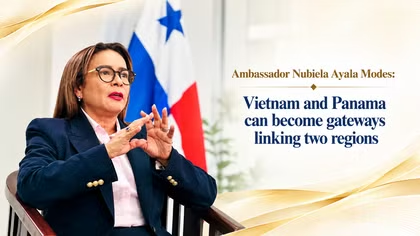
"Panama can serve as a strategic platform for Vietnamese companies seeking greater access to Latin America and the Caribbean, while Vietnam represents an important gateway for strengthening Panama’s engagement with Southeast Asia", Ambassador Nubiela Ayala Modes confirmed.
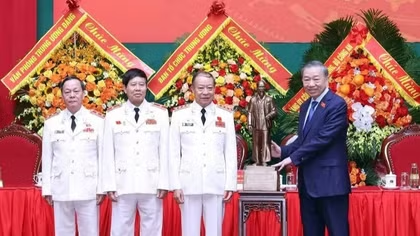
The Vietnam Association of Former People's Public Security Officers must truly serve as a common home that fosters comradeship and solidarity among former public security officers and those who have contributed to the cause of safeguarding security and social order, said top leader To Lam.
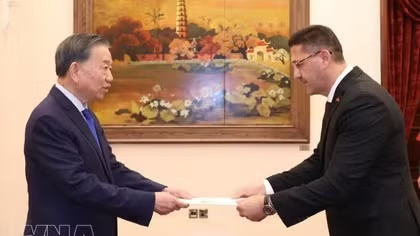
General Secretary and President To Lam receives newly accredited ambassadors
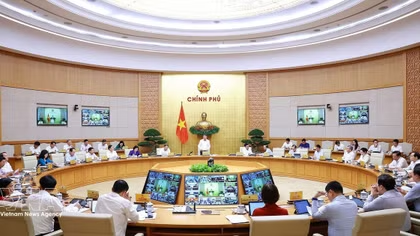
Localities nationwide hailed effective and flexible directions delivered by the Government so far this year, resulting in positive nine-month socio-economic growth, and reaffirmed their commitment to achieving targets set for the whole 2026 at an online Government-locality conference on October 3.
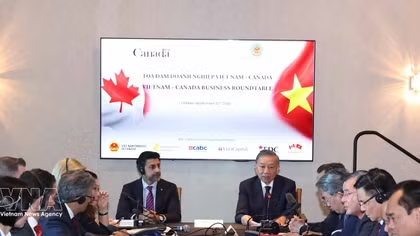
The elevation of bilateral ties to a Strategic Partnership shows that Vietnam and Canada increasingly view each other not simply as trading partners, but as long-term partners in addressing economic, technological and regional challenges.
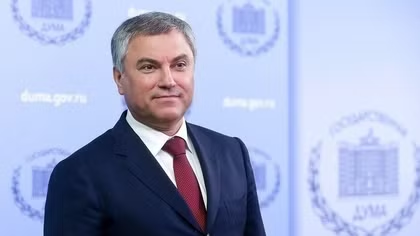
National Assembly President Tran Thanh Man on October 1 sent a congratulatory letter to Vyacheslav Volodin on his re-election as Chairman of the State Duma of the Federal Assembly of Russia.
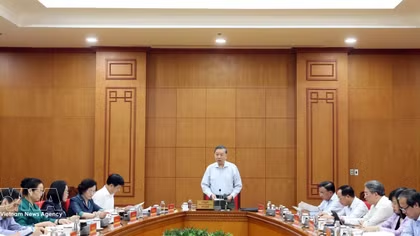
The top leader applauded the efforts of ministries, sectors, localities, social organisations, coaches, athletes, experts in developing physical education and sports in recent times, stressing that Resolution No. 08 has provided an important political foundation for sports development over the past 15 years, while Conclusion No. 70 set important orientations for the new period.
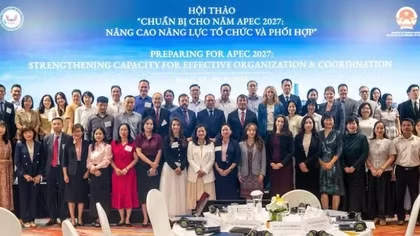
PSNews - Vietnam is recognised by its partners as an influential member of the Asia-Pacific Economic Cooperation (APEC) forum, with expectations that it will continue to demonstrate leadership when it hosts APEC for the third time in 2027, according to Standing Deputy Minister of Foreign Affairs Nguyen Minh Vu.
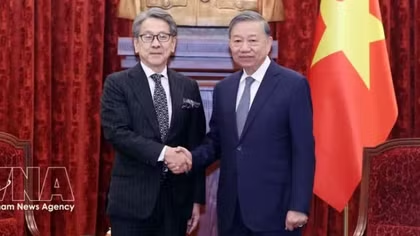
General Secretary and President Lam urged JBIC to continue promoting the substantive implementation of projects under the Asia Zero Emission Community (AZEC), and step up discussions on potential cooperation within the framework of the POWERR Asia (Partnership on Wide Energy and Resources Resilience Asia) initiative, including the development of strategic energy reserves.
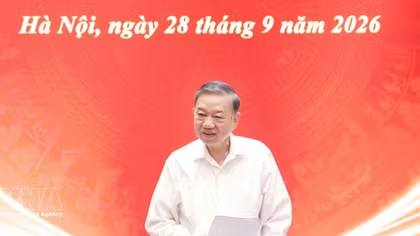
Overhauling the Party’s leadership methods is an objective, inevitable and urgent requirement to elevate the Party’s governing capacity and combat strength and keep the political system effective in the new development era.
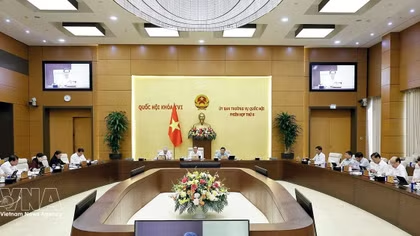
During the session, the NA Standing Committee will give opinions on a number of draft laws, namely the revised Land Law, the revised Housing Law, the revised Law on Real Estate Business, the Law on Legal Normative Documents, and the consolidated Law on the State Budget.
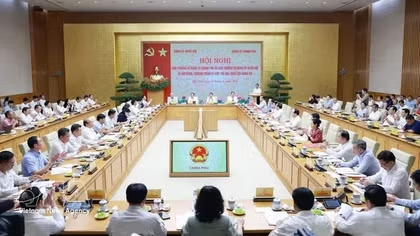
National Assembly President Tran Thanh Man coordination must go beyond finishing the agenda to improve the quality of NA decisions and Government enforcement; deal with policies rather than just paperwork, especially in the fight against corruption and other negative phenomena; and pin down final responsibility for each product, not just progress.
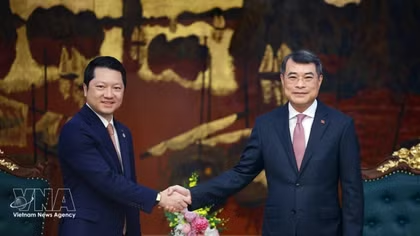
Prime Minister Le Minh Hung asked the two countries' inspection agencies to build on their achievements by regularly exchanging information and experience, maintaining delegation exchanges, and coordinating inspections in areas related to bilateral economic, trade and investment cooperation.
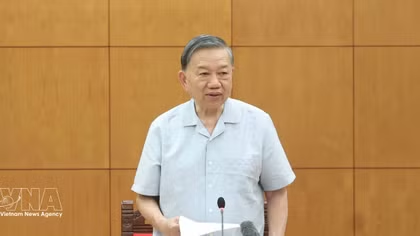
General Secretary and President To Lam demanded a sweeping review rather than piecemeal amendments to individual laws, so that people's rights are protected on a continuing basis.