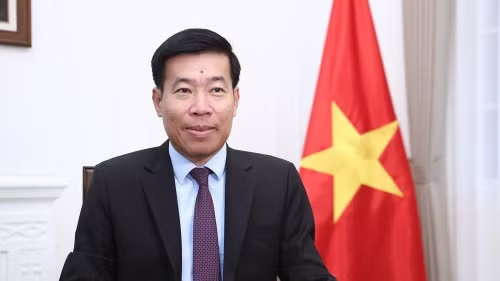
Prime Minister Nguyen Xuan Phuc and his entourage arrived in Hanoi late June 16, concluding his trip to Thailand to attend the 8th Ayeyawady-Chao Phraya-Mekong Economic Cooperation Strategy Summit (ACMECS 8) and 9th Cambodia-Laos-Myanmar-Vietnam Summit (CLMV 9).
At the 8th ACMECS Summit, themed “Towards an Integrated and Connected ACMECS Community”, the leaders focused their discussions on measures to facilitate socio-economic development, improve competitiveness of member economies, and outlined orientations for cooperation for inclusive and sustainable development in the Mekong region.
The leaders also discussed establishing the ACMECS Fund and ACMECS Infrastructure Fund and Trust as a financing mechanism for cooperation projects in the region.

The summit adopted the Bangkok Declaration and the ACMECS Master Plan for the 2019-2023 period with the goal of turning ACMECS into an economic hub with seamless connectivity and strong integration. It also agreed that Cambodia will host the 9th ACMECS in 2020.
Addressing the event, Prime Minister Nguyen Xuan Phuc hailed the work of building the ACMECS Master Plan and affirmed that Vietnam will coordinate with other member countries to build a plan of action to implement cooperative projects as soon as possible.
He suggested a number of measures to make ACMECS cooperation more effective, saying that ACMECS needs to contribute more directly to and become an integral part of the ASEAN Community formation process through integrating the implementation of the ACMECS Master Plan with that of the ASEAN Community Vision 2025, the Master Plan on ASEAN Connectivity, and other ASEAN cooperation programmes.
It is necessary to improve the working mechanism of ACMECS and pay more attention to the mobilisation of financial sources via initiatives like the ACMECS Fund and ACMECS Infrastructure Fund and Trust, the Vietnamese PM noted.
He also recommended a number of specific contents for cooperation in trade-investment, agriculture, tourism, environmental protection, natural resources management, and human resources development. He called for efforts to be channeled into developing the East-West Economic Corridor, the South Economic Corridor and building new roads to facilitate investment within the region.
Meanwhile, the 9th CLMV Summit, themed “For Greater Economic Integration and Connectivity”, leaders of the four member states affirmed their determination to bolster collaboration to tap their economic potential, making contributions to the development of the ASEAN bloc and ensuring inclusive and sustainable development in the region.
They shared the goal of narrowing the development gap within ASEAN and building a dynamic, prosperous CLMV region with sustainable development.
At the end of the summit, the leaders adopted a joint statement of the CLMV 9 and agreed that Laos will be host of the CLMV 10.
Addressing the CLMV 9, Prime Minister Nguyen Xuan Phuc stressed that narrowing the development gap within the ASEAN is significant to the socio-economic development in Cambodia, Laos, Myanmar and Vietnam as well as to stability and prosperity of ASEAN as a whole.
The Prime Minister said there are three points worth of attention in order to achieve the best outcomes in CLMV cooperation. First of all, the cooperation should focus on sectors which are the strength of the concerned countries with high feasibility, especially in the context of limited resources and the four countries’ participation in various Mekong mechanisms. He pinpointed some examples such as soft infrastructure connection, agriculture, tourism, human resource training, and development of sound and equal business climate.
Secondly, CLMV should be creative in mobilizing resources and building joint projects, he said, suggesting integrating CLMV’s contents into other Mekong cooperation mechanisms and invloving development partners in CLMV meetings and project execution.
Thirdly, the four nations should build mid and long-term cooperation strategies to serve as foundation for their joint activities.
He said Vietnam is ready to contribute to cooperation in the framework of the Cambodia-Laos-Myanmar-Vietnam (CLMV) mechanism and proposed specific support for the countries, such as helping the countries attend big trade fairs in Vietnam, build e-government, improve digital capacity and skills, and continue to provide CLMV scholarships for Cambodian, Lao and Myanmar students.
During the time he attending the ACMECS 8 and CLMV 9, PM Phuc held bilateral meetings with his Thai, Lao and Cambodia counterparts and the President of Myanmar, and received executives of some major Thai corporations.
On the occasion, Phuc and his Thai counterpart witnessed the signing of an MoU on cooperation between the Enterprises Development Department under the Vietnamese Ministry of Planning and Investment and Thai bank Kasikorn, and a deal on developing the solar power plants Dau Tieng 1 and 2 in Vietnam’s Tay Ninh province with total investment of approximately 400 million USD.
The trip to attend the ACMECS 8 and CLMV 9 of Prime Minister Nguyen Xuan Phuc demonstrates the importance that Vietnam attaches to the two cooperation mechanisms. It also helped enhance Vietnam’s position and role in the region, and contributed to opening up a new chapter in Mekong cooperation and to sustainable development and prosperity in the region.
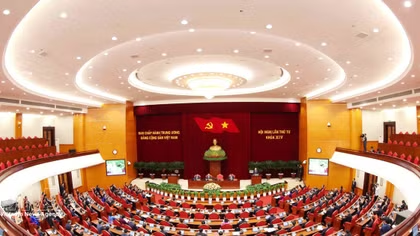
The fourth plenum of the 14th Central Committee of the Communist Party of Vietnam (CPV) continued its second working day in Hanoi on October 6.
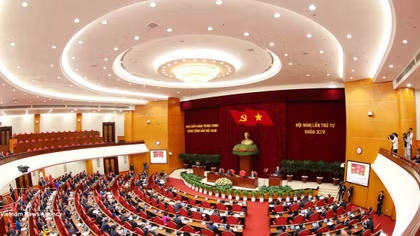
Delegates held group discussions on the CPV Central Committee resolution calling for stronger building and rectification towards a clean, strong and comprehensive Party and political system able to meet the country's development needs in the new era.
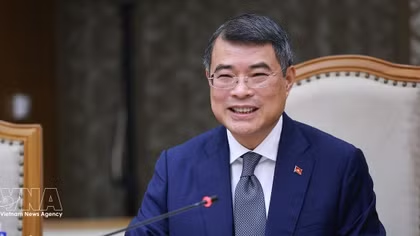
Prime Minister Le Minh Hung will lead a high-level Vietnamese delegation on official visits to Laos and Cambodia from October 8 to 10.
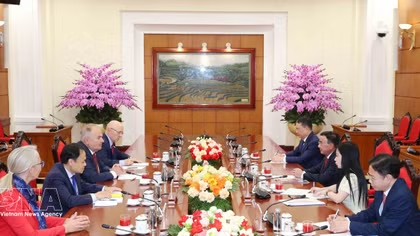
The Communist Party of Vietnam always values its solidarity and friendship with the Hungarian Workers' Party and communist and workers' parties worldwide, which helps build political trust and supports Vietnam's relations with other countries, said key Party leader Tran Cam Tu.
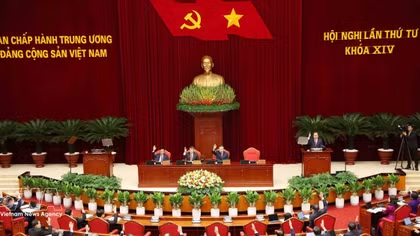
In his opening remarks, General Secretary and President To Lam said that the 14th National Party Congress set out major orientations and strategic goals, while the second and third plenums adopted important policies on Party building, personnel, development and national defence. The fourth plenum must focus on creating conditions for effective implementation while preparing the theoretical, organisational and human resources foundations for the country’s long-term development.
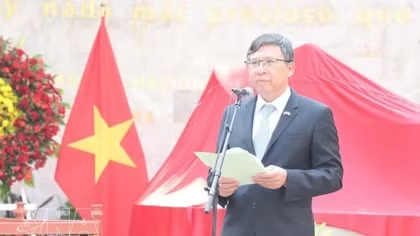
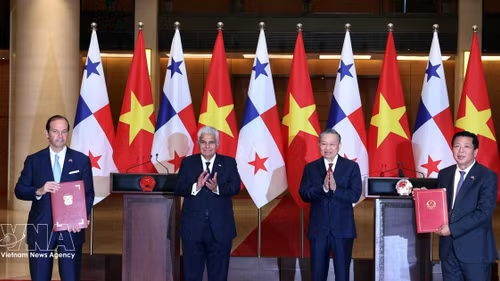
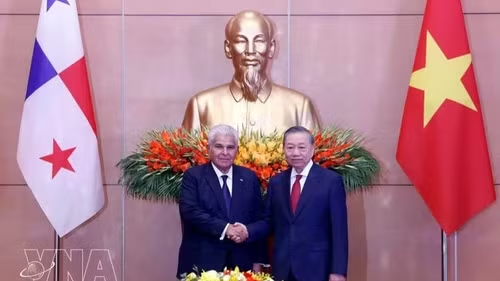
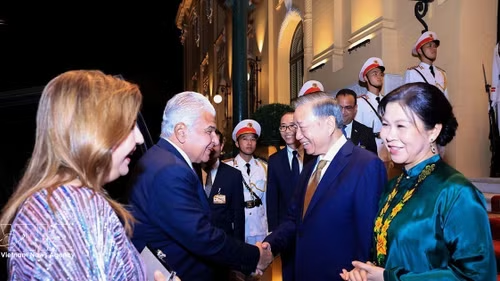
Vietnamese Ambassador to Mexico and Panama Nguyen Van Hai noted that the visit is particularly significant as the first high-level exchange between the two countries in nearly 15 years, following then-President Ricardo Martinelli’s visit to Vietnam in 2012, and came shortly after the 50th anniversary of diplomatic relations in 2025.
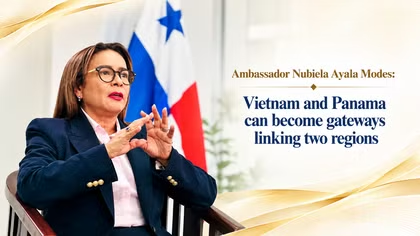
"Panama can serve as a strategic platform for Vietnamese companies seeking greater access to Latin America and the Caribbean, while Vietnam represents an important gateway for strengthening Panama’s engagement with Southeast Asia", Ambassador Nubiela Ayala Modes confirmed.
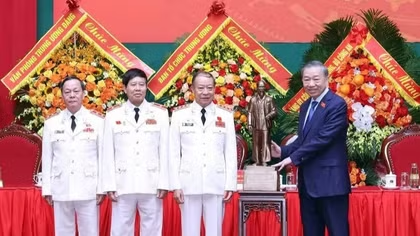
The Vietnam Association of Former People's Public Security Officers must truly serve as a common home that fosters comradeship and solidarity among former public security officers and those who have contributed to the cause of safeguarding security and social order, said top leader To Lam.
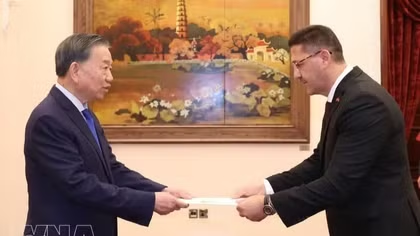
General Secretary and President To Lam receives newly accredited ambassadors
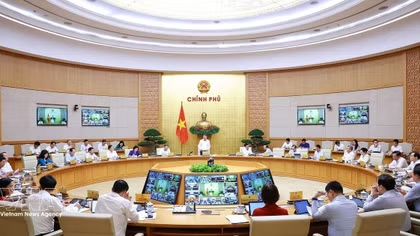
Localities nationwide hailed effective and flexible directions delivered by the Government so far this year, resulting in positive nine-month socio-economic growth, and reaffirmed their commitment to achieving targets set for the whole 2026 at an online Government-locality conference on October 3.
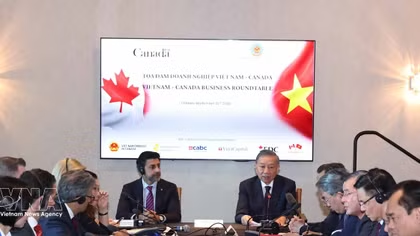
The elevation of bilateral ties to a Strategic Partnership shows that Vietnam and Canada increasingly view each other not simply as trading partners, but as long-term partners in addressing economic, technological and regional challenges.
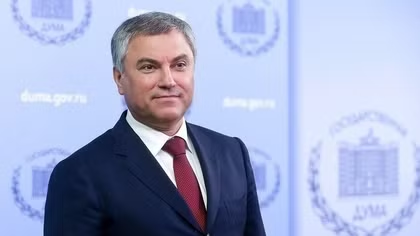
National Assembly President Tran Thanh Man on October 1 sent a congratulatory letter to Vyacheslav Volodin on his re-election as Chairman of the State Duma of the Federal Assembly of Russia.
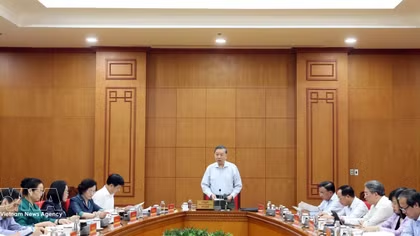
The top leader applauded the efforts of ministries, sectors, localities, social organisations, coaches, athletes, experts in developing physical education and sports in recent times, stressing that Resolution No. 08 has provided an important political foundation for sports development over the past 15 years, while Conclusion No. 70 set important orientations for the new period.
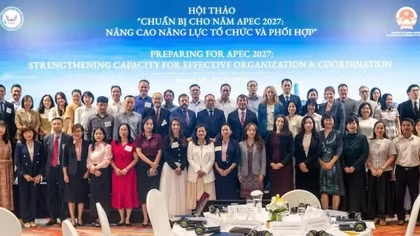
PSNews - Vietnam is recognised by its partners as an influential member of the Asia-Pacific Economic Cooperation (APEC) forum, with expectations that it will continue to demonstrate leadership when it hosts APEC for the third time in 2027, according to Standing Deputy Minister of Foreign Affairs Nguyen Minh Vu.
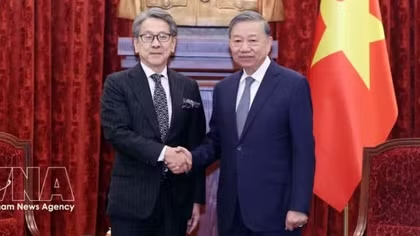
General Secretary and President Lam urged JBIC to continue promoting the substantive implementation of projects under the Asia Zero Emission Community (AZEC), and step up discussions on potential cooperation within the framework of the POWERR Asia (Partnership on Wide Energy and Resources Resilience Asia) initiative, including the development of strategic energy reserves.
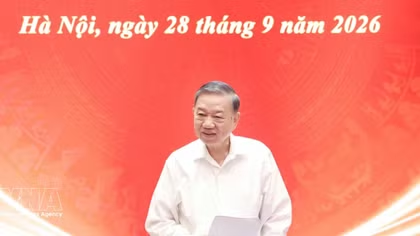
Overhauling the Party’s leadership methods is an objective, inevitable and urgent requirement to elevate the Party’s governing capacity and combat strength and keep the political system effective in the new development era.
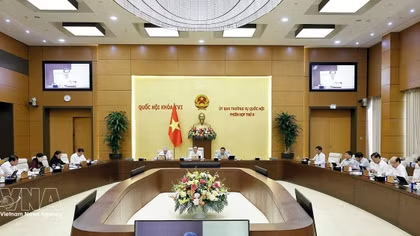
During the session, the NA Standing Committee will give opinions on a number of draft laws, namely the revised Land Law, the revised Housing Law, the revised Law on Real Estate Business, the Law on Legal Normative Documents, and the consolidated Law on the State Budget.
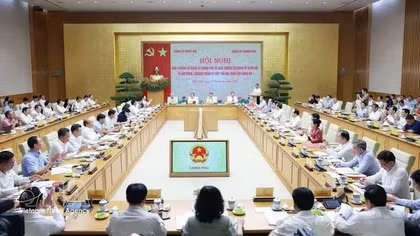
National Assembly President Tran Thanh Man coordination must go beyond finishing the agenda to improve the quality of NA decisions and Government enforcement; deal with policies rather than just paperwork, especially in the fight against corruption and other negative phenomena; and pin down final responsibility for each product, not just progress.
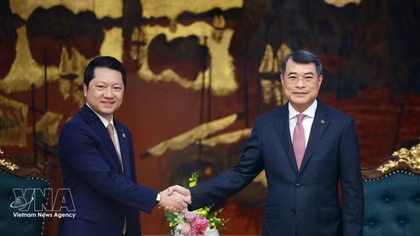
Prime Minister Le Minh Hung asked the two countries' inspection agencies to build on their achievements by regularly exchanging information and experience, maintaining delegation exchanges, and coordinating inspections in areas related to bilateral economic, trade and investment cooperation.
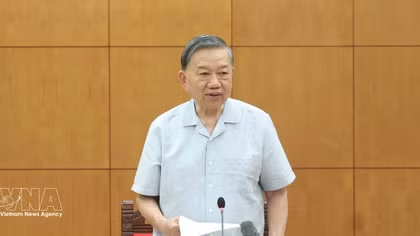
General Secretary and President To Lam demanded a sweeping review rather than piecemeal amendments to individual laws, so that people's rights are protected on a continuing basis.