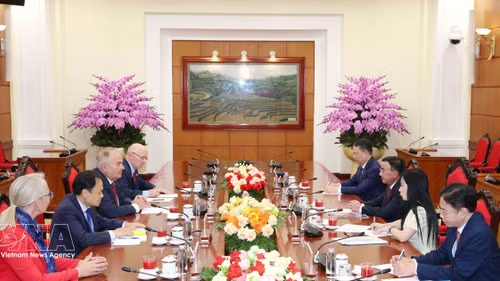
Canberra (VNA) – General Secretary of the Communist Party of Vietnam (CPV) Central Committee and President To Lam held talks with Australian Prime Minister Anthony Albanese in Canberra on August 11 morning (local time), affirming that Vietnam always attaches importance to Australia’s role and position, and the close and trusted Comprehensive Strategic Partnership between the two countries as well.
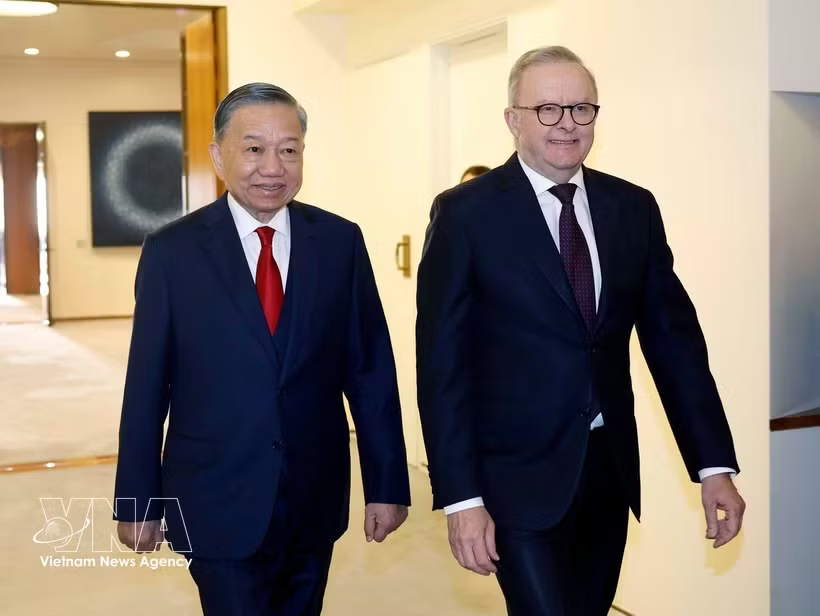
PM Albanese welcomed General Secretary and President Lam and the high-ranking Vietnamese delegation on their state visit to Australia, stressing its signficance amid the rapidly growing ties, particularly since the two countries elevated their ties to a Comprehensive Strategic Partnership in March 2024.
In a world growing more uncertain, it is vitally important that the two countries cooperate closely across all fields, he said.
On the occasion, he voiced admiration for Vietnam and its people, praising the country’s striking gains, particularly in socio-economic progress. He also lauded the keynote speech by General Secretary and President Lam at the 23rd Shangri-La Dialogue in Singapore in May, saying that it reflects Vietnam’s regional vision and makes clear that peace and stability are shared values for nations, including Australia and Vietnam.
The Vietnamese Party and State leader, for his part, conveyed PM Le Minh Hung’s greetings to PM Albanese and lauded Australia as a friend and trusted partner of Vietnam. He also expressed wish to keep lifting bilateral relations to a new level.
Both leaders said they are pleased with the vigorous momentum of Vietnam-Australia ties after more than half a century, defined by solid political trust and ever-deepening mutual understanding and sharing. They welcomed the swift, effective rollout of the 2024–2027 Action Plan that puts the Comprehensive Strategic Partnership into practice, with breakthroughs registered across all six pillars. Defence-security ties have expanded, and two-way trade has doubled over the past five years, surpassing 14 billion USD in 2025. Joint efforts in education - training, development assistance, science, technology, innovation, and people-to-people exchanges have continued to grow.
They reached broad consensus on major directions to widen Vietnam-Australia ties in the coming time, aiming to meet each country’s development needs while adapting to global and regional changes. The two sides agreed to reinforce the political foundation of the relationship by facilitating all-level exchanges, and further deepen defence-security ties, including in cybersecurity, combating transnational crime, and responding to non-traditional security challenges.
On economic, trade, and investment fronts, they stressed the need to harness the two economies’ complementary strengths, make full use of the free trade agreements both countries are part of, clear barriers, and smooth the way for trade. They set a target of 20 billion USD in two-way trade and called for stronger supply chain links, quality investment, and closer cooperation in the green and digital economies, new energy, and future industries.
General Secretary and President Lam and PM Albanese agreed to make science and technology, innovation and digital transformation a new driver of bilateral relations; expand cooperation in strategic areas such as artificial intelligence (AI), semiconductors, quantum technology, biotechnology, biomedicine, marine research, critical minerals and green hydrogen; and promote joint research projects and links between universities, research institutes and businesses, with a view to establishing a Vietnam-Australia technology connectivity ecosystem and developing a highly skilled workforce.
The two leaders also consented to promote green and sustainable transition and climate change adaptation, working towards the goal of achieving net-zero emissions.
They spoke highly of the solid results achieved in education, training and human resource development cooperation, and agreed to continue promoting links between universities, research institutes, educational establishments and vocational training institutions, with a view to developing programmes for knowledge and experience sharing and joint training of high-quality human resources between the two countries.
The top leader of Vietnam welcomed the effective operation of the Vietnam Australia Centre at the Ho Chi Minh National Academy of Politics and its contributions to the training of Vietnam’s mid- and senior-level officials.
PM Albanese expressed his sincere thanks to the Vietnamese Government for creating favourable conditions for Australian universities, including RMIT University, to operate sustainably and smoothly in the country.
The leaders also welcomed projects and programmes promoting people-to-people links and broad knowledge sharing between the two countries, including the Australia Vietnam Policy Institute (AVPI), the Hub for Vietnam Policy Studies at the Australian National University, and the Australia-Vietnam Strategic Technology Centre (AVSTC), among others.
They encouraged stronger cooperation and exchanges in culture, tourism and people-to-people relations. General Secretary and President Lam suggested that Australia continue to facilitate Vietnamese students’ study, work and acquisition of experience in Australia, and encourage the Vietnamese community in Australia to grow in strength and unity, promote the positive cultural values of both countries, and serve as an effective bridge of friendship between the two nations.
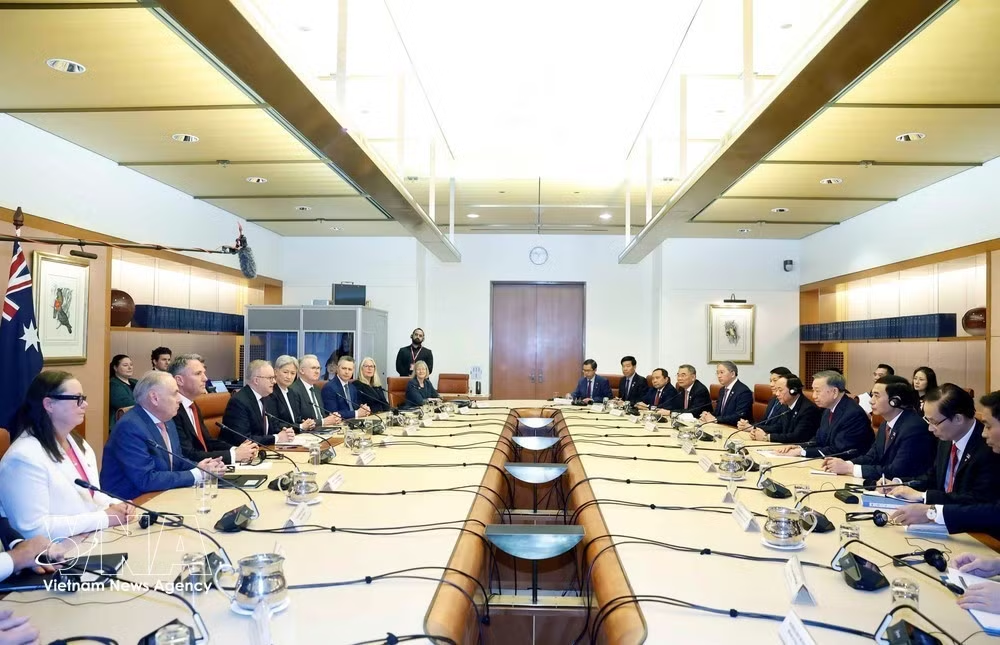
On regional and international issues, the two leaders agreed to strengthen coordination at multilateral forums, particularly the United Nations (UN), the Association of Southeast Asian Nations (ASEAN) and ASEAN-led mechanisms.
They called for promoting dialogue and trust-building, respecting international law and the UN Charter, ensuring maritime and aviation security, safety and freedom of navigation and overflight, and settling disputes by peaceful means on the basis of international law, including the 1982 UN Convention on the Law of the Sea (UNCLOS).
Vietnam affirmed its readiness to work with Australia to strengthen connectivity with Southeast Asia, uphold ASEAN centrality and contribute to a region of peace, stability, and sustainable and inclusive development.
Following their talks, the two leaders witnessed the signing and exchange of a number of cooperation documents in science and technology, innovation, the digital economy, education and training, and other fields. The two sides instructed ministries and sectors to urgently put the agreements into effect, translating high-level directions into concrete programmes, projects and results.
They also expressed their confidence that a foundation of political trust, increasingly aligned interests and new drivers of cooperation would usher Vietnam-Australia relations into a deeper phase of development, bringing practical benefits to the people and businesses of both countries, while making a positive contribution to peace, stability, cooperation and development in the Indo-Pacific and around the world./.