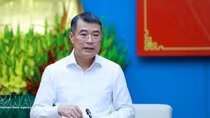
Deputy Minister of Foreign Affairs Dang Hoang Giang has reaffirmed Vietnam's commitment to advancing human rights after its re-election to the United Nations Human Rights Council for the 2026–2028 term, pledging to pursue priorities, including human rights amid climate change and digital transformation, gender equality, and the protection of vulnerable groups.
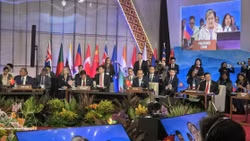
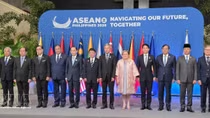
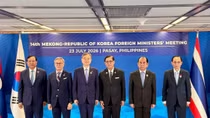
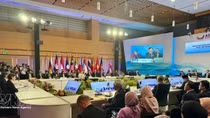
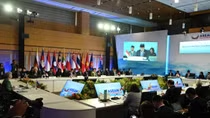
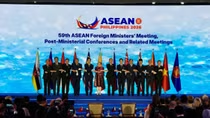
Giang, who is also head of the Vietnamese delegation to the ASEAN Senior Officials' Meeting (SOM), made the statement at an interface meeting between ASEAN foreign ministers and ASEAN Inter-Governmental Commission on Human Rights (AICHR) representatives in Manila, the Philippines on July 20, as part of the 59th ASEAN Foreign Ministers' Meeting (AMM-59) and relevant meetings from July 20-24.
He affirmed that Vietnam attaches importance to AICHR’s role in advancing regional human rights cooperation, stressing that it is a cross-sectoral and cross-pillar task demanding a comprehensive approach and close coordination with ASEAN's specialised bodies.
AICHR should continue to operate in accordance with the ASEAN Charter, the ASEAN Human Rights Declaration, and the bloc's established rules, procedures and principles, ensuring that regional human rights cooperation proceeds in a spirit of mutual trust and understanding, he said.
Vietnam looks forward to working closely with fellow ASEAN members to raise the bloc's voice and contribution to international human rights efforts, he said.
He also thanked ASEAN member states and AICHR representatives for backing the June AICHR workshop in Hanoi on raising awareness and sharing best practices on the promotion and protection of human rights at sea.
Participating ministers praised AICHR's positive contributions to the ASEAN Community building process, and the commission’s continued efforts to promote and protect human rights, work closely with ASEAN bodies to raise awareness of human rights across cooperation areas, advance the rights of women, children and those with disabilities, and respond to emerging issues in a timely manner, including the environment, the rights to development and peace, transnational crime, human trafficking, and online scams.
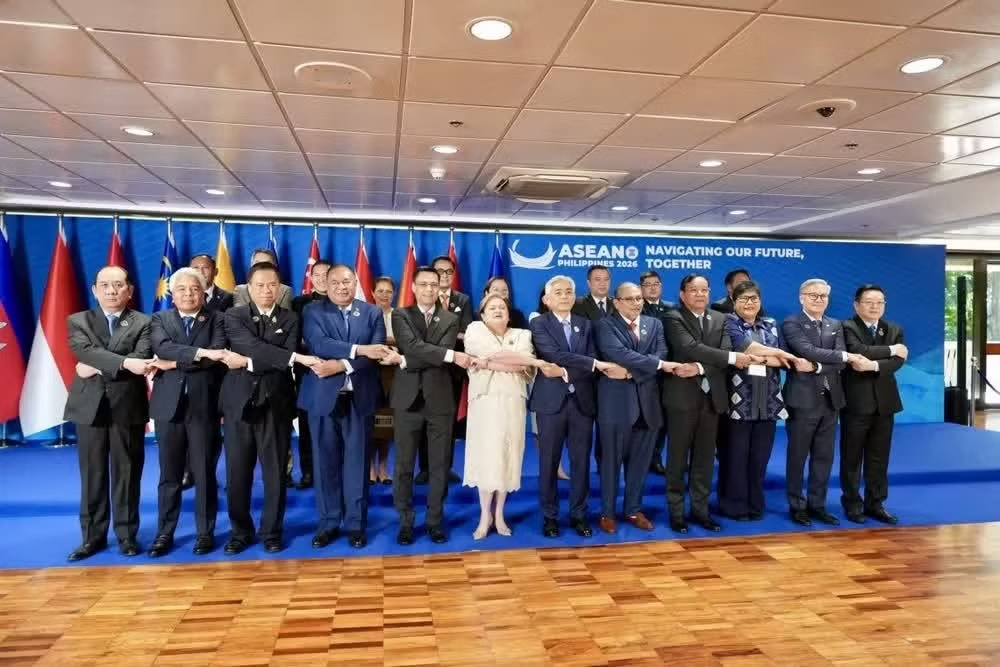
They mulled over AICHR's annual report for 2025–2026 and its Priority Agenda 2027, acknowledged first-year progress on the AICHR Work Plan 2026–2030, and the roadmap for realising the ASEAN Declaration on the Right to a Safe, Clean, Healthy and Sustainable Environment and the ASEAN Declaration on Promoting the Right to Development and the Right to Peace.
At the meeting of the Commission on the Southeast Asia Nuclear Weapon-Free Zone (SEANWFZ), Giang expressed concern over mounting strategic uncertainty and the increasingly prominent role of nuclear weapons in national security doctrines, warning that these trends are eroding strategic trust and heightening the risks of arms races and nuclear proliferation.
Against that backdrop, he stressed that the SEANWFZ Treaty reflects the Southeast Asia’s shared determination to prevent nuclear proliferation, reduce nuclear risks, and work toward the ultimate goal of a nuclear-weapon-free world, thereby making a meaningful contribution to global and regional peace and security. He called on ASEAN to fully and effectively follow the Treaty's Plan of Action, not only through actions supporting international peace and security but also strengthening cooperation on nuclear safety and emergency preparedness and response.
Giang also suggested ASEAN elevate its role and contribution to global nuclear disarmament and non-proliferation by establishing consultative relations and deeper cooperation with other nuclear-weapon-free zones. Such cooperation, he said, would facilitate the exchange of experiences, stronger collective advocacy for nuclear disarmament, reduced strategic risks, and better compliance with international non-proliferation norms.
On the occasion, he thanked ASEAN member states for their strong support and active contributions to Vietnam in its capacity as President of the 11th Review Conference of the Parties to the Treaty on the Non-Proliferation of Nuclear Weapons (NPT).
Ministers noted the progress on the 2023–2027 Plan of Action for the SEANWFZ Treaty. They also shared views on encouraging nuclear-weapon states to accede to the Treaty's Protocol, as well as possible cooperation with the Agency for the Prohibition of Nuclear Weapons in Latin America and the Caribbean (OPANAL) and the Central Asian Nuclear-Weapon-Free Zone (CANWFZ). They vowed to continue upholding ASEAN unity and common stance while promoting the Treaty's value and role at the global level.
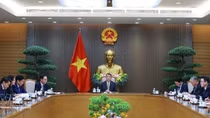
Earlier on July 19, senior officials met to prepare for the AMM-59, reaching broad consensus on the agenda and documents for ministerial approval, including a draft joint communiqué, joint ministerial statements with dialogue partners, and new action plans with ASEAN’s partners.
On July 21, ASEAN foreign ministers will continue their second working day with the opening ceremony, plenary and retreat of the AMM-59, followed by an expanded informal consultation on the implementation of the Five-Point Consensus on Myanmar.