Vietnamese community in Singapore urged to contribute to deeper bilateral ties

Standing member of the Secretariat Tran Cam Tu encouraged experts and intellectuals overseas to contribute knowledge and technology to the homeland's development.

Singapore (VNA) – Politburo member and Standing member of the Communist Party of Vietnam (CPV) Central Committee’s Secretariat Tran Cam Tu met with the Vietnamese Embassy staff and Vietnamese community in Singapore on August 24.
tai-xuong-4.png
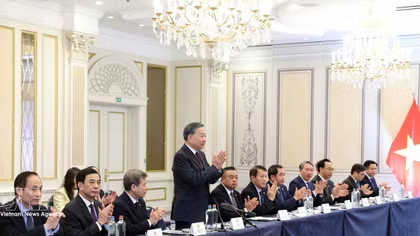
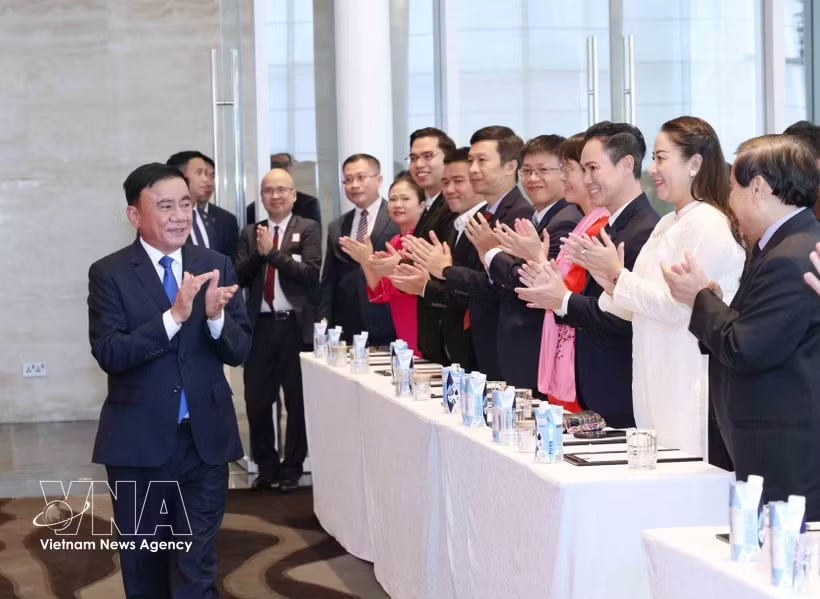
Politburo member and Standing member of the Communist Party of Vietnam Central Committee’s Secretariat Tran Cam Tu meets with the Vietnamese Embassy staff and Vietnamese community in Singapore on August 24. (Photo: VNA)

The activity formed part of his official visit to the city-state, during which he is set to co-chair the first Vietnam–Singapore Strategic Dialogue between the CPV and Singapore’s People’s Action Party (PAP).

Participants included many Vietnamese experts and intellectuals and working in Singapore.

Vietnamese Ambassador to Singapore Tran Phuoc Anh welcomed Tu and the high-ranking CPV delegation, saying bilateral relations have developed effectively across various fields. He described the visit as an important opportunity to further strengthen the Vietnam–Singapore Comprehensive Strategic Partnership.

He said embassy officials and staff have continued to focus on three key tasks, namely political and diplomatic work, community affairs, and Party affairs and internal solidarity, aiming to contribute to national construction and defence.

Reporting on the Vietnamese community in Singapore, the ambassador said Vietnamese expatriates remain closely connected with and strongly supportive of their homeland.

In coordination with the embassy, the community has organised various activities to promote people-to-people diplomacy and connect with partners in Vietnam in science – technology, innovation, education – training, digital transformation and start-up promotion, helping enhance cooperation between the two countries.

Prof. Dr Vu Minh Khuong of the Lee Kuan Yew School of Public Policy said the visit could open a major opportunity and become a model for bilateral and regional cooperation towards peace, prosperity and partnership.

Ta Thuy Lien, head of the liaison board of the Vietnamese community in Singapore, shared the community's experience in digital transformation and called the visit a major source of encouragement. She affirmed the community's desire to contribute its expertise and knowledge to the homeland's development and serve as a strategic link between Vietnamese people overseas and those at home.
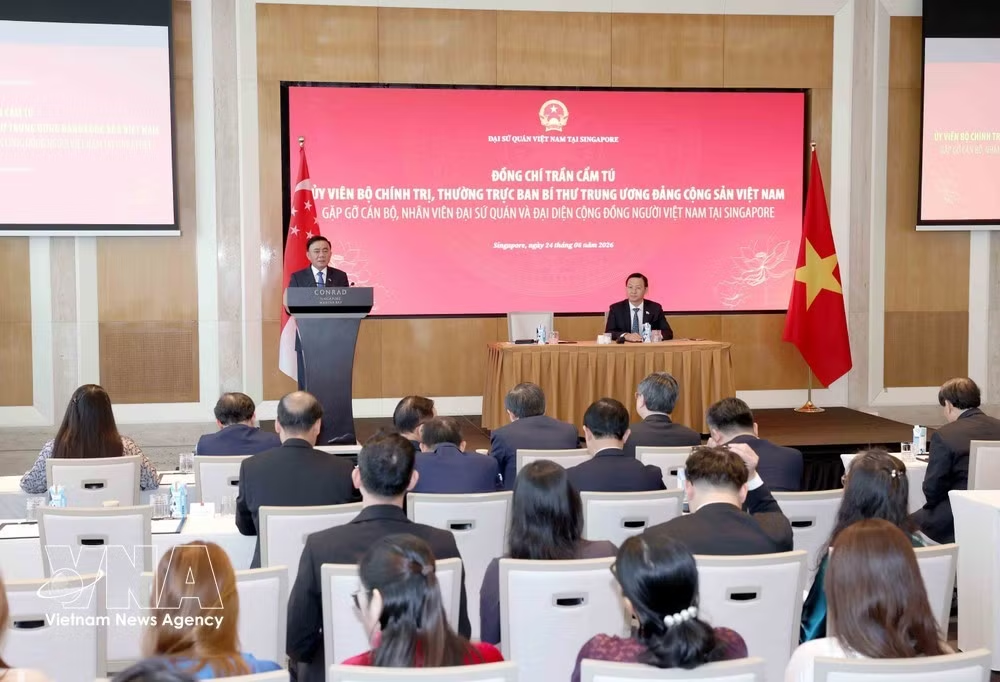
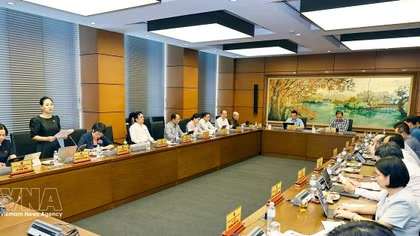
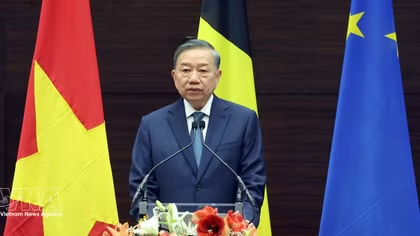
Politburo member and Standing member of the Communist Party of Vietnam Central Committee’s Secretariat Tran Cam Tu speaks at the meeting with the Vietnamese Embassy staff and Vietnamese community in Singapore on August 24. (Photo: VNA)

Expressing his pleasure at meeting the Vietnamese community, Tu said the visit reflects Vietnam's consistent policy of giving high priority to relations with neighbouring countries, including Singapore. It also aims to deepen ties between the CPV and PAP, thus strengthening the political foundation for comprehensive cooperation between the two countries' parties, states and peoples while further advancing the Vietnam–Singapore Comprehensive Strategic Partnership.

Updating the community on the domestic situation, he said Vietnam has passed one year of operating its two-tier local administration model. The reform has a broad scope and strategic significance, helping streamline the administrative apparatus, improve institutional frameworks and renew leadership and implementation methods.

He said the next priority is to improve the quality, capabilities and effectiveness of the new system, with a focus on institutional reform, decentralisation linked to resources and power control, better telecommunications and digital infrastructure, digital transformation across the political system, and development of a contingent of capable officials.

The leader also highlighted progress in implementing Politburo Resolution No. 57-NQ/TW on breakthroughs in science – technology development, innovation and national digital transformation.

Vietnam has identified 10 strategic technologies, 30 strategic technology products and 20 major national challenges, he said, adding that some Vietnamese businesses are gradually mastering technologies and developing products for both domestic and export markets.

However, bottlenecks remain in institutions, infrastructure, human resources and cybersecurity. The country will therefore focus more strongly on turning scientific and technological advances into concrete products and value, contributing to double-digit economic growth.

Tu noted that Singapore boasts strengths in these areas, and that the two sides have reached preliminary agreement on a Vietnam–Singapore technology connectivity strategy with specific projects.

The Standing member of the Secretariat welcomed the active role of the Vietnamese community liaison board in bringing Vietnamese expatriates together and preserving cultural identity. He encouraged experts and intellectuals overseas to contribute knowledge and technology to the homeland's development.

The Party and State always care for Vietnamese people abroad, considering them an inseparable part and an important resource of the nation, he affirmed.

Tu praised the Vietnamese Embassy staff in Singapore for their efforts and urged the embassy to further strengthen community affairs and links between Vietnamese expatriates and the homeland./.
VNA
en.vietnamplus.vn

Other News

16th NA wraps up first extraordinary session

16th NA wraps up first extraordinary session

Lawmakers passed 15 laws and six legal resolutions and gave first-round consideration to seven other draft laws. The session was aimed at clearing bottlenecks, fine-tuning the legal and institutional framework, accelerating decentralisation and delegation of authority, cutting administrative procedures, clearing barriers, unlocking resources, creating favourable conditions for citizens and businesses, and improving the effectiveness and efficiency of state management.

Lawmakers debate real estate, budget, nuclear project changes

Lawmakers debate real estate, budget, nuclear project changes

The draft revised real estate law is intended to turn Party and State guidelines into statute, codify tested resolutions that have been tested in practice, and shift power under the two-tier local administration model. It seeks to cut investment and business conditions, accelerate digital transformation, improve market transparency and predictability, strengthen market regulation, and clear practical bottlenecks to support a healthy property market.

Vietnam values relationship with US: Deputy Foreign Minister

Vietnam values relationship with US: Deputy Foreign Minister

Deputy Foreign Minister Dang Hoang Giang said Vietnam-US ties have maintained positive momentum following the February 2026 meeting between General Secretary of the Communist Party of Vietnam Central Committee and President To Lam and President Donald Trump, with regular exchanges and expanding cooperation across various fields.

Government proposes 30% income tax cut for small businesses

Government proposes 30% income tax cut for small businesses

The personal income tax payable for the 2026 and 2027 tax years is proposed to be reduced by 30% for resident individuals earning income from business activities, provided their annual revenue does not exceed 10 billion VND (about 383,600 USD).

National Assembly adds three items to agenda of first extraordinary session

National Assembly adds three items to agenda of first extraordinary session

The NA Standing Committee recommends adding three items to the agenda: separating the Ninh Thuan nuclear power project into independent projects; mechanisms and policies for sea-reclamation urban development projects to be incorporated into the draft Law on Urban Development; and a draft NA resolution on reducing personal income tax and corporate income tax for individuals and businesses.

Vietnam seeks to deepen strategic partnership with Kazakhstan

Vietnam seeks to deepen strategic partnership with Kazakhstan

Ambassador Nguyen Thanh Le affirmed that he will work closely with Kazakhstan’s Ministry of Foreign Affairs, ministries, agencies and localities to effectively implement high-level agreements, strengthen political trust and promote cooperation in trade, investment, transport and logistics, tourism, culture, education and people-to-people exchanges.

Amendments to Land Law aim to achieve three key goals

Amendments to Land Law aim to achieve three key goals

The Government has identified three major objectives: promptly institutionalising Party policies on land, private-sector development and national digital transformation; addressing urgent practical obstacles to unlock resources and support the goal of double-digit economic growth; and building a modern, streamlined and effective land management system through stronger decentralisation and administrative reform.

Draft laws must support management reform, stronger decentralisation: PM

Draft laws must support management reform, stronger decentralisation: PM

Participants looked into 11 draft laws and one draft resolution, including laws amending and supplementing several articles of laws on non-agricultural land use tax and corporate income tax; natural resources tax; securities; accounting and independent auditing; the Labour Code; and laws on archives, gender equality, Red Cross activities and employment.