77 years of Declaration of Independence - the will and aspiration of Vietnam

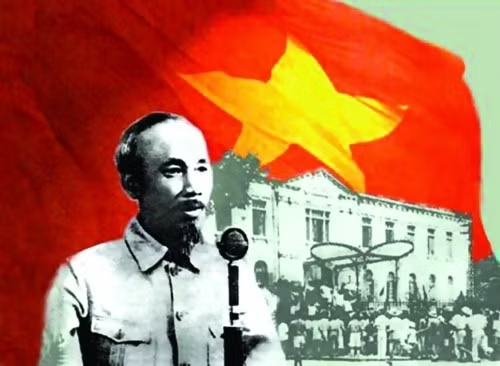
Seventy-seven years ago on September 2, 1945, at Ba Dinh Square, President Ho Chi Minh solemnly read the Declaration of Independence, proclaiming the birth of the Democratic Republic of Vietnam, now the Socialist Republic of Vietnam.

77 years of declaration of independence - the will and aspiration of vietnam picture 1

On September 2, 1945 President Ho Chi Minh read the Declaration of Independence, proclaiming the birth of the Democratic Republic of Vietnam, now the Socialist Republic of Vietnam.

The Declaration strongly demonstrates the true will and aspirations of Vietnamese people that they would rather sacrifice everything than lose the country and live as slaves. Although 77 years have now elapsed, the value of the Declaration of Independence remains fresh.

To begin with, President Ho Chi Minh quoted several immortal lines from the 1776 Declaration of Independence of the United States of America and the 1791 Declaration of the Rights of Man and Citizen of the French Revolution.

Referring to human rights as an inevitability for an independent country, meaning the right to live, to be free, and to pursue happiness, President Ho Chi Minh, with his wisdom, practical experience and revolutionary practices in Vietnam, cleverly developed an irrefutable thesis on the rights of citizens. Broadly, it means that all the peoples on earth are equal from birth, and they have the right to live, to be happy and free.

From the concept of a man to the concept of a nation, he affirmed that national rights and human rights have a dialectical relationship and clearly interact with each other. An independent nation is a prerequisite for ensuring human rights, and conversely the strong implementation of human rights is used in order to promote the noble value and true meaning of national independence.

Assessing the Declaration of Independence, Japanese Professor Singo Sibata said that, “Ho Chi Minh’s famous dedication is that he had developed the rights of people into the rights of the nation, that all peoples have the right to determine their own destiny.”

Therefore, the 1945 Declaration of Independence can be considered not only a declaration of independence by Vietnamese people, but also a declaration of human rights and the rights of subjugated peoples in their struggle against colonialism and imperialism. President Ho Chi Minh’s elevation of human rights to national rights can be viewed as his contribution to the ideology of human rights for humanity.

The right to national independence, the right to life, the right to liberty, and the pursuit of happiness represent the most fundamental values of human rights, although under the colonial and feudal systems previously enforced those rights were stripped and trampled upon.

Under the sound leadership of the Communist Party, Vietnamese people stood up to drive away colonialists, feudalists, and imperialists, wresting back independence, freedom, and human rights. Human rights in the country were not given by anyone, but instead come as result of the long struggle endured by the Vietnamese people. In his speech, President Ho Chi Minh declared, “The French have fled, the Japanese have capitulated, Emperor Bao Dai has abdicated. Our people have broken the chains which for nearly a century have fettered them and have won independence for the Fatherland. Our people at the same time have overthrown the monarchic regime that has reigned supreme for dozens of centuries. In its place has been established the present Democratic Republic.”

At the end of the Declaration of Independence, President Ho Chi Minh solemnly declared to the world, “Vietnam has the right to be a free and independent country - and in fact is so already. The entire Vietnamese people are determined to mobilize all their physical and mental strength, to sacrifice their lives and property in order to safeguard their independence and liberty.”

Through a rigorous and sharp argument, strong words, and persuasion encapsulated in over 1,000 words, the Declaration of Independence is a solid legal foundation that strongly affirms Vietnamese national sovereignty in front of the entire world. It lays the basis for the establishment of the rule of law in the country towards the goal of Independence-Freedom-Happiness. It illuminates the Vietnamese revolutionary path towards building a law-governed socialist state of the people, by the people and for the people, for the sake of a prosperous people, a strong country, democracy, justice, and civilization.
77 years of declaration of independence - the will and aspiration of vietnam picture 2

Under the leadership of the Communist Party of Vietnam, Vietnam has carried out the Doi Moi (Renewal) process and reaped remarkable achievements.

Despite 77  years having elapsed, President Ho Chi Minh’s views and thoughts reflected in the Declaration of Independence remain fresh in the present day during a period of national development and defence. Since then, Vietnamese people have constantly strived for human rights and have duly achieved positive and important results. People’s fundamental human rights in all areas, from politics to economics and social affairs are recognised, respected, protected, and guaranteed according to the Constitution and law. For its achievements, Vietnam was elected to the UN Human Rights Council for the 2014 - 2016 term.

The country’s position has changed a great deal since the Declaration of Independence was read in Hanoi 77 years ago. President Ho Chi Minh’s thoughts have served as the great source of spiritual strength for the entire nation, helping the entire Party, army, and people to overcome all difficulties and reap great achievements in the struggle for national reunification, socio-economic development, and international integration.

After more than 30 years since the implementation of the the Doi Moi (Renewal) process, Vietnam has escaped from underdevelopment and become a middle-income developing country with an average economic growth of 7% per year. The country’s Human Development Index (HDI) has gradually improved, ranking 118 out of 189 countries and territories worldwide, according to the statistics from 2019.

Furthermore, Vietnam has substantially expanded foreign relations and international integration to elevate its international prestige. It has so far established diplomatic relations with nearly 200 countries and territories around the world, actively built the ASEAN Economic Community and effectively joined numerous free trade agreements.

Whilst time may pass, the spirit of the 1945 Declaration of Independence will always live long in the hearts of generations of Vietnamese people, not only because of its historical and legal values that it sets out, but also because it contains the noble humane values of human rights.
VOV

Other News

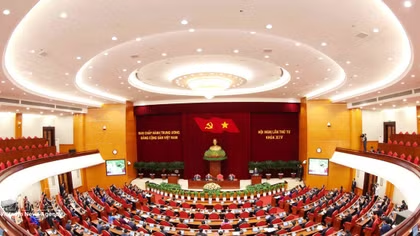
First working day of Party Central Committee's fourth plenum

First working day of Party Central Committee's fourth plenum

Delegates held group discussions on the CPV Central Committee resolution calling for stronger building and rectification towards a clean, strong and comprehensive Party and political system able to meet the country's development needs in the new era.

Key Party leader hosts Hungarian Workers' Party chief

Key Party leader hosts Hungarian Workers' Party chief

The Communist Party of Vietnam always values its solidarity and friendship with the Hungarian Workers' Party and communist and workers' parties worldwide, which helps build political trust and supports Vietnam's relations with other countries, said key Party leader Tran Cam Tu.

14th Party Central Committee convenes fourth plenum

14th Party Central Committee convenes fourth plenum

In his opening remarks, General Secretary and President To Lam said that the 14th National Party Congress set out major orientations and strategic goals, while the second and third plenums adopted important policies on Party building, personnel, development and national defence. The fourth plenum must focus on creating conditions for effective implementation while preparing the theoretical, organisational and human resources foundations for the country’s long-term development.

Panamanian President's Vietnam visit offers new opportunity to deepen bilateral ties

Panamanian President's Vietnam visit offers new opportunity to deepen bilateral ties

Vietnamese Ambassador to Mexico and Panama Nguyen Van Hai noted that the visit is particularly significant as the first high-level exchange between the two countries in nearly 15 years, following then-President Ricardo Martinelli’s visit to Vietnam in 2012, and came shortly after the 50th anniversary of diplomatic relations in 2025.

Vietnam and Panama can become gateways linking two regions

Vietnam and Panama can become gateways linking two regions

"Panama can serve as a strategic platform for Vietnamese companies seeking greater access to Latin America and the Caribbean, while Vietnam represents an important gateway for strengthening Panama’s engagement with Southeast Asia", Ambassador Nubiela Ayala Modes confirmed.

Localities committed to achieving 2026 growth targets

Localities committed to achieving 2026 growth targets

Localities nationwide hailed effective and flexible directions delivered by the Government so far this year, resulting in positive nine-month socio-economic growth, and reaffirmed their commitment to achieving targets set for the whole 2026 at an online Government-locality conference on October 3.

Creating new drivers for Vietnam-Canada cooperation

Creating new drivers for Vietnam-Canada cooperation

The elevation of bilateral ties to a Strategic Partnership shows that Vietnam and Canada increasingly view each other not simply as trading partners, but as long-term partners in addressing economic, technological and regional challenges.

Top leader asks for sports development to build national strength

Top leader asks for sports development to build national strength

The top leader applauded the efforts of ministries, sectors, localities, social organisations, coaches, athletes, experts in developing physical education and sports in recent times, stressing that Resolution No. 08 has provided an important political foundation for sports development over the past 15 years, while Conclusion No. 70 set important orientations for the new period.

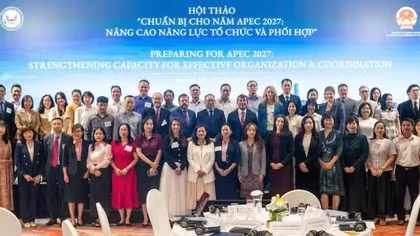
Vietnam mobilises resources to affirm its leadership role in APEC 2027

Vietnam mobilises resources to affirm its leadership role in APEC 2027

PSNews - Vietnam is recognised by its partners as an influential member of the Asia-Pacific Economic Cooperation (APEC) forum, with expectations that it will continue to demonstrate leadership when it hosts APEC for the third time in 2027, according to Standing Deputy Minister of Foreign Affairs Nguyen Minh Vu.

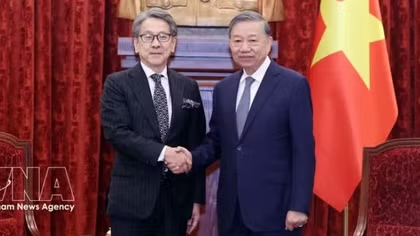
Top Vietnamese leader receives Chairman of Japan Bank for International Cooperation

Top Vietnamese leader receives Chairman of Japan Bank for International Cooperation

General Secretary and President Lam urged JBIC to continue promoting the substantive implementation of projects under the Asia Zero Emission Community (AZEC), and step up discussions on potential cooperation within the framework of the POWERR Asia (Partnership on Wide Energy and Resources Resilience Asia) initiative, including the development of strategic energy reserves.

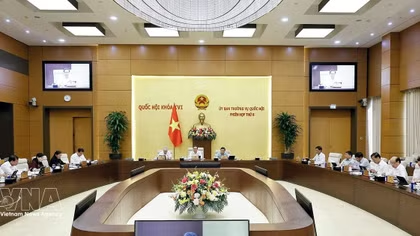
NA, Government's Party committees meet on legislature's second session agenda

NA, Government's Party committees meet on legislature's second session agenda

National Assembly President Tran Thanh Man coordination must go beyond finishing the agenda to improve the quality of NA decisions and Government enforcement; deal with policies rather than just paperwork, especially in the fight against corruption and other negative phenomena; and pin down final responsibility for each product, not just progress.

Prime Minister receives Cambodian Minister of Inspection

Prime Minister receives Cambodian Minister of Inspection

Prime Minister Le Minh Hung asked the two countries' inspection agencies to build on their achievements by regularly exchanging information and experience, maintaining delegation exchanges, and coordinating inspections in areas related to bilateral economic, trade and investment cooperation.