AFF 2026 marks Vietnam's transition from participant to regional agenda-setter

With sharp strategic mindset and a proven capacity for practical action at both bilateral and multilateral levels, Vietnam has demonstrated its role as a builder and agenda-setter, contributing to a robust platform for dialogue and cooperation in pursuit of a resilient, peaceful, and truly people-centred ASEAN Community by 2045

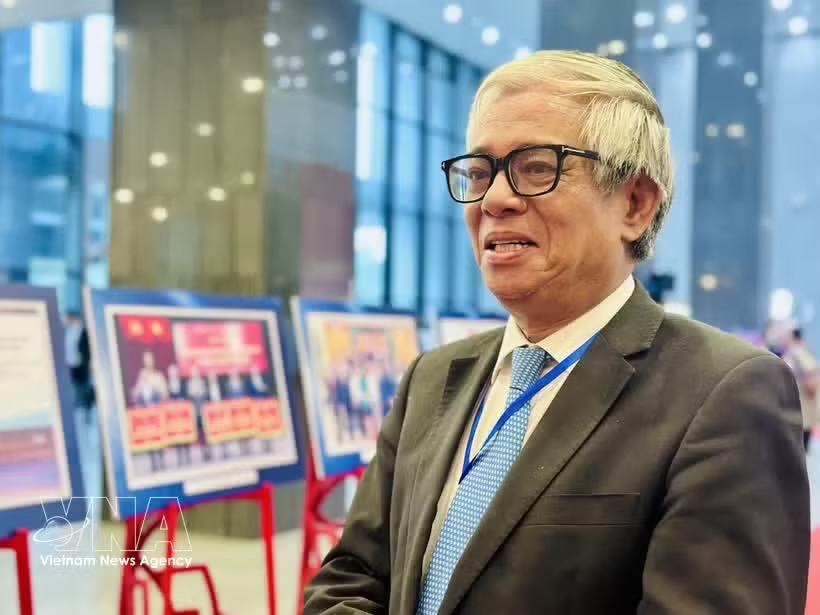
Hanoi (VNA) – The third ASEAN Future Forum (AFF) 2026 underscored Vietnam’s evolving role in ASEAN, reflecting its transition from a participant to a proactive contributor helping shape the region’s future, while generating strong synergies between multilateral and bilateral diplomacy, according to former Deputy Minister of Foreign Affairs Ambassador Pham Quang Vinh.
3.jpg
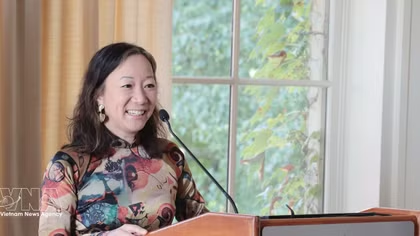
Former Deputy Minister of Foreign Affairs Ambassador Pham Quang Vinh. (Photo: VNA)

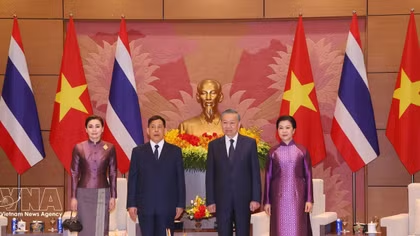
AFF 2026 concluded not only as a pivotal multilateral event for the region, but also as a gathering combined with the official visits to Vietnam by the Prime Ministers of Laos, Cambodia, Thailand, and Timor-Leste.

Vinh said ASEAN is facing a dual challenge - implementing the ASEAN Community Vision 2045, and responding to pressing issues such as supply chain disruptions, artificial intelligence (AI) governance, and the transition towards green and digital development models. In this context, he stressed, no country can effectively address these challenges alone, making intra-bloc cooperation more important than ever.

Reflecting on Vietnam’s integration process, he noted that AFF 2026 demonstrated the country’s growing confidence and leadership within ASEAN. He said Vietnam’s vision is increasingly guided by three priorities - peace as the foundation, prosperity as momentum, and people as the ultimate goal.

To translate those ambitious goals into reality, ASEAN as a whole must undergo a fundamental shift in mindset, he said.

Dr. Dao Ngoc Bau, Director of the Institute of Politics and International Relations under the Ho Chi Minh National Academy of Politics, said a series of first-time initiatives at AFF 2026 reflected ASEAN’s shift from a largely top-down model toward multi-stakeholder and multi-layered regional governance.

For the first time, Vietnam initiated a dialogue of Southeast Asian political parties and the ASEAN Cities Leaders Conference, expanding regional discussions beyond governments. The initiatives created new channels for political consultation, policy coordination and practical cooperation on emerging issues such as AI governance, urban development and Mekong sub-regional connectivity.

Bau said the political parties dialogue could help build trust and reduce misunderstandings among regional political actors, while strengthening ASEAN’s strategic autonomy amid growing geopolitical competition. Meanwhile, the city leaders conference brought local governments into regional policymaking, enabling greater cooperation on urbanisation, digital transformation and environmental sustainability.

Jonathan Wallace Baker, UNESCO Representative to Vietnam, praised Hanoi’s pioneering role in organising the ASEAN Cities Leaders Conference, noting that with nearly 70% of ASEAN’s population expected to live in urban areas in the coming decades, networks connecting cities to share experience in governance, digital transformation, and environmental protection will become increasingly important.

This multi-layered shift is also the key to turning the “people-centred” principle into a tangible reality. According to Bau, by creating discussion channels ranging from political parties debating social welfare and inequality, and city leaders addressing transport, housing and climate change, to youth forums, ASEAN is bringing citizens directly into the process of shaping policy priorities rather than merely implementing them. This represents a transformative shift from “making policies for the people” to “making policies with the people”.

Dr. Nguyen Hung Son, President of the Diplomatic Academy of Vietnam, which was tasked with organising the forum, said this year’s event had successfully achieved its objective of creating an open platform that brought together a wide range of stakeholders. According to him, the forum generated practical and innovative ideas to help the region address emerging challenges and advance towards a future marked by political stability, economic prosperity and a people-centred approach.

Beyond the multilateral agenda, AFF 2026 gained additional significance from the presence of four ASEAN leaders in Hanoi, underscoring strong political trust in Vietnam and opening new opportunities for cooperation.

Dr. Bau observed that the presence of the PMs of Laos, Cambodia, Thailand and Timor-Leste in Hanoi sent a clear diplomatic message about the exceptionally high level of political trust among regional partners. He described this as a rare opportunity to translate shared priorities into concrete agreements, while enabling Vietnam to advance its vision of linking the development space of the Mekong sub-region with the ASEAN Community Vision.

The convergence of multilateral engagement and bilateral diplomacy demonstrated Vietnam’s growing capacity to connect regional vision with practical cooperation. Strategic trust at the bilateral level provides a solid foundation for Vietnam and its neighbours to jointly shape common policies and decisions within ASEAN.

As highlighted by Prime Minister Le Minh Hung in his keynote address at AFF 2026, Vietnam and ASEAN are undergoing a strategic shift in mindset — from merely participating in global trends to helping shape them. ASEAN can no longer remain simply a manufacturing hub or a consumer of technology, it must emerge as a centre of innovation.

Through strategic vision and a strong capacity for practical action at both the bilateral and multilateral levels, Vietnam has demonstrated its role as a proactive contributor and agenda-setter, helping build a robust platform for dialogue and cooperation. In doing so, it is working alongside regional partners towards an ASEAN Community 2045 that is resilient, peaceful and truly centred on its people.

With sharp strategic mindset and a proven capacity for practical action at both bilateral and multilateral levels, Vietnam has demonstrated its role as a builder and agenda-setter, contributing to a robust platform for dialogue and cooperation in pursuit of a resilient, peaceful, and truly people-centred ASEAN Community by 2045./.
en.vietnamplus.vn

Other News

Top leader hands over appointment decisions to two Vietnamese ambassadors

Top leader hands over appointment decisions to two Vietnamese ambassadors

Amid a rapidly changing and complex world, the top leader asked the diplomatic sector, particularly ambassadors, to remain steadfast in principles while being flexible in tactics, maintain independence and self-reliance, proactively safeguard national interests, and seek new advantages and opportunities for the country while contributing to common peace and development.

National Defence Academy must become top military think-tank: PM

National Defence Academy must become top military think-tank: PM

The National Defence Academy must track global and regional developments closely, accurately size up partners and rivals, and stay ahead of changes in the international security environment. It should produce practical output, such as strategic forecasts, early warning and policy proposals, and absorb global military advances and technology without copying foreign models outright.

VUFO must focus on building networks for mobilising resources: Top leader

VUFO must focus on building networks for mobilising resources: Top leader

General Secretary and President To Lam expressed his confidence that VUFO will truly become a sharp and effective spearhead, proactively building trust, turning trust into resources and, through concrete actions, contributing to the country’s breakthrough development in the new era of national rise

Key leader highlights important tasks in Party building

Key leader highlights important tasks in Party building

The Party building covers four key areas: political, ideological and ethical work, and organisation and personnel. These areas are closely interconnected and together form a unified whole that determines the Party’s strength and its ability to lead the revolutionary cause.

Thai King, Queen arrive in Hanoi for State visit to Vietnam

Thai King, Queen arrive in Hanoi for State visit to Vietnam

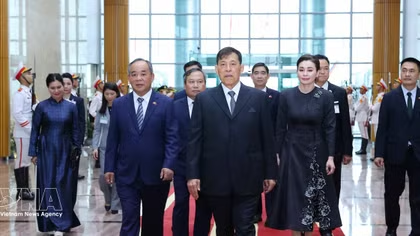
The State visit to Vietnam by King of Thailand Maha Vajiralongkorn Phra Vajiraklaochaoyuhua and Queen Suthida Bajrasudhabimalalakshana holds not only political significance but also serves as a continuation of the friendship and close ties between the Thai Royal Family, Government and people and the Vietnamese Government and people.

Vietnam attaches importance to promoting friendly relations, cooperation with Burundi: PM

Vietnam attaches importance to promoting friendly relations, cooperation with Burundi: PM

Thanking President Ndayishimiye and the Burundi Government for supporting the effective operation of Lumitel, the telecommunications joint venture of Vietnam’s Viettel Group in Burundi, Prime Minister Le Minh Hung proposed that Burundi continue facilitating Lumitel’s participation in e-government and digital transformation projects, while enabling it to expand investment and business activities, making it a symbol of bilateral cooperation.

PM Le Minh Hung wraps up working trip to India

PM Le Minh Hung wraps up working trip to India

​The working trip reaffirmed Vietnam's foreign policy of proactive and active integration into the world, and multilateralisation and diversification of external relations. It also helped to strengthen ties with partners, broaden avenues for cooperation, and enhance Vietnam's role and standing at regional and global multilateral mechanisms.

Vietnam seeks effective, substantive ties with Saudi Arabia

Vietnam seeks effective, substantive ties with Saudi Arabia

Affirming that Saudi Arabia is one of Vietnam’s most important partners in the Middle East, PM Hung expressed his pleasure at the positive development of bilateral relations in recent years, and voiced his wish to work with Saudi Arabia to further develop the bilateral relationship in a more effective and substantive manner, for the benefit of the two countries' people.

Vietnamese PM Le Minh Hung attends 18th BRICS Summit in New Delhi

Vietnamese PM Le Minh Hung attends 18th BRICS Summit in New Delhi

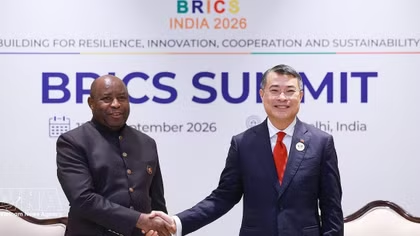
Vietnam's own development model centres on people, institutional reform, modern governance and science and technology, while ensuring harmony among economic growth, social equity and environmental protection, PM Hung said, affirming that Vietnam stands ready to work with BRICS in a spirit of responsibility, goodwill and substantive cooperation to create a peaceful, prosperous, sustainable and inclusive future for all countries and people.

Prime Minister meets with staff of Vietnamese representative agencies, community in India

Prime Minister meets with staff of Vietnamese representative agencies, community in India

At a meeting with staff of the Vietnamese Embassy and representative agencies in New Delhi on September 13, PM Hung said that officials and employees working overseas must firmly grasp the Party’s new mindset and policies on foreign affairs as well as overseas Vietnamese affairs, including the Politburo's Resolution No. 23-NQ/TW on overseas Vietnamese.

PM Le Minh Hung calls on WTO to continue support for Vietnam

PM Le Minh Hung calls on WTO to continue support for Vietnam

Vietnam actively and responsibly participates in the WTO’s agenda and supports its coordinating role in promoting inclusive and balanced global trade for peace, cooperation and development, while effectively responding to global challenges, said Prime Minister Le Minh Hung.

Prime Minister holds talks with Indian counterpart

Prime Minister holds talks with Indian counterpart

Vietnam and India are among the world's fastest-growing economies and have highly complementary strengths, with substantial untapped potential for cooperation. They expressed determination to step up measures to achieve the target of 25 billion USD in bilateral trade at an early date and facilitate market access for products from both countries, particularly pharmaceuticals, agricultural products, fisheries and livestock products.