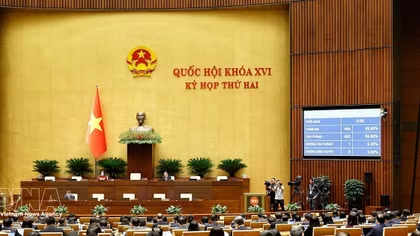
Hanoi (VNA) – The 16th National Assembly (NA) on November 13 passed the Law on amendments and supplements to several articles of the Law on Commerce, Law on Competition, Law on Foreign Trade Management and Law on Protection of Consumer Rights, with 458 out of 460 deputies voting in favour.

Before the vote, Minister of Industry and Trade Le Manh Hung, on behalf of the Government, reported on the incorporation and explanation of feedback from the NA’s Standing Committee, the NA Committee for Economic and Financial Affairs and lawmakers.
The amendments aim to address institutional bottlenecks, strengthen decentralisation, streamline administrative procedures and business conditions, promote fair competition and protect consumer rights, while meeting management requirements amid the development of the digital economy and the two-tier local administration model.
Regarding the Law on Commerce, the Government revised provisions on State monopoly to ensure transparency and define its scope and duration.
In the defence and security sector, which has specific characteristics, the goods and services subject to monopoly, as well as the areas in which such monopolies apply, shall be determined by the Ministers of National Defence and Public Security.
For the Law on Competition, the revised provisions establish differentiated statutes of limitations for handling violations: five years for serious competition-related offences, including anti-competitive agreements, abuse of dominant market positions and economic concentration violations, and one year for other violations. The amendments also clarify enforcement procedures and remedies.
Regarding the Law on Foreign Trade Management, the revisions clarify responsibilities for issuing certificates of origin (C/O). The Ministry of Industry and Trade will oversee origin management and operate a centralised online electronic certification system, while provincial-level authorities will certify the origin of exported goods and the Ministry of Finance will handle imported goods in accordance with international treaties.
Amendments to the Law on Protection of Consumer Rights require businesses to obtain consumers’ clear consent for each purpose and scope of personal information collection and use. Consumers must also be able to withdraw their consent and must not be required to provide information unnecessary for transactions. The revised law clarifies responsibilities of commune- and provincial-level authorities under the two-tier local administration model.
Minister Hung said cases involving multiple localities, complicated matters or digital platforms will be handled through coordination between provincial agencies and relevant ministries.
The law will take effect on July 1, 2027, while several provisions repealing parts of the Law on Commerce will become effective on January 1, 2028, allowing time for transition.
Earlier the same afternoon, the National Assembly unanimously approved adjustments to the agenda of its second session, with all 444 deputies present voting in favour./.