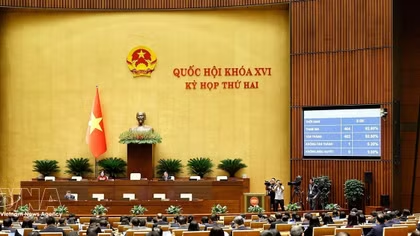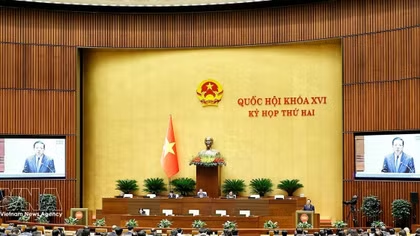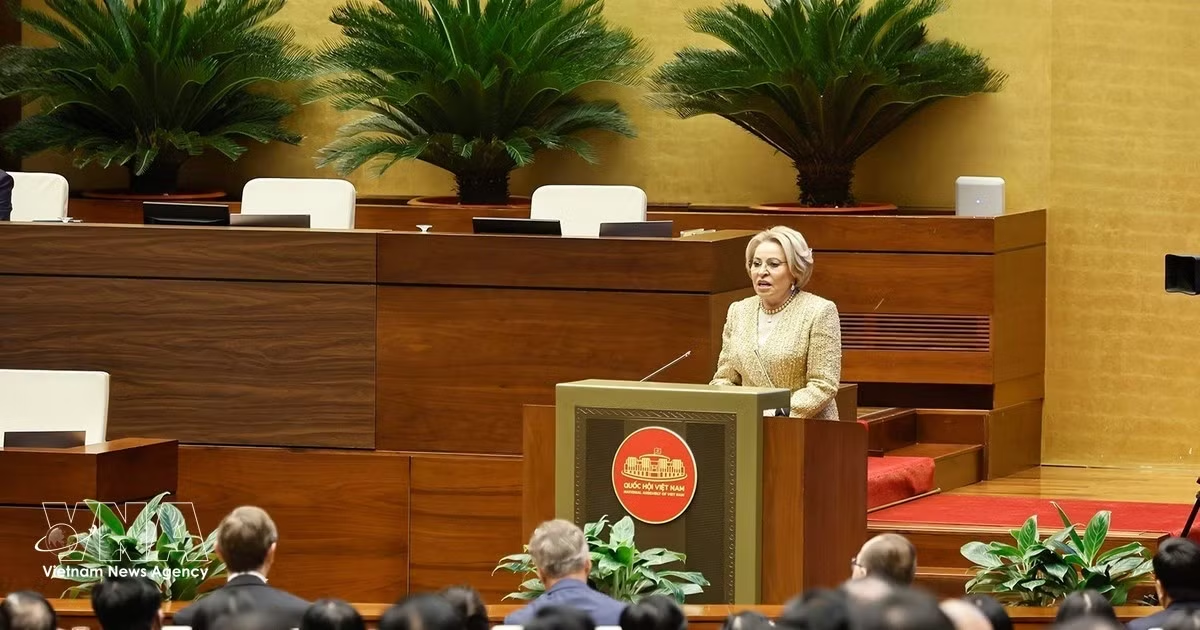
Hanoi (VNA) – Chairwoman of the Federation Council of the Federal Assembly of Russian Valentina Matviyenko delivered a speech at a plenary session of the Vietnamese National Assembly (NA) in Hanoi on November 13 as part of her official visit to Vietnam.
Opening her address, Matviyenko highlighted the historical bonds between the two countries, whose people are united by shared traditions and a time-tested sense of comradeship.
She affirmed that President Ho Chi Minh laid the foundations for this longstanding friendship, noting a monument to the late leader was inaugurated in 2023 in Saint Petersburg, her hometown. Reviewing bilateral relations, Matviyenko noted that 25 years ago, in 2001, President Vladimir Putin made his first official visit to Vietnam, during which the Joint Declaration on Strategic Partnership was signed.
In 2012, the relationship was elevated to a Comprehensive Strategic Partnership. The two countries have consistently maintained regular political dialogue at high and highest levels. The highlight of this year was the state visit to Russia by General Secretary of the Communist Party of Vietnam Central Committee and President To Lam in September 2026, during which a number of important cooperation documents were signed in the fields of energy, education, and science.
On parliamentary cooperation, Matviyenko recalled that the first visit by Vietnamese NA deputies to the Soviet Union took place 70 years ago. Today, inter-parliamentary relations are expanding actively and becoming increasingly substantive. Following her meeting with NA President Tran Thanh Man in Moscow in 2024, a new cooperation agreement between the Federation Council and Vietnam's National Assembly was signed.
Russia recognises the significance of Vietnam becoming a BRICS partner country in 2025 and highly values its contributions within ASEAN, including to the development of Russia-ASEAN dialogue.
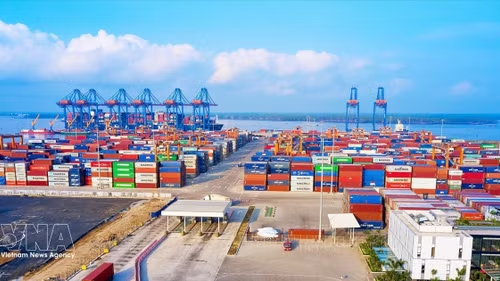
In terms of economic and trade cooperation, the Russian Federation Council Chairwoman expressed her expectations for growth over the full year of 2026. A key driver of this growth is the Free Trade Agreement between the Eurasian Economic Union and Vietnam, the first agreement signed between the union and a country outside the bloc, which took effect in 2016.
Regarding investment, Matviyenko said joint ventures in oil and gas, agro-industry and various other sectors are operating effectively. Examples include the production of dairy products in Kaluga Region with the participation of Vietnamese businesses, and oil extraction by the Rusvietpetro joint venture in the Nenets Autonomous Okrug.
In the energy sector, she highlighted an agreement signed by the heads of government of the two countries in March this year on the construction of the Ninh Thuan 1 nuclear power plant based on Russian design. The Nuclear Science and Technology Research Centre under construction in Vietnam is also an important joint project in the peaceful use of atomic energy.
On education, culture, tourism and local cooperation, the Russian leader said tens of thousands of Vietnamese people have received training at Russian educational institutions, with many now holding senior positions in Vietnam. More than 3,000 Vietnamese students and postgraduate researchers are currently studying in Russia, while over 500 agreements between scientific and educational institutions in the two countries remain in force.
In the fields of sanitary, epidemiological and biological safety, the leaders of the two countries have inaugurated a laboratory in Hanoi for research into and prevention of infectious diseases. In the cultural sphere, Vietnam is set to host a major cultural project entitled “Russian Seasons” next year.
In tourism, Vietnam welcomed nearly 700,000 Russian visitors in 2025, and the figure already exceeded 800,000 in the first six months of 2026. Matviyenko said the development of direct air routes and the simplification of visa procedures remain important drivers.
She noted that the Russian President signed a decree granting Vietnamese citizens visa-free entry to Russia for one year, until October 15, 2027, with a maximum stay of 30 days. She described this as a good opportunity to promote cultural exchanges and strengthen friendship between the people of the two countries.
She stressed that a solid foundation for Russia-Vietnam cooperation lay in active exchanges among their localities, including cooperation councils between Moscow and Hanoi, and between Saint Petersburg and Ho Chi Minh City.
Concluding her address, Matviyenko expressed her belief that Russia-Vietnam friendship will grow ever stronger and bring prosperity to the people of both countries. Quoting the Vietnamese proverb “A journey of a thousand miles broadens one's knowledge”, she said she is confident that the two countries will continue on the right path and achieve new milestones together.