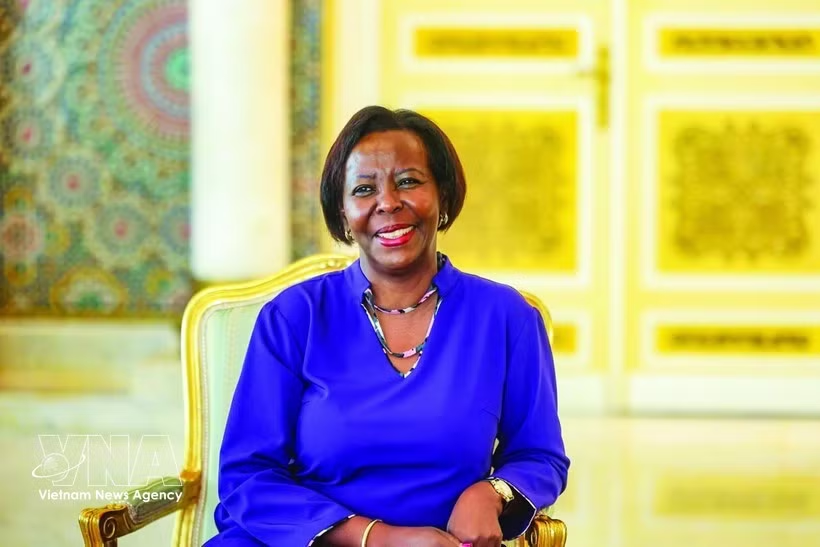
Hanoi (VNA) – Secretary-General of the International Organisation of La Francophonie (OIF) Louise Mushikiwabo has praised Vietnam's commitment to the community and expressed her hope that the country will help give Asia a stronger voice at Francophone forums.
In an editorial released ahead of the 20th Francophonie Summit, scheduled for November 15–16 in Phnom Penh, Cambodia, Mushikiwabo highlighted the significance of the 7th Francophonie Summit in Hanoi in 1997, which she described as a milestone that laid the foundation for the modern Francophone community.
She wrote that Hanoi changed the destiny of the Francophone community in November 1997. At the 7th Summit, leaders created the position of Secretary-General, giving the Francophone community a political face. At Vietnam's initiative, they also placed economic cooperation on the agenda for the first time.
“The modern Francophonie, political and focused on the economy, was born in Asia,” she wrote.
Nearly 30 years later, the community will return to the region when Cambodia hosts the 20th Francophonie Summit, the first to be held in the country.
While many still see the Francophone community primarily as an association dedicated to preserving the French language, its activities today extend far beyond that mission, Mushikiwabo noted.
")
Since 2020, the OIF has helped nearly 100,000 women create or develop economic activities, trained thousands of young people annually in digital professions, and supported members in combating misinformation. It has also helped one million people register in their countries' civil registries, enabling them to access education, healthcare and other essential services.
According to the Secretary-General, Vietnam recognised early the value of this practical Francophone community. It hosts the OIF Regional Office for Asia and the Pacific in Hanoi and the Regional Centre for Francophone Education in Asia-Pacific (CREFAP) in Ho Chi Minh City.
The country previously chaired the Economic Commission, responsible for developing the Francophonie's Economic Strategy for the 2020–2025 period. In March 2022, Vietnam and Cambodia jointly hosted the OIF's first economic and trade mission, bringing together businesses from Africa, Europe, the Americas and the Indian Ocean region in Ho Chi Minh City, Hanoi and Phnom Penh. A return mission followed in 2025.
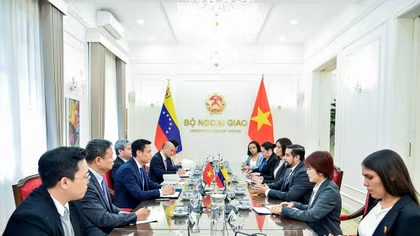
Mushikiwabo said that Minister of Foreign Affairs Le Hoai Trung, during their meeting in March 2026, proposed stronger cooperation in science, digital technology, culture and education.
Initial results have already been achieved. Under the Destination Eco-Talents project, more than 2,000 young Vietnamese people, most of them women, have explored career opportunities in sustainable tourism, with nearly 680 receiving training. Meanwhile, the La Francophonie avec Elles fund has helped hundreds of Vietnamese women launch or strengthen businesses.
The theme of the Phnom Penh Summit is “Investing in Peace for Shared Prosperity and Lasting Stability”, which carries particular meaning for Southeast Asia, she said.
Cambodia and Vietnam have overcome decades of hardship and understand that peace must be followed by reconstruction. Vietnam's experience in poverty reduction, education and digital transformation could offer valuable lessons for OIF members in Africa, the Caribbean, the Middle East and Eastern Europe.
According to the report “The French Language in the World 2026”, French has 396 million speakers and has become the world's fourth most spoken language. For Vietnamese students and professionals, proficiency in French opens access to universities, markets and career opportunities across five continents.
As Vietnam enters a new era of national rise, its open diplomacy carries increasing weight in OIF discussions, Mushikiwabo said.
“In 1997, Hanoi gave a face to the Francophone community. In 2026, Vietnam can help amplify its voice even further,” she concluded.