American female photographer teaches photography through General Giap’s portraits

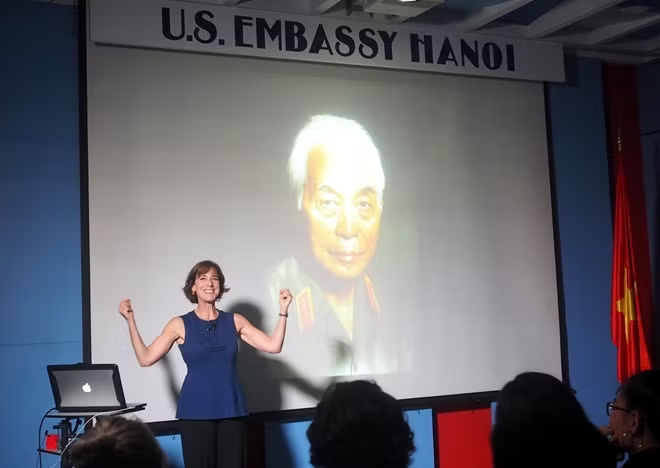
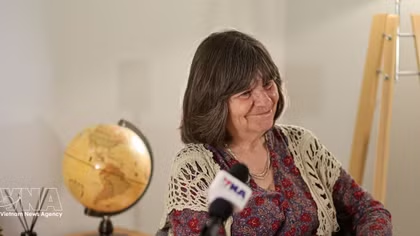
PSNews – As a famous American photographer with General Vo Nguyen Giap's portrait named "Snow-covered Volcano", Catherine Karnow came back to Hanoi in October and chaired a workshop at American Center, with the aim of sharing her experiences and techniques in photography with Vietnamese photographers and young people, through General Giap's portraits.
Catherine Karnow sharing experiences about photography skills during her presentation at American Center.
Catherine Karnow sharing experiences about photography skills during her presentation at American Center. 

During her presentation themed "Photographing People" at American Center (Hanoi), Catherine Karnow shared with participants about amazing stories behind her photos as well as analyzed the techniques which she used in each case. Particularly, with General Giap's portrait "Snow-covered volcano", she emphasized that photographers should attach importance to natural light and emotion of subject.

Providing tips for photographing people, Catherine said: “The most important thing is to emit a positive vibe and approach your subject as a person, not as a camera. Let their first impression be your smiling face, not a big fat lens. And ask permission to shoot when you feel that is appropriate”.

American photographer Catherine Karnow has been shooting in Vietnam since 1990.
American photographer Catherine Karnow has been shooting in Vietnam since 1990. 

With her experiences, she suggested that when travelling to foreign countries, photographers should learn to say a few positive words like beautiful and wonderful. “Continue to speak encouraging words to make them feel good while you are photographing them”, said Catherine.

To erase the barrier between photographer and subject, photographers should not use a long lens from across the street. Just sit down to make friends with people, hang out. If you socialize with people, your subjects will be at ease.
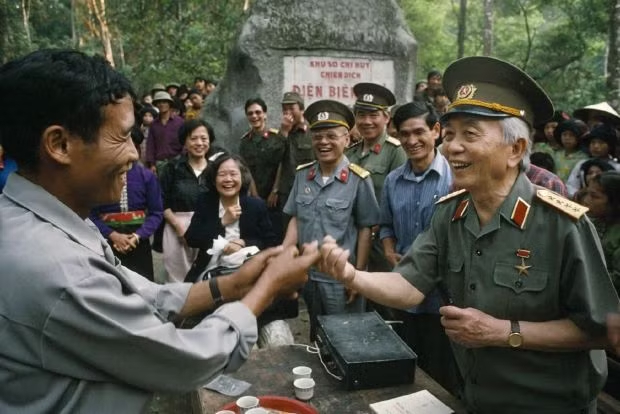
General Giap greets villagers, photo by Catherine Karnow in 1994.
General Giap greets villagers, photo by Catherine Karnow in 1994. 
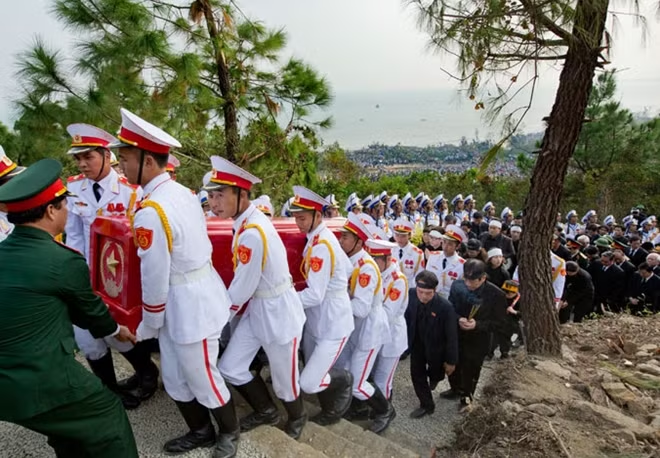
In 2013, she was the only foreigner to photograph up close the funeral and burial of General Giap. "BURIAL OF GENERAL VO NGUYEN GIAP, 2013 – General Giap's coffin is transported to the burial site in Quang Binh province, chosen not because it was his birthplace, but because the site was deemed auspicious, beautiful and fated correct".
In 2013, she was the only foreigner to photograph up close the funeral and burial of General Giap. "BURIAL OF GENERAL VO NGUYEN GIAP, 2013 – General Giap's coffin is transported to the burial site in Quang Binh province, chosen not because it was his birthplace, but because the site was deemed auspicious, beautiful and fated correct". 
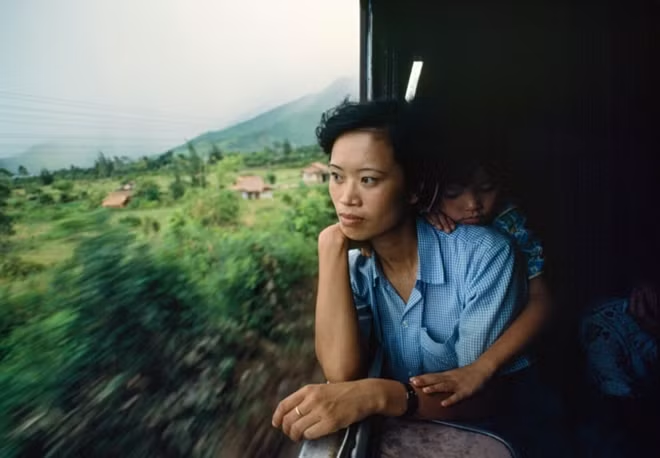
One of Catherine's favorite photos that she took in Vietnam. "WOMAN ON THE TRAIN, 1990 – In Central Vietnam, Tran Thi Diep, a schoolteacher from Hanoi, rides the Ho Chi Minh City-Hanoi train, also known as the Reunification Express".

“Additionally, show them the photos on the back of the screen and get someone else to photograph you and them together or let them photograph you. Later, email them the photos. If they don’t do email, send them prints. Maybe this last step seems like a huge hassle, but it is worth it. It can make someone so very happy”, shared Catherine.

Sending a message to young Vietnamese people who love photography, Catherine underscored: “Just follow your passion but don’t forget the business side of it. Equipment is secondary, it is important that you always learn and improve yourself, enjoy and exert all-out efforts with your passion”.
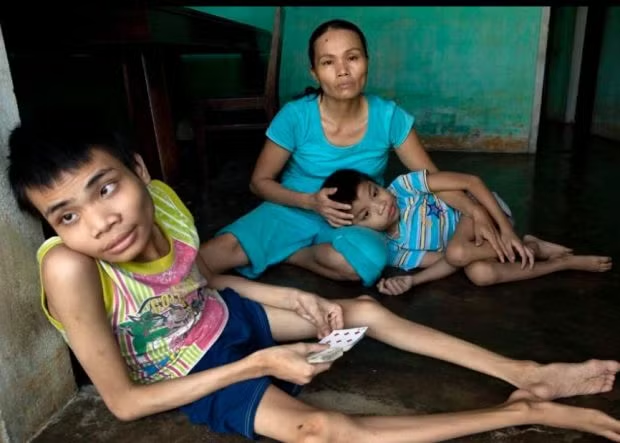
Catherine Karnow is following a project called "Agent Orange", with the aim of raising American people's awareness of humanitarian assistance to people affected by the past war in Vietnam.
Catherine Karnow is following a project called "Agent Orange", with the aim of raising American people's awareness of humanitarian assistance to people affected by the past war in Vietnam. 
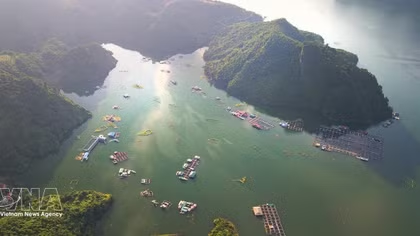
She loves travelling around Vietnam. "FISHING JUNK, HA LONG BAY, 1994 – Photographed in 1995, the traditional fishing junk no longer exists. Amongst Halong Bay's 2,000 islands — a UNESCO world heritage site — a fisherman plies the waters in an early morning fog. With a 3,800 kilometer coastline, fishing is a major industry in Vietnam, and the Vietnamese have always been daring and productive fishermen".
She loves travelling around Vietnam. "FISHING JUNK, HA LONG BAY, 1994 – Photographed in 1995, the traditional fishing junk no longer exists. Amongst Halong Bay's 2,000 islands — a UNESCO world heritage site — a fisherman plies the waters in an early morning fog. With a 3,800 kilometer coastline, fishing is a major industry in Vietnam, and the Vietnamese have always been daring and productive fishermen". 
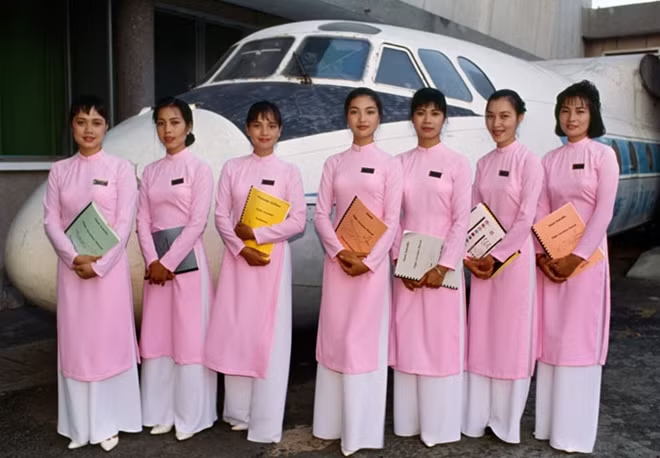
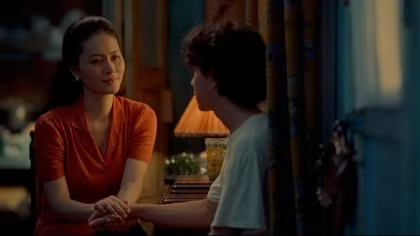
She took this photo in 1994. "VIETNAM AIRLINES, NEW STEWARDESS SCHOOL, 1994 – Anticipating an influx in tourism and business travel, Vietnam Airlines opens up new routes and a school for flight attendants".
She took this photo in 1994. "VIETNAM AIRLINES, NEW STEWARDESS SCHOOL, 1994 – Anticipating an influx in tourism and business travel, Vietnam Airlines opens up new routes and a school for flight attendants". 

Born and raised in Hong Kong, the daughter of an American journalist, San Francisco-based photographer National Geographic photographer Catherine Karnow seems destined to have travel and photo-journalism at the center of her life.

She studied photography in high school, and graduated Brown University with honors degrees in Comparative Literature and Semiotics. After a brief career as a filmmaker – her film Brooklyn Bridge premiered at the Berlin Film Festival in 1984 – she turned her attention to photography full time in 1986.

She has been shooting in Vietnam since 1990. In 1994, she was the only non-Vietnamese photo-journalist to accompany General Giap on his historic first return to the forest encampment in the northern Vietnam highlands from which he plotted the battle of Dien Bien Phu. In 2013, she was the only foreigner to photograph up close the funeral and burial of General Giap.
By Linh Bui

Other News

Vietnam secure berth at FIFA U17 World Cup 2026 for first time

Vietnam secure berth at FIFA U17 World Cup 2026 for first time

Vietnam national U17 football team secured a place at the FIFA U17 World Cup 2026 for the first time after defeating United Arab Emirates national U17 football team 3-2 on in the final Group C match of the AFC U17 Asian Cup 2026 in Saudi Arabia on early May 14 (Vietnam time).

Vietnam’s most beautiful railway station twins with French counterpart

Vietnam’s most beautiful railway station twins with French counterpart

A twinning agreement between Da Lat Railway Station in Vietnam and Trouville-Deauville Railway Station in France was signed at the French Embassy in Vietnam on May 7, creating new opportunities for cooperation in station management and operations, as well as cultural and tourism promotion between the two sides.

Hanoi gains two more craft villages in World Crafts Cities network

Hanoi gains two more craft villages in World Crafts Cities network

The recognition of Chuyen My and Son Dong craft villages as members of the World Crafts Cities network represents international acknowledgement of the cultural value, artisanal techniques, creativity and sustainable vitality of Vietnam’s traditional craft villages, he said.

Thang Long - Hanoi Festival 2026 to return in September

Thang Long - Hanoi Festival 2026 to return in September

Co-hosted by the municipal People’s Committee, the Department of Culture and Sports, and domestic and foreign agencies, the whole spectacle is meant to honour the city’s millennia-old heritage while reafffirming its strategy of establishing culture as a development engine.

Spreading Vietnamese cultural identity in digital space

Spreading Vietnamese cultural identity in digital space

In the context of deep international integration, cultural identity serves as both a “shield” against assimilation and a defining marker of a nation’s image. Protecting and promoting uniquely Vietnamese cultural values has therefore become a pressing task, particularly in an increasingly complex digital environment.

ITE HCMC 2026 to promote Vietnam’s tourism on global map

ITE HCMC 2026 to promote Vietnam’s tourism on global map

With its large scale, the ITE HCMC 2026 aims to promote tourism cooperation between Vietnam and priority markets such as Northeast Asia, Western Europe, North America, Southeast Asia, and Oceania while also boosting visitor arrivals from the Indian market

Vietnamese puppetry seeks renewal amid preservation challenges

Vietnamese puppetry seeks renewal amid preservation challenges

Although widely regarded as a cultural “speciality” attracting tourists, Vietnamese puppetry is facing multiple challenges in preservation and development, requiring renewed efforts to both safeguard its identity and adapt to contemporary cultural currents.

Project on digital transformation in cultural sector approved

Project on digital transformation in cultural sector approved

By 2030, the project targets the establishment of shared digital platforms across 100% of cultural sectors. All digitised cultural heritage will be standardised under the national data framework and shared in accordance with regulations, while 80% of public digital heritage assets are expected to receive digital identifiers to clarify ownership and management, encouraging organisations and individuals to do the same and support market development.

Vietnam eyes becoming region’s leading tourism destination

Vietnam eyes becoming region’s leading tourism destination

Vietnam has in recent years undergone a notable transformation in its tourism development strategy, placing a strong emphasis on nature-based and eco-tourism. This shift is not merely aligned with global trends, but represents a necessary step towards safeguarding valuable natural resources, while appealing to a growing segment of environmentally conscious travellers.