My Son inscriptions set sights on UNESCO documentary heritage status

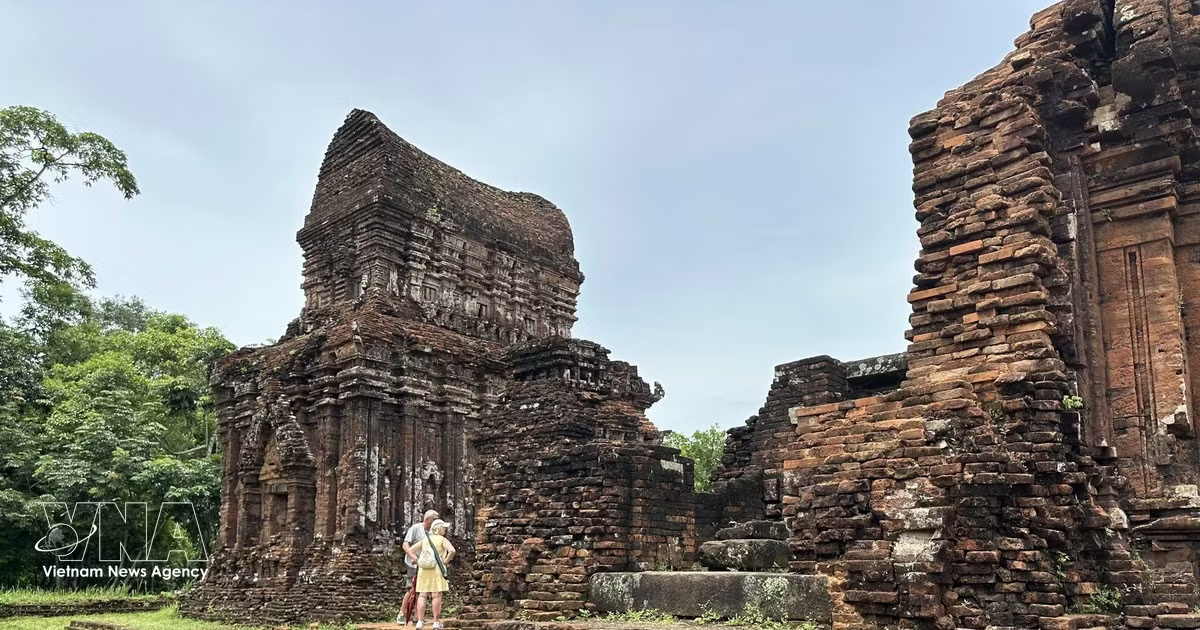
Located in Thu Bon commune, Da Nang city, My Son is renowned for its architectural heritage, but it also preserves an exceptional archive engraved on stone. These inscriptions have enabled scholars to unravel the history of the sanctuary and trace the rise and development of the ancient Champa kingdom over many centuries.

My Son inscriptions set sights on UNESCO documentary heritage status

Beyond its celebrated temple towers, the My Son Sanctuary is home to another priceless legacy carved in stone. Through its ancient inscriptions, the UNESCO world heritage site is now working towards recognition as a documentary heritage site in Asia-Pacific, opening a new avenue for preserving and promoting its historical value alongside its existing world heritage status.

Located in Thu Bon commune, Da Nang city, My Son is renowned for its architectural heritage, but it also preserves an exceptional archive engraved on stone. These inscriptions have enabled scholars to unravel the history of the sanctuary and trace the rise and development of the ancient Champa kingdom over many centuries.

A stone archive of history

The management board of My Son World Cultural Heritage has completed the initial phase of a project to catalogue, document and build a digital database of the site's inscriptions.

The preliminary survey identified around 50 inscriptions, including complete steles and numerous fragmented stones bearing engraved texts.

According to Nguyen Van Tho, head of the board’s conservation and museum division, the inscriptions are not only original artefacts of outstanding historical, cultural and scientific value, but also primary historical sources that shed light on the establishment and evolution of the My Son temple complex, as well as the political, religious and cultural life of the Champa Kingdom across different periods.

He said the goal of securing recognition as UNESCO Memory of the World for Asia and the Pacific is entirely achievable.

International cooperation to unlock ancient texts

Since 2018, the management board has worked with Indian scholars and the Embassy of India in Vietnam on a project to study and translate around 30 Sanskrit inscriptions preserved at My Son into Vietnamese and English.

The inscriptions are of exceptional significance, as most were carved directly onto the stone structures of the temple complex and contain invaluable information about Champa's history, religion and society.

Deciphering them, however, has proved far from straightforward. Many were damaged during wartime, leaving broken or missing sections, while centuries of weathering have eroded numerous engraved characters.

Complicating matters further, many original artefacts were transferred in the early 20th century to the Da Nang Museum of Cham Sculpture, the Vietnam National Museum of History, and other institutions, making it more difficult to compare and systematically document the entire corpus.

Against this backdrop, experts from the French School of Asian Studies (École française d'Extrême-Orient – EFEO) reaffirmed in May their commitment to translating the Cham-language inscriptions, sharing archival materials from French archaeological research and restoration work at My Son, and supporting preparations for a UNESCO documentary heritage nomination

According to researcher Tran Ky Phuong, former curator of the Da Nang Museum of Cham Sculpture, cooperation with EFEO has led to the discovery of around 140 additional Champa inscriptions since 2010, many of which have already been translated into English and French.

The EFEO also possesses advanced photogrammetry technology capable of creating highly accurate digital models of the inscriptions, recording every crack, chip and weathered surface in remarkable detail. The accompanying software can digitally reconstruct fragmented steles, allowing researchers to piece together missing sections and recover previously unreadable texts.

"We have also completed a comprehensive study of the My Son inscription system, which will be published soon," Phuong said. "Together with the EFEO's published research on Champa, it will provide an important body of reference material for future scholarship and heritage conservation."
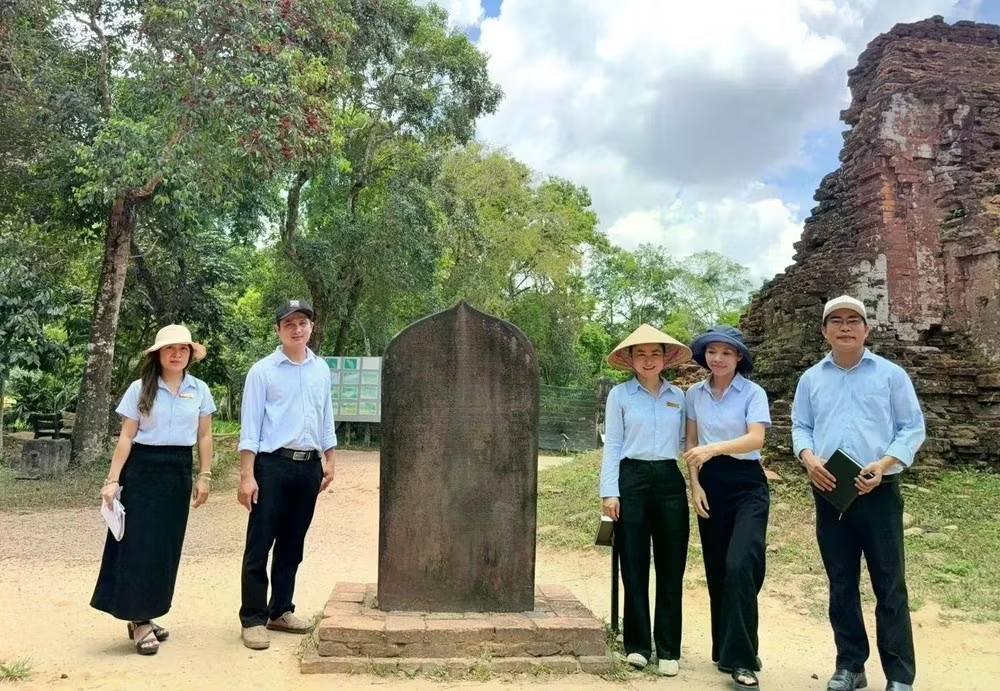
A remarkably well-preserved stone inscription at the My Son Sanctuary, retaining its original form and exceptional state of preservation. (Photo: thanhnien.vn)

Strong potential for UNESCO recognition

Architect and Cham culture researcher Le Tri Cong said numerous studies have demonstrated that the My Son inscriptions are the key to understanding the history of the Champa Kingdom, its religious institutions, and the relationship between royal authority and spiritual power.

In his view, the inscription collection possesses all the qualities needed for UNESCO to consider it for inscription on the Memory of the World Register.

Few places in Southeast Asia, he noted, have preserved such a coherent body of inscriptions within a single sacred landscape, documenting the continuous history of a kingdom over nearly 900 years.

The inscriptions also record the process of cultural exchange between India and Southeast Asia through the transition from Sanskrit to Old Cham.

"It is this combination of historical, linguistic, religious and regional significance that gives the inscriptions their outstanding international value," Cong said./.

en.vietnamplus.vn

Other News

Ta Xua named Asia's leading emerging tourism destination 2026

Ta Xua named Asia's leading emerging tourism destination 2026

In recent years, Ta Xua, dubbed "the paradise of clouds", has emerged as one of the mountainous destinations attracting strong interest from young travellers, particularly for its spectacular sea of clouds stretching across the mountains in the northwestern region.

Digital transformation key to preserving, promoting ethnic cultural values

Digital transformation key to preserving, promoting ethnic cultural values

Training local young people in filming, audio recording, digital storytelling, data preservation and responsible use of AI can help build a new generation of cultural custodians. This, in turn, can help transform cultural heritage into a resource for economic development while contributing to the country’s broader development.

Indigenous culture becomes tourism asset in northern highlands

Indigenous culture becomes tourism asset in northern highlands

With growing recognition of indigenous knowledge, customs and cultural values as unique assets, ethnic communities in the northern mountainous region are shifting from simply providing tourism services to becoming creators and owners of tourism products, confidently telling their own cultural stories

UNESCO ready to work with Vietnam to implement International Decade of Culture for Sustainable Development initiative: Representative

UNESCO ready to work with Vietnam to implement International Decade of Culture for Sustainable Development initiative: Representative

Jonathan Wallace Baker, UNESCO Representative to Vietnam, noted that the official proclamation of the 2027–2036 period as the "International Decade of Culture for Sustainable Development" comes at a particularly important moment. As the international community works to accelerate progress towards the 2030 Agenda while beginning to consider what comes after 2030, the Decade provides a ten-year framework to strengthen the place of culture in development.

Traditional culture finds new life in contemporary Vietnam

Traditional culture finds new life in contemporary Vietnam

Under Resolution 80-NQ/TW, dated January 7, 2026, November 24 was designated Vietnam Culture Day, to be observed annually. The occasion aims to give the public opportunities to participate in, create and enjoy cultural activities, helping spread positive values and foster pride in Vietnamese culture.

Vietnam prioritises MICE tourism as strategic product

Vietnam prioritises MICE tourism as strategic product

For the MICE tourism sector in both Ho Chi Minh City and Vietnam, growth can no longer be driven merely by increasing the number of events; instead, the focus must shift to enhancing the value of each event and the competitiveness of each destination.

Potential of ethnic minority women's football

Potential of ethnic minority women's football

Women’s football movements in local communities have been quietly growing, but they’ve now built up enough momentum to inspire organisers to launch the first Vietnam Ethnic Minority Women’s Football – VTV Cup in 2026.

Phong Nha - Ke Bang named among Vietnam's 11 most beautiful destinations

Phong Nha - Ke Bang named among Vietnam's 11 most beautiful destinations

According to the magazine, boat trips into Phong Nha Cave and strolls through Paradise Cave (both family-friendly) offer a tantalising glimpse of their astonishing scale, but the real adventure lies deeper within the park, where cavers wade through underground rivers and weave among stalagmites.

Tourism seeks new growth momentum under Resolution 26

Tourism seeks new growth momentum under Resolution 26

Tourism effectiveness should be measured not only by visitor numbers and revenue, but also by spending, length of stay, repeat visits, job quality, visitor satisfaction and environmental carrying capacity, said experts.

Vietnam welcomes nearly 2 million international visitors in August, up 19.7% from July and 18.4% year-on-year. (Illustrative photo: VNA)

Vietnam tourism maintains strong growth, expands international markets

The National Statistics Office under the Ministry of Finance reported that Vietnam welcomed nearly 2 million international visitors in August, up 19.7% from July and 18.4% year-on-year. The figure represented 63.6% of the tourism sector’s full-year target of 25 million arrivals.

First ladies of Vietnam, Myanmar visit Van Phuc silk village

First ladies of Vietnam, Myanmar visit Van Phuc silk village

Ngo Phuong Ly, the spouse of General Secretary of the Communist Party of Vietnam Central Committee and President To Lam, said the two countries share similarities in silk weaving and can enrich their cultural heritage through exchanges and experience sharing.