Rather than simply receiving information from display boards or tour guides, visitors to Van Mieu – Quoc Tu Giam (Temple of Literature – Imperial Academy) now have more opportunities to explore the site independently through interactive activities, hands-on experiences and visual tools.
These approaches are enriching visits while bringing historical and cultural values closer to the public, particularly younger generations.
One of the new approaches at the site is the organisation of activities that combine hands-on experiences with journeys to discover the site's history.
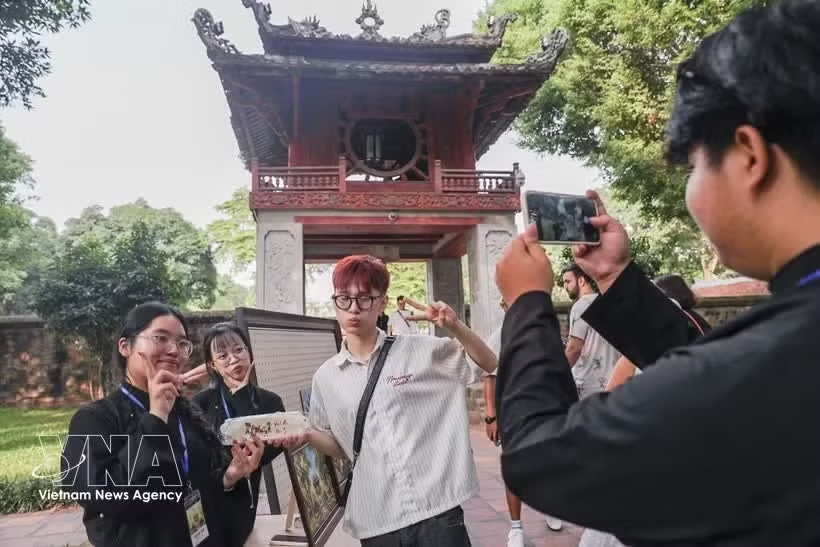
Through the “Journey of National Learning – Imprints of Knowledge” programme, participants explore different attractions by completing tasks, answering questions and taking on challenges.
Completing each stage, collecting stamps and learning about individual locations make visits more engaging and give participants clear objectives. Other activities bring history to life through role-playing and direct interaction.
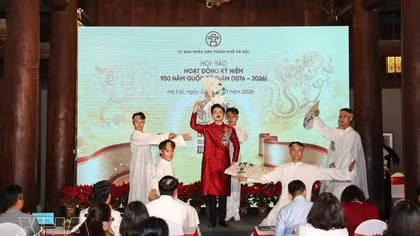
The “Meeting Talented People” programme allows visitors to learn about distinguished historical figures and scholars in a setting closely connected with the country's educational history. This approach presents historical personalities and events in a more accessible and memorable way.
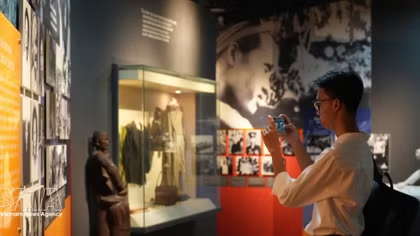
Tran Thi Thu Van, a student at the Academy of Journalism and Communication, said that although she already has some knowledge of the site's history, experiencing it in person gives her a different perspective.
Van believed interactive activities not only appeal to young people but can also spark international visitors' interest in Vietnamese history and culture. She suggested introducing more activities linked to tradition education, such as learning about academic titles in the country's feudal examination system or trying traditional calligraphy.
The new approach also gives visitors greater freedom to choose what they want to explore and how much time they spend at each location.
To support independent exploration, information at the site is presented in a clear, visual and convenient way. Alongside display boards, visitors are provided with other materials to help plan their routes, identify key structures and access essential information.

On November 3, the Centre for Cultural and Scientific Activities of Van Mieu – Quoc Tu Giam, in collaboration with the French Embassy, the French Institute in Vietnam and Hanoi Architectural University, introduced two new publications: a site map and an information leaflet.
The map shows the layout of the complex, the locations of its structures and major attractions, helping visitors navigate the site and choose suitable routes. The leaflet provides an overview of its history, architecture, historical figures and outstanding cultural and educational values. The two publications complement each other by offering both practical directions and background information.
Notably, the map is available in Vietnamese, English and French, catering to both domestic and international visitors.
Eric Soulier, Counsellor for Culture and Cooperation at the French Embassy and Director of the French Institute in Vietnam, said the visitor routes are designed to help people better understand the places they explore, while the use of three languages makes the site more accessible to Vietnamese-, English- and French-speaking visitors.
Digital technology is also creating new opportunities to present historical content through images and sound. At the site, 3D mapping projections have been introduced to bring stories about the heritage complex closer to the public through engaging visual presentations.
Assessing these changes, Dr Nguyen Viet Chuc, former Vice Chairman of the National Assembly’s Committee for Culture, Education, Youth, Adolescents and Children, described the introduction of maps, leaflets and new technologies as a practical and timely move.
He noted that Van Mieu – Quoc Tu Giam is a special national relic closely associated with the development of Vietnam's education system and was once a major centre for training the country's talents. Therefore, efforts to improve heritage interpretation should help visitors gain a deeper understanding of its historical, cultural and educational values.
However, he stressed that technology should serve as a supporting tool rather than a complete substitute for direct experiences. Remote access allows people who cannot visit the site to learn about its cultural values, but seeing the architecture and artefacts firsthand and experiencing the historical atmosphere remain irreplaceable.
From interactive activities and visitor publications to digital applications, the changes share a common goal: diversifying ways of accessing heritage to meet the needs of different audiences. Regardless of the format, information must remain accurate and highlight the site's historical and cultural significance, ensuring that technology and entertainment do not overshadow the heritage itself.
Renewing heritage storytelling is not simply about adding interactive activities or adopting new technologies. More importantly, it means creating appropriate ways for the public to explore and appreciate heritage independently, allowing the historical values and tradition of learning preserved at Van Mieu – Quoc Tu Giam to continue inspiring contemporary life.