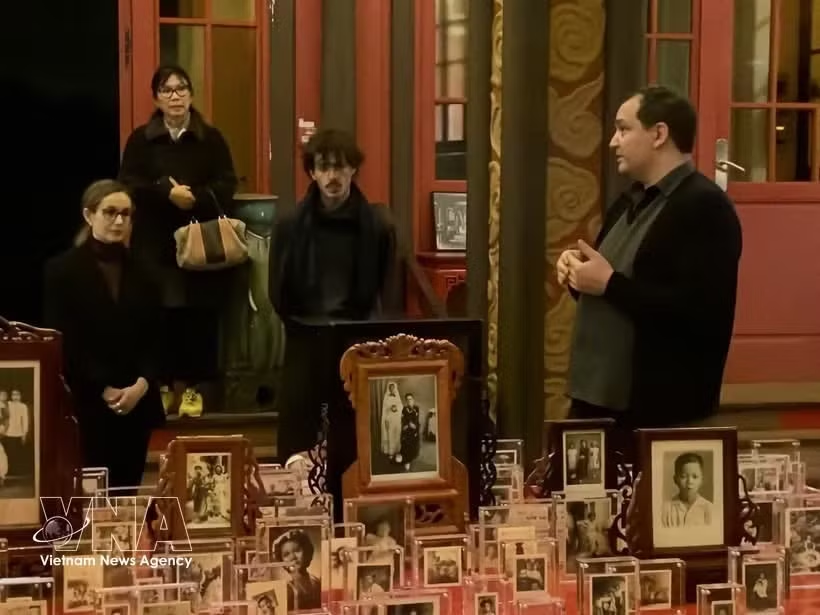
Hundreds of old photographs are displayed side by side in an East Asian-inspired room at the Southeast Asia Student House in Paris, depicting childhood faces, family portraits, documents and postcards faded by time. Behind these nameless faces lies the personal story of Olivier Dhenin Huu, a French artist of Vietnamese origin, and his quest to discover a childhood he never knew.
This journey is also the theme of his exhibition, “The childhood I never had” (L’Enfance que je n’ai jamais eue), which opened in Paris on the evening of November 18.
Developed following his artistic residency at Villa Saigon, an initiative of the French Institute in Vietnam, the exhibition goes beyond photographs and archival materials, inviting visitors into layers of intertwined memories of family, history, Vietnam in the past and the country today.
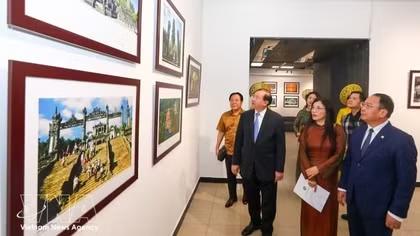
A “forest” of photographs occupies the centre of the display, with portraits of various sizes arranged in wooden frames or on transparent acrylic panels. Visitors are invited to move slowly among the faces, taking a closer look at photographs dating back several decades. Some subjects are identified while many children remain completely anonymous.
For Olivier Dhenin Huu, these gaps are precisely what leave room for imagination. He shared that the childhood he never had is an imagined childhood – the childhood he might have had if his mother had stayed in Vietnam and had not left the country in 1958.
The artist acknowledged, however, that this was a scenario that could never have become reality as his father was French. Had his mother not left Vietnam, he might never have been born. This paradox has turned the photographs into a means for Olivier to construct a “parallel biography” for himself.
The exhibition unfolds through several thematic sections. In “Contours of landscapes”, civil records, family albums, postcards, engravings and old photographs emerge as fragments of memories from a distant past.
In the section bearing the exhibition’s title, portraits of children take centre stage.
One discovery that particularly caught Olivier’s attention was two boys in archival photographs whose faces bore a striking resemblance to two teenagers he met in Ho Chi Minh City today. He said it was as if they had travelled through time.
Inspired by this coincidence, he photographed contemporary teenagers at locations associated with old Saigon and his mother's memories, including the Saigon Zoo and Botanical Gardens, District 1 and the Ho Chi Minh City Museum. Other photographs were taken in Paris, featuring a teenager of Lao-Cambodian origin.
One boy in France and two in Vietnam. Faces from the present are placed alongside those from the past, creating a dialogue that transcends time and geographical boundaries.
In the “Golden Book” section, photographs meet the written word. Excerpts of prose and poetry are displayed alongside old images, giving a voice to faces whose names and stories have not been fully preserved by history.
The final chapter of this journey through memory lies beyond the exhibition room. In the garden, the installation “Retours” (Returns) features three granite slabs and a small metal boat on the water. The slabs bear the names of Ho Chi Minh City, Da Nang and Vung Tau – localities linked to Olivier's family history – alongside their former names, Saigon, Tourane and Cap-Saint-Jacques.
According to the artist, the slabs must be brought together for the place names to appear in their entirety, evoking layers of history that have been separated and subsequently reconnected.
The small boat on the water also carries special significance.
He revealed that he named the work "Returns", in the plural, because so many people have left and then returned to their homeland, including overseas Vietnamese and himself – someone who has rediscovered this country.
The exhibition's journey will continue with a return in the literal sense. Following its Paris presentation, the exhibition is scheduled to be displayed at the Ho Chi Minh City Museum from April 1 to 15, 2027.
For Olivier, this choice holds particular significance as the museum, formerly Gia Long Palace, is the site of many historical events. He hopes the exhibition will connect archival materials with contemporary Vietnam while serving as another bridge of friendship between Vietnam and France.
He said Vietnam and France share a long history and had endured a difficult 20th century, adding that friendship, cooperation and art could help the two countries reconnect through their shared past, despite its painful chapters.
Olivier said he hopes to focus not on loss but on the continuity of life, noting that images of young people from both the past and present show that life always endures.
The exhibition will run in Paris until December 2.