British experts continue uncovering mysteries of Vietnam's 'Kingdom of Caves'

Park authorities believe continued cooperation with international cave experts will not only uncover more geological treasures but also enhance the site's appeal as a world-class destination for adventure tourism, scientific research and nature conservation.

More than three decades after first arriving in Vietnam, British cave explorers continue to reveal new geological wonders hidden beneath the ancient forests of Phong Nha-Ke Bang National Park, reinforcing its reputation as one of the world's most remarkable karst landscapes and opening fresh opportunities for scientific research and sustainable tourism.

Their latest expedition in early 2026 led to the exploration of Cha Ngheo Cave, a largely untouched vertical cave system that experts believe may form part of an even larger network. The team plans to return in March 2027 to continue the survey.

Decades of exploration

Dr Howard Limbert recalled that his first expedition to Vietnam took place in 1990, when British experts and scientists from the former Hanoi General University began surveying caves in what is now Phong Nha-Ke Bang National Park.

During that pioneering expedition, the team explored Phong Nha Cave and Dark Cave, surveying thousands of metres of cave passages.

Even after leaving Phong Nha, Limbert and his colleagues immediately began planning their return. "The caves here have kept my wife and me coming back ever since," he said.

Professor Dr Ta Hoa Phuong of the Vietnam Institute of Palaeontology said the 1990 expedition marked the beginning of long-term cooperation between Vietnamese scientists and British cave experts, laying the scientific foundation for later geological research in the area.

Their work proved invaluable in preparing the nomination dossier that led UNESCO to recognise Phong Nha-Ke Bang as a Natural World Heritage Site in 2003 under geological and geomorphological criteria, making it Vietnam's Natural World Heritage after Ha Long Bay.

Limbert also recalled meeting General Vo Nguyen Giap in 1992, saying the legendary military leader encouraged the British team to continue exploring Vietnam's cave systems, giving them added motivation to pursue their research.
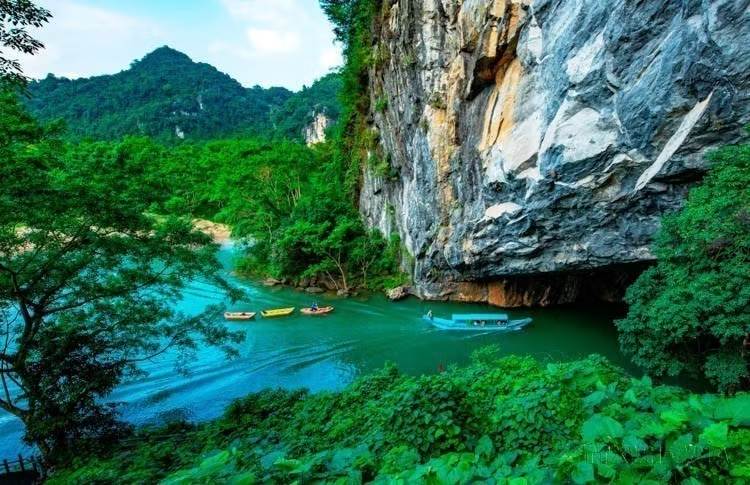
Scenery outside the entrance of Phong Nha Cave in Phong Nha – Ke Bang National Park. (Photo: published by VNA)

One of the expedition's greatest achievements came in 2009 with the discovery of Son Doong Cave after more than a decade of searching. Local forest ranger Ho Khanh guided the British team to an entrance he had first spotted in 1990, leading to the exploration of what is now recognised as one of the world's largest known caves.

Stretching more than 6.5 kilometres, Son Doong ends at a massive limestone wall known as the Great Wall of Vietnam and has since become an international tourism icon.

Discoveries beneath the forest

Asked about his most memorable recent expedition, Limbert pointed to the exploration of Cha Ngheo Cave in early 2026.

Residents had long reported seeing a cave entrance high on a mountain where a stream disappeared into a deep vertical shaft, but no one had attempted to descend because of the extreme terrain.

In early April, a 13-member expedition team comprising ten foreign specialists and three Vietnamese experts, supported by a logistics team, set out to investigate the cave.

After more than a day trekking through dense forest and crossing streams, the team reached the entrance and camped overnight before beginning the descent the following morning.

The first section dropped nearly 90 metres vertically. Using thousands of metres of climbing rope, the explorers descended in stages, drilling anchor bolts into limestone outcrops before continuing deeper into the cave.

At a depth of around 350 metres, they reached a horizontal passage and then swam nearly 600 metres through an underground river.

Only two members of the team succeeded in reaching the cave's deepest section.

"The cave is extremely cold, and without specialised thermal equipment we could not stay there for long," Limbert said.

He noted that the cave extends well beyond the areas surveyed so far, suggesting it could form part of a much larger underground system.

Strengthening global recognition

According to Pham Hong Thai, Director of Phong Nha-Ke Bang National Park, experts have identified seven major cave areas, including the Phong Nha, Vom, and Nuoc Mooc systems.

To date, researchers have documented 472 caves with a combined surveyed length of more than 254 kilometres, making the park one of the world's richest and most distinctive karst regions and earning it the nickname "Kingdom of Caves."

During the latest survey in early 2026, Limbert's team explored 29 caves, including 26 newly discovered caves and extensions to three previously known caves, mapping more than 13.6 kilometres of underground passages.

Professor Phuong said the findings have provided valuable scientific evidence supporting studies of the park's geology and geomorphology while strengthening its universal value.

Park authorities believe continued cooperation with international cave experts will not only uncover more geological treasures but also enhance the site's appeal as a world-class destination for adventure tourism, scientific research and nature conservation./.

en.vietnamplus.vn

Other News

Vietnam invites travellers on multi-sensory journey

Vietnam invites travellers on multi-sensory journey

Vietnam's appeal lies not in a single attraction but in the seamless combination of authentic experiences rooted in local culture. From colourful highland markets and traditional festivals to centuries-old craft villages, all remain an integral part of everyday life.

Promoting souvenir industry to spread national image

Promoting souvenir industry to spread national image

Experts said that with market-oriented development, improved functionality, stronger storytelling and greater involvement from designers, businesses and market-connecting organisations, souvenirs could become a bridge linking Vietnam with the world while contributing to the growth of cultural industries and the creative economy.

Interactive sound exhibition breathes new life into cultural heritage

Interactive sound exhibition breathes new life into cultural heritage

One of the exhibition's highlights is the "Our Sound" installation, where visitors become part of the artwork itself. As multiple participants interact simultaneously, sound and light merge into a shared composition, conveying messages of connection, sharing and collective responsibility for building sustainable communities in harmony with nature.

Festival for Peace 2026 opens, featuring wide rage of activities

Festival for Peace 2026 opens, featuring wide rage of activities

Standing on the historic land of Quang Tri, alongside the Ben Hai River, the Quang Tri Ancient Citadel and the national martyrs’ cemeteries, people are reminded of the true value of peace and the sacrifices made for national independence, freedom and reunification.

Smart tourism takes hold nationwide

Smart tourism takes hold nationwide

Under the country’s 2026–2030 digital economy and digital society development programme, the sector has been identified as one of the priority ones for accelerating digital transformation to improve governance efficiency, service quality, and visitor experiences.

UAE grants visa-on-arrival for eligible Vietnamese citizens

UAE grants visa-on-arrival for eligible Vietnamese citizens

PSNews - The UAE Embassy in Vietnam also confirmed that Vietnamese citizens holding ordinary passports, and their eligible accompanying family members, are able to get a visa on arrival from June 25, 2026 as long as they meet the above requirements.

Hanoi festival celebrates cultural heritage of lotus

Hanoi festival celebrates cultural heritage of lotus

The festival is part of Hanoi's strategy to boost its cultural industries by transforming cultural heritage into a driver of socio-economic development while preserving and promoting the city's traditional cultural values.

Vietnam's Hidden Spa-Water Hope wins top jury prize at Architizer A+Awards 2026

Vietnam's Hidden Spa-Water Hope wins top jury prize at Architizer A+Awards 2026

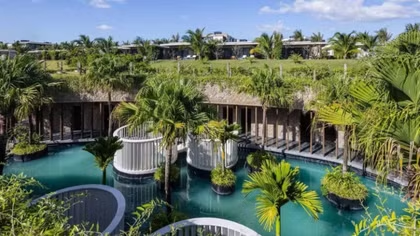
Nestled among coastal sand dunes in Cam Ranh, the project was conceived with a strong commitment to respecting the natural landscape and harnessing water as its central element. Rather than creating a visually dominant structure, the design blends into the terrain, making use of sand layers, native vegetation and open spaces to strengthen the connection between people and nature.

Heritage resources fuel Hue's new growth ambitions

Heritage resources fuel Hue's new growth ambitions

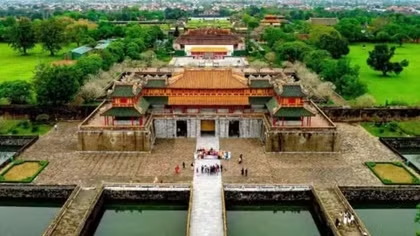
Hue is simultaneously stepping up efforts to attract investment into tourism, services and cultural industries. In the first five months of 2026, the city secured more than 19 trillion VND in newly registered investment capital, with projects planned in coastal tourism, lagoon-based ecotourism, cultural spaces along the Perfume River, convention and exhibition centres, night-time economy projects and cultural innovation hubs.

Phu Tho moves to unlock tourism potential after administrative mergence

Phu Tho moves to unlock tourism potential after administrative mergence

With coordinated efforts in planning, infrastructure development, product diversification, human resources training, digital transformation and destination branding, Phu Tho is well-positioned to transform tourism into a spearhead economic sector and a new engine of sustainable growth in the years ahead.

AI ushers in a new era for digital art

AI ushers in a new era for digital art

As cultural industries and the creative economy gain momentum, AI is proving valuable in improving efficiency, streamlining operations and enabling creators to focus more on artistic content.

Green tourism charts a new course for Vietnam

Green tourism charts a new course for Vietnam

With its rich agricultural ecosystem, where each region boasts unique produce, culinary traditions, and farming practices, Vietnam is well positioned to develop and expand the farm-to-table model. Cities and provinces, such as Hanoi, Thai Nguyen, Da Nang, Hue, Can Tho, Lam Dong, and Vinh Long, are already embracing the model as part of their green tourism strategies.