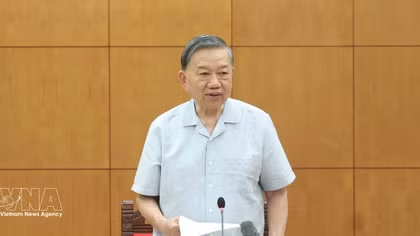
- Vietnam chairs first meeting of ASEAN Committee in New York
- MPS ready to ensure security and safety for Vietnam’s 2020 ASEAN Chairmanship
January 1, 2020 marks Vietnam’s official assumption of its ASEAN Chairmanship 2020. As both the ASEAN Chair for 2020 and a non-permanent member of the United Nations Security Council for 2020 – 2021, Vietnam is standing before numerous opportunities to showcase its role in the region and the world. Prior to this year’s ASEAN Chairmanship, Vietnam successfully hosted the 6th ASEAN Summit in Hanoi in 1998, and presided over the 34th ASEAN Standing Committee (ASC) from July 2000 to July 2001 and fulfilled the ASEAN Chairmanship for 2010.
Since the end of 2018, Vietnam has been making active preparations for the ASEAN Chairmanship 2020. We are seeking to add new building blocks to the ASEAN Community building, and achieve synergy between our ASEAN Chairmanship and UNSC non-permanent membership in line with the Politburo’s Resolution 22-NQ/TW dated April 10, 2013 on international integration, and the Secretariat’s Directive 25-CT/TW dated August 8, 2018 on promoting and elevating the Vietnamese multilateral diplomacy until 2030.
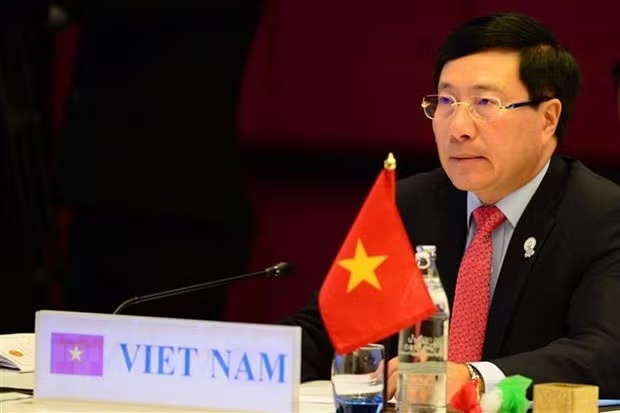 |
| Deputy Prime Minister and Minister of Foreign Affairs Pham Binh Minh (Photo: VNA) |
The ASEAN came into being on August 8, 1967 with its Bangkok Declaration, demonstrating its ambition of an association under which all Southeast Asian countries would work together for a region of peace, freedom and prosperity. Over the years, the dream of an ASEAN uniting the ten Southeast Asian nations under its banner has become a reality. The ASEAN Community was formed on December 31, 2015, gradually establishing itself as a model Community: politically cohesive, economically integrated and socially responsible.
ASEAN has thus become an important partner for countries beyond the region, and a central player in various dialogue and cooperation processes. With a view to realizing the ASEAN Community Vision 2025, the ASEAN Community has been striving for cohesion and consolidating its centrality in the regional processes for peace, security, stability and development in Southeast Asia. The voice of the ASEAN Community is growing in importance in the evolving regional architecture and with regards to major international issues. Within the strategic considerations of major powers, ASEAN has become a key partner for dialogue and cooperation in the region.
After stepping aboard the ship that is ASEAN in 1995, Vietnam and fellow ASEAN member states have together bravely sailed through the turbulent high seas. The resilience of ASEAN today bears the mark of Vietnam’s tireless effort in cultivating the solidarity and unity that enabled ASEAN to surmount times of hardship and adversity. Assuming the ASEAN Chairmanship upon the 25th anniversary of our membership presents us with multiple advantages and yet numerous challenges. Therefore, promoting vigorous emergence and sustainable development of ASEAN will be a practical contribution that Vietnam can make to the Community.
The world continues to witness uncertainties and increasing rivalry among major powers. ASEAN, geo-strategically located at the center of a vast area connecting the Indian and Pacific Oceans, is facing novel opportunities and challenges. With a population exceeding 642 million and an area of more than 1.7 million square kilometers, ASEAN represents a market with immense potential, a dynamic economy and a bright spot in the global economy. ASEAN members have also been constantly striving for new heights, harnessing the benefits of the 4th Industrial Revolution by adopting new technologies such as AI and cutting-edge robotics.
However, the rise of protectionism and trade friction among major powers are posing challenges and hindering the global trade and economic growth. At the same time, disparities in economic development among member states and demands for deeper integration in the new phase of development require suitable economic policies from governments. Thus, ASEAN needs to maximize the extant opportunities, effectively address challenges and avoid falling behind in order to maintain sustainable growth.
By choosing the theme of “Cohesive and Responsive” for ASEAN Vietnam 2020, we wish to highlight the decisive role of solidarity and unity in maintaining the sustainability of ASEAN. Only a cohesive and advanced ASEAN Community may effectively respond to external influences, whereas responsiveness would allow ASEAN to further strengthen its cohesion, thereby enhancing its overall capacities. This theme is built on the previous ASEAN themes in 2019 – “Advancing Partnership for Sustainability” and in 2018 – “Resilience and Innovation”. It has also earned strong support from ASEAN member states and its partners.
Reality has proven that in order to persevere before and respond effectively to the manifold turmoil in the region and the world, ASEAN needs to maintain solidarity and unity, bolster its economic resilience, enhance its rapid responsiveness to emerging challenges, and foster innovation, initiative and reinvention to vigorously drive itself forward. Alongside reinforcing internal capacities, how to skillfully coordinate external relations and effectively harness the resources from our partners to serve the shared interests are other puzzles that need to be addressed.
Thus, in order to translate the theme of “Cohesive and Responsive” into reality, Vietnam has identified 5 key priorities for our ASEAN Chairmanship in 2020, as follows.
First, to advance ASEAN’s active role and contribution to the maintenance of the regional peace, security and stability. This shall be done by consolidating ASEAN’s solidarity and unity, fostering stronger cohesion and mutual support among its member states, improving the coordination of ASEAN positions in addressing regional and international issues, promoting the formulation and observance of common rules and norms of conduct in the relations among states, and thereby allowing ASEAN to timely and effectively respond to any threats to the regional peace, security and stability.
Second, to promote regional connectivity and integration, heighten our responsiveness and harness opportunities arising from the fourth Industrial Revolution. This involves extensive economic integration and comprehensive connectivity within ASEAN and between ASEAN with its partners, and sustainable and inclusive economic, financial and social development grounded on innovation and the use of digital and novel technologies. The process would also include sustained efforts to narrow development gaps, build a quality workforce, and improve social services for our citizens.
Third, to foster the ASEAN sense of community and identity by cultivating a set of ASEAN shared values and instilling these values among the ASEAN people, promoting an awareness and identity of an ASEAN Community united in diversity, and popularizing the image of the ASEAN Community in the region and the world.
Fourth, to advance partnerships for peace and sustainable development with countries around the world. We seek to promote ASEAN’s role and contributions in the international community, and expand and elevate relations with partners all over the world, and thereby contributing to the formulation of the new regional and global architecture and rules.
To realize these targets, the fifth priority of no less importance is to improve the responsiveness and operational effectiveness of ASEAN organs via institutional reforms, and adjustment, improvement and upgrade of ASEAN’s procedures and standards.
December 2018 saw the establishment of the ASEAN 2020 National Committee. With this landmark, the preparation for our Chairmanship has progressed in all dimensions, from working agendas, protocol, communications and culture, logistics, to security and healthcare. In this endeavor, Vietnam is enjoying the support from fellow ASEAN member states, partners and friends, and the active participation of all central and local agencies and most notably the entire Vietnamese people.
We are, therefore, confident that we will successfully fulfill our mandate as the ASEAN Chair for 2020, and contribute to ushering in a cohesive and responsive ASEAN and realizing the ASEAN Community Vision 2025. As the ASEAN Chair, Vietnam also looks forward to strengthening relations between regional and global organizations via our concurrent capacity as a non-permanent member of the United Nations Security Council. This would help advance ASEAN’s status and reinforce its centrality in the region and the world.