ASEAN growth solid despite global risks

Although geopolitical risks continue to plague economies, ASEAN countries are still expected to grow thanks to their strong fundamentals and increasing supply of intra-block capital.

And among all ASEAN countries, Vietnam seems to be the most attractive destination for this capital flow.

At the Invest ASEAN 2017 conference held by Maybank Kim Eng last week in Singapore, 800 participants from funds, universities, and listed corporates discussed the future of ASEAN following the breakup of the Trans-Pacific Partnership (TPP). Three ASEAN states- Vietnam, Malaysia, and Singapore- were part of the doomed trade pact from which the US already withdrew.
“The world is going through a tough time with rising protectionist policies in the US and Europe, the fall-through of TPP,  rate hiking plans of the US federal Reserve, and slowdowns in the Chinese economy. As a region with strong connectedness to the world in term of trade and investment, ASEAN is affected by these headwinds as well”, said Dato’ John Chong, CEO of Maybank Kim Eng Group.

The CEO was optimistic about ASEAN’s future growth, saying that the region will benefit from its 600 million consumers, expanding middle-class, a focus on infrastructure development, and intra-ASEAN capital.

Reports from this investment bank shows that ASEAN-5 countries-Indonesia, Vietnam, Malaysia, the Philippines, and Thailand-will grow by 5% in 2017 while the rest of the world remains sluggish. Most notably, Vietnam is forecast to expand by 6.3%, behind only the Philippines in the ASEAN-5 region.

Between 2011 and 2015, intra-ASEAN investment jumped by 11%. Intra-trade still takes up only 24% of the total trade quota, meaning that there is still room for growth. According to Chong, to stay strong amid global volatilities, ASEAN as a whole should focus on intra-block investment and trade. New emerging markets in the region, especially Vietnam, have high potential as recipients for this flow.

Dr Kishore Mahbubani, dean in the practice of Public Policy at the Lee Kuan Yew School (National University of Singapore), also believes in intra-ASEAN collaborations in investment and trade. However, he is concerned that despite geographical proximity, ASEAN states are vastly diverse in terms of politics, culture, languages, and economic development. ASEAN investors must be well-in-formed of these differences when venturing to nearby countries.

Experts at the event praised Vietnam’s determination to build its capital market, including the equitisation and state withdrawals from various state-owned enterprises. More private firms also choose to list on stock exchanges. At the end of 2017, the Vietnamese stock market is expected to reach US$100 billion in market capitalisation, from only US$80 billion last year.

Besides indirect capital, ASEAN investors are also likely to pour direct investments into Vietnam, thanks to cheap money pumped into the market from central banks around the region.

Thailand seems to be the most enthusiastic investor in the merges-and-acquisitions market, having bought a slew of big Vietnam-based firms like Big C, Nguyen Kim, and Metro.

Marc Woo, head of Asia E-commerce at Google, told VIR that Vietnam would also be attractive to regional e-commerce sites and startups in financial services. He expects to see more names like Zalora, Lazada, and Grab in Vietnam in the coming years.

“Similar to other developing markets in ASEAN, only 6% of sales in Vietnam are made through online channels, and less than 2% of Vietnamese people use credit cards. At the same time, 60% of consumers here check reviews online before heading to the shops or restaurants. This is a great potential for e-commerce websites and startups in financial technology across ASEAN” said Woo.

Despite their overall optimism about Vietnam, experts still listed out challenges that should be tackled to welcome foreign investors. Lee Eng Keat, executive director of Singapore’s Economic Development Board, told VIR that Vietnam must focus on infrastructure development to improve its logistical standards.

Funding for infrastructure projects, according to Lee, should come from the private domestic or foreign sector instead of the national budget. He warned that if Vietnam does not improve its facilities, its great economic potential will not be realised.
VIR

Other News

Private economic sector poised for breakthrough growth

Private economic sector poised for breakthrough growth

More than a year after the Politburo's Resolution No. 68-NQ/TW on private sector development came into effect, expectations now extend beyond increasing the number of enterprises. The goal is to build a stronger business community with greater resilience, larger ambitions and the capacity to compete in global supply chains.

Vietnam remains ASEAN growth leader in 2026 despite global headwinds: WB

Vietnam remains ASEAN growth leader in 2026 despite global headwinds: WB

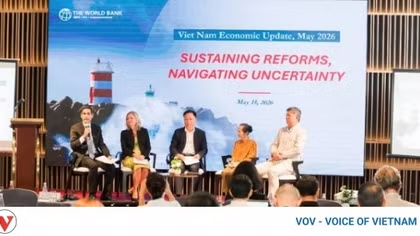
Vietnam is expected to remain one of ASEAN’s fastest-growing economies in 2026, supported by resilient exports, strong investment inflows and an ambitious reform agenda, despite mounting global uncertainties, according to the World Bank’s latest Vietnam Economic Update released on May 15.

Ministry establishes monitoring framework for carbon market

Ministry establishes monitoring framework for carbon market

Under a new circular, the exchange of greenhouse gas emission quotas and carbon credits is conducted on the domestic carbon credit exchange through the carbon trading system, which is interconnected with the national registration system.

Biofuel ready for nationwide rollout

Biofuel ready for nationwide rollout

For biofuels, particularly E10, to develop successfully, stronger and more coordinated policies are needed, especially pricing mechanisms capable of creating a sufficiently attractive gap between E10 and mineral-based petrol, an expert has said.

Vietnamese farm produce promoted at African investment, trade forum

Vietnamese farm produce promoted at African investment, trade forum

The 12th Africa Forum for Investment & Commerce (AFIC 12) opened in Algiers, the capital of Algeria, on May 9, drawing around 2,000 participants, including officials, economists, businesses, financial and development organizagtions from 43 African countries and international partners, including Vietnam.

Int'l medical, pharmaceutical expo opens in Hanoi

Int'l medical, pharmaceutical expo opens in Hanoi

The exhibition, which runs until May 9 at the Hanoi International Centre for Exhibition, showcases advanced products and technologies across a range of fields, including pharmaceuticals, drug manufacturing machinery and equipment, medical devices, hospital and clinic services and dental equipment.

Mega projects to transform Ho Chi Minh City urban landscape

Mega projects to transform Ho Chi Minh City urban landscape

Leading the charge in this massive building spree is the new central city square in the core of the Thu Thiem new urban area. Spanning more than 20 ha, it’s the crown jewel of the Central Square and new administrative center complex.

Vietnam establishes itself as one of region’s most dynamic manufacturing and supply bases

Vietnam establishes itself as one of region’s most dynamic manufacturing and supply bases

The country’s stable political and economic environment provides a critical foundation for long-term sourcing strategies. At the same time, Vietnam has demonstrated a strong ability to scale up manufacturing, supported by a continuously expanding industrial base capable of meeting both high-volume demand and increasingly complex technical and quality requirements.

Vietnamese pomelos gain broader access to Australian market

Vietnamese pomelos gain broader access to Australian market

The update by Australia’s Department of Agriculture, Fisheries and Forestry to its Biosecurity Import Conditions system (BICON) on April 10, officially setting out import conditions for Vietnamese pomelos, is regarded as a major milestone in market access efforts.

Vietnam's industry spearheads transition to circular economy

Vietnam's industry spearheads transition to circular economy

The circular economy is no longer just a policy choice. It has become an inevitable trend for delivering sustainable and green growth, sharpening competitiveness at home and abroad, and meeting Vietnam’s net-zero emissions target by 2050. It is now a prerequisite to sustain long-term economic expansion, particularly in industrial production and supporting industries.

Nearly 100 tonnes of Vietnamese fruits, vegetables airlifted to UAE

Nearly 100 tonnes of Vietnamese fruits, vegetables airlifted to UAE

Vietnamese fresh produce and processed foods are increasingly recognised for their quality, with items such as cashew nuts, coffee and spices gaining popularity among Middle East consumers. In 2025, Vietnam’s farm produce exports to the UAE exceeded 445 million USD, up nearly 24% year-on-year.