Modern retail channels help expand market access for Vietnamese farm produce

As many agricultural businesses continue to face challenges in finding stable outlets, modern retail systems are increasingly becoming key distribution channels helping Vietnamese products access the market more professionally.

Modern retail channels help expand market access for Vietnamese farm produce -0
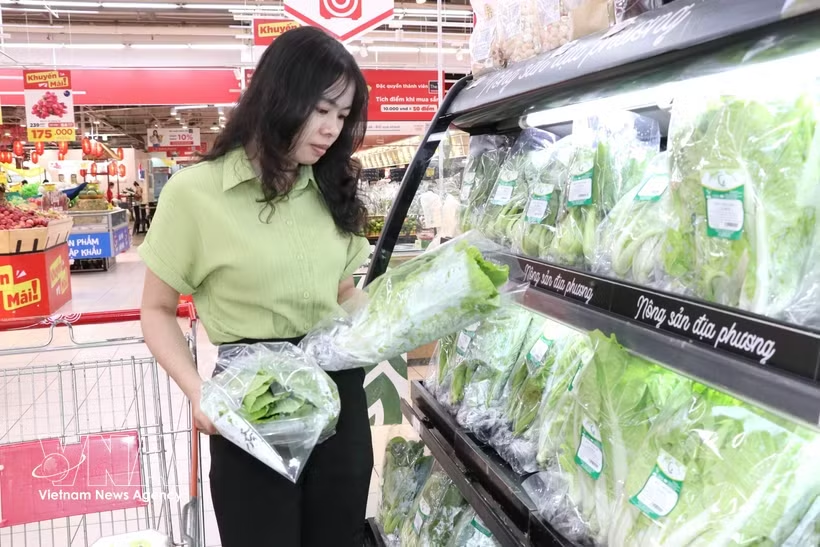
A customer buys hydroponic vegetables at a supermarket. (Photo: VNA)

Ensuring stable domestic demand for farm produce requires not only quality products and attractive packaging, but also strong retail distribution networks. Through modern retail channels, businesses are bringing products closer to consumers while gradually building brands and expanding markets sustainably.

According to the Ho Chi Minh City Department of Agriculture and Environment, the city currently has more than 426 agricultural cooperatives, 1,232 cooperative groups and 1,347 farms in operation. However, many agricultural businesses are still struggling to secure stable outlets for their products.

Nguyen Duc Hung, Vice Chairman of the Ho Chi Minh City Clean Farm Produce Association, said most small businesses have to handle everything themselves, from production and partner searches to marketing and market expansion. High borrowing costs and interest rate pressures also make it difficult for firms to invest in branding and product quality improvements.

He said some businesses produce good products but still struggle because they do not know where to sell them, who to connect with, or how to access larger distribution networks and overseas Vietnamese communities.

Representatives of the Ho Chi Minh City Food and Foodstuff Association shared similar concerns, saying businesses do not lack demand-stimulation programmes, but rather a comprehensive support ecosystem to help Vietnamese products strengthen their position in the domestic market.

As many agricultural businesses continue to face challenges in finding stable outlets, modern retail systems are increasingly becoming key distribution channels helping Vietnamese products access the market more professionally.

Industry experts noted that retailers today are doing more than simply selling goods. They are also supporting quality standardisation, traceability and consumer trust-building for Vietnamese farm produce.

Nguyen Ngoc Huong, CEO of Thien Nhien Viet Import-Export Co., Ltd., said her company considers the domestic market the foundation before expanding internationally, with supermarket systems playing a crucial role.

She noted that cooperation with major distribution channels, including Co.opmart, has helped improve product recognition and strengthen consumer trust through supermarket distribution.

Nguyen Hong Quyet, Director of the Kim Long High-Tech Agricultural Cooperative in Phu Giao commune, said participation in modern retail systems such as Co.opmart has enabled cooperatives to expand market access while encouraging greater investment in product quality and traceability.

As one of Vietnam’s leading domestic retailers, Saigon Co.op has long prioritised support for Vietnamese goods, particularly agricultural and OCOP (One Commune One Product) items. Through cooperation with cooperatives and suppliers, local specialties such as Can Gio bird’s nest and Xuan Nguyen honey have been introduced to consumers through its supermarket network.

In late 2025, Saigon Co.op also partnered with the Ho Chi Minh City Farmers’ Association to launch the “Accompanying Clean Farm Produce” programme, bringing VietGAP-certified, organic and OCOP products directly to consumers through Co.opmart Foocosa Quang Trung supermarket at more affordable prices. According to Duong Minh Quang, Deputy General Director of Saigon Co.op, the model will gradually be expanded across more outlets in the system.
VNA

Other News

Vietnam – one of most attractive destinations for leading US semiconductor companies: expert

Vietnam – one of most attractive destinations for leading US semiconductor companies: expert

Vietnam has built a solid semiconductor and electronics industry before joining ITSI, attracting major US semiconductor companies. Intel Products Vietnam is one of Intel's largest assembly and testing facilities worldwide, while chip design companies such as Synopsys, Cadence, Marvell and Qualcomm have established engineering and research centres in the Southeast Asian country.

Vietnam targets higher-quality FDI under Resolution 10

Vietnam targets higher-quality FDI under Resolution 10

During the first seven months of 2026, Vietnam attracted more than 38 billion USD in registered FDI, up nearly 58% year-on-year. More importantly, the increase was driven by large-scale, high-tech projects rather than a surge in the number of new investments, signalling a significant improvement in the quality of capital inflows.

Manufacturing, engineering drive hiring growth in H1: report

Manufacturing, engineering drive hiring growth in H1: report

Manufacturing and engineering posted the strongest recruitment growth, with hiring demand surging 70% year-on-year, driven by production expansion, supply chain restructuring and sustained investment inflows in high-tech manufacturing.

Government proposes special mechanisms to unblock APEC 2027 projects in Phu Quoc

Government proposes special mechanisms to unblock APEC 2027 projects in Phu Quoc

The projects in Phu Quoc have been implemented under tight deadlines. Since May 2025, the Prime Minister has directed preparations for APEC 2027, including accelerated infrastructure development on the special zone. An Giang province and investors have subsequently launched a number of major projects involving complex technical requirements and demanding construction schedules.

Financial market reform plan targets high, sustained growth through 2045

Financial market reform plan targets high, sustained growth through 2045

The plan seeks to develop a balanced and modern financial market that is closely integrated with regional and global markets, strengthens the mobilisation and allocation of domestic and foreign capital, and enhances the market’s role as a key provider of medium- and long-term capital for the economy and as a major driver of sustained high economic growth.

An Giang aims to become leading maritime economic hub

An Giang aims to become leading maritime economic hub

Under the province's master plan for 2021–2030 with a vision to 2050, An Giang will prioritise investment in five strategic sectors: strategic infrastructure; processing industries and clean energy; trade, services, logistics and border-gate economy; high-quality tourism; and high-tech agriculture, ecological development and the circular economy.

Lien Khuong International Airport set to reopen on August 19

Lien Khuong International Airport set to reopen on August 19

Once operations stabilise, Lien Khuong International Airport in the Central Highlands province of Lam Dong is projected to serve approximately 6,800 passengers a day, nearly 1,000 more than before its temporary closure. Passenger throughput during the final four months of 2026 is forecast to reach around 816,000.

Global buyers turn to Ho Chi Minh City for sourcing

Global buyers turn to Ho Chi Minh City for sourcing

The growing number of international retailers and importers choosing Ho Chi Minh City as a sourcing destination underscores the city's transformation from a trade promotion venue into a regional procurement hub.

PM's conclusions set to clear bottlenecks, spur corporate growth

PM's conclusions set to clear bottlenecks, spur corporate growth

The PM called on the business community, business associations and the Vietnam Chamber of Commerce and Industry (VCCI) to strengthen self-reliance, innovation and competitiveness by improving governance, adopting advanced technologies, enhancing product quality and using capital more efficiently.

Incentive policies for high-tech agricultural zones

Incentive policies for high-tech agricultural zones

Under Decree No. 263/2026/ND-CP, qualified projects are given priority to participate in State support programmes as well as funds and policies on research and development, technological innovation, technology transfer, human resource training, investment promotion and trade promotion.