Resolution 68 opens new pathways for Vietnamese brands in regional, global markets

According to Dr. Bui Thanh Minh, Deputy Director of the Office of the Private Economic Development Research Board under the Prime Minister’s Advisory Council for Administrative Procedure Reform, Resolution 68 has helped foster a stronger entrepreneurial spirit through a series of concrete policy measures.

Resolution 68 opens new pathways for Vietnamese brands in regional, global markets -0
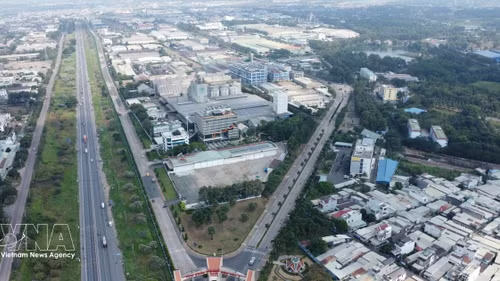
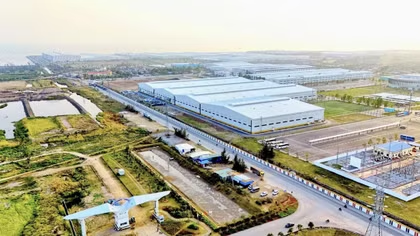
Nam Cau Kien Industrial Park - A representative private sector model in Hai Phong that has been selected by the United Nations Industrial Development Organisation (UNIDO) as one of 37 industrial parks from seven countries participating in the Global Eco-Industrial Park Programme. (Photo: VNA)

More than a year after the implementation of the Politburo’s Resolution 68-NQ/TW on private sector development, Vietnam has introduced a range of new mechanisms and policies aimed at removing institutional bottlenecks, expanding investment space and unlocking resources for businesses.

The reforms are not only creating fresh momentum for the private sector but are also opening greater opportunities for Vietnamese brands to integrate more deeply into regional and global value chains.

According to Dr. Bui Thanh Minh, Deputy Director of the Office of the Private Economic Development Research Board under the Prime Minister’s Advisory Council for Administrative Procedure Reform, Resolution 68 has helped foster a stronger entrepreneurial spirit through a series of concrete policy measures.

Among the notable initiatives are Decree No. 20/2026/ND-CP guiding the implementation of special mechanisms for private sector development, the Prime Minister’s Decision approving the programme to develop 1,000 pioneering enterprises during 2026–2030, and another decision approving a programme aimed at training 10,000 chief executive officers by 2030.

Official data from the National Statistics Office under the Ministry of Finance showed that in the first four months of 2026, Vietnam recorded 77,800 newly established enterprises with total registered capital of nearly 785.4 trillion VND (29.8 billion USD), representing 50.7% in the number of new firms and 60.1% in capital year-on-year.

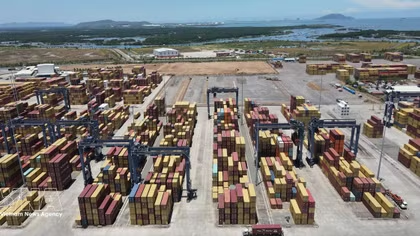
Several major corporations have also proactively proposed and participated in strategic national projects, including high-speed railways, the international financial centre and maritime hubs, reflecting growing confidence within the business community, built on shifts in thinking and policies.

Despite these positive signals, businesses continue to face multiple challenges, including limited access to capital and land, labour shortages, technological transformation pressures, policy uncertainty and high administrative compliance costs. During the first four months of the year, more than 15,000 enterprises completed dissolution procedures, nearly double the figure recorded during the same period last year.

Minh stressed that private sector confidence could only be strengthened through substantive reforms that allow enterprises to feel tangible improvements, including faster administrative procedures, lower compliance costs, reduced legal risks and fairer access to resources and markets.
Resolution 68 opens new pathways for Vietnamese brands in regional, global markets -0
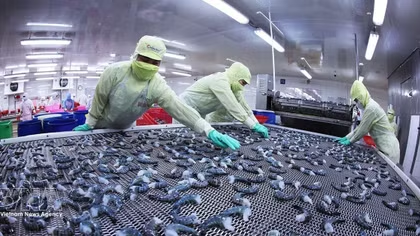
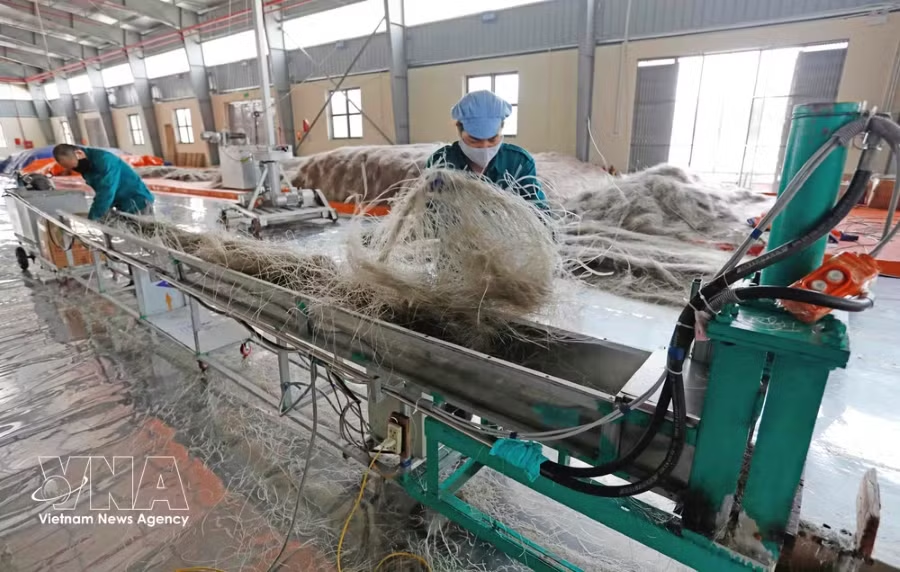
Viet Cuong Vermicelli Cooperative specialises in producing various types of vermicelli for both domestic consumption and export. (Photo: VNA)

To further realise the objectives of Resolution 68, he proposed three major priorities. First, Vietnam should continue building a transparent, stable and predictable business environment to encourage long-term investment, particularly in strategic infrastructure, high technology, digital economy, green growth, logistics, energy and innovation.

Second, administrative reform and implementation efficiency should be put at the centre. Recent government efforts to simplify procedures and business conditions, including the removal of 184 administrative procedures and 890 business conditions, are expected to reduce compliance costs and processing times by more than 50%.

Third, Vietnam should focus on developing a group of pioneering enterprises with the capacity to compete globally. These firms, he noted, should not only possess large-scale operations but also demonstrate strengths in governance, technology, innovation, finance, ESG standards and international competitiveness. Such enterprises could help build stronger domestic supply chains while enabling Vietnamese brands to penetrate deeper into regional and global markets.

The impact of Resolution 68 has also become increasingly visible at the enterprise level. The Dong Tam High-Tech Agriculture Joint Stock Company (Agri Dong Tam), for example, said the resolution has provided an important strategic impetus for private enterprises to accelerate transformation.

According to its General Director Nguyen Van Luu, the company has pursued a “dual transformation” strategy over the past year, combining digital transformation with greener and more sustainable production models. Luu said the biggest change brought by Resolution 68 was not only reflected in a 50% increase in revenue, but also in a shift in business thinking, from “selling what the company has” to “providing what the market needs”, while ensuring environmental responsibility and digital transparency.

He suggested the Government support cooperatives and enterprises in standardising digital traceability systems and carbon emission data in line with international standards. He also called for a legal framework for carbon credits and mechanisms to value specialised agricultural assets, enabling businesses to gain better access to green financing for sustainable investment.

VNA

Other News

Data-driven land valuation to curb speculation: Experts

Data-driven land valuation to curb speculation: Experts

From a property-market perspective, Do Thi Thu Giang, National Director of Valuation and Advisory at Savills Vietnam, said the orientations under Resolution No. 21-NQ/TW could make the market more transparent and efficient, with property values increasingly tied to actual development and use potential.

Resolution No. 19-NQ/TW sets new growth drivers for Vietnam

Resolution No. 19-NQ/TW sets new growth drivers for Vietnam

Science and technology, innovation, digital transformation and AI must be translated into higher productivity rather than pursued as ends in themselves. At the same time, people should be placed at the centre of development, not merely viewed as a resource but as the ultimate objective of development policies.

Expo to open door for Vietnamese suppliers to enter US market

Expo to open door for Vietnamese suppliers to enter US market

US retail giant Target is seeking Vietnamese suppliers of household goods, home textiles, children’s products, personal care and beauty products, with a focus on companies capable of manufacturing and developing products that meet requirements on quality, design and supply chain management.

2026 Banking Sector Digital Transformation to open in Hanoi

2026 Banking Sector Digital Transformation to open in Hanoi

The annual event, which will be held on August 18-19, 2026, at the ICE International Exhibition Centre, 91 Tran Hung Dao Street, Hanoi, is expected to attract around 324 delegates and feature 21 booths representing credit institutions, payment intermediary service providers, and technology companies.

Vietnam – one of most attractive destinations for leading US semiconductor companies: expert

Vietnam – one of most attractive destinations for leading US semiconductor companies: expert

Vietnam has built a solid semiconductor and electronics industry before joining ITSI, attracting major US semiconductor companies. Intel Products Vietnam is one of Intel's largest assembly and testing facilities worldwide, while chip design companies such as Synopsys, Cadence, Marvell and Qualcomm have established engineering and research centres in the Southeast Asian country.

Vietnam targets higher-quality FDI under Resolution 10

Vietnam targets higher-quality FDI under Resolution 10

During the first seven months of 2026, Vietnam attracted more than 38 billion USD in registered FDI, up nearly 58% year-on-year. More importantly, the increase was driven by large-scale, high-tech projects rather than a surge in the number of new investments, signalling a significant improvement in the quality of capital inflows.

Manufacturing, engineering drive hiring growth in H1: report

Manufacturing, engineering drive hiring growth in H1: report

Manufacturing and engineering posted the strongest recruitment growth, with hiring demand surging 70% year-on-year, driven by production expansion, supply chain restructuring and sustained investment inflows in high-tech manufacturing.

Government proposes special mechanisms to unblock APEC 2027 projects in Phu Quoc

Government proposes special mechanisms to unblock APEC 2027 projects in Phu Quoc

The projects in Phu Quoc have been implemented under tight deadlines. Since May 2025, the Prime Minister has directed preparations for APEC 2027, including accelerated infrastructure development on the special zone. An Giang province and investors have subsequently launched a number of major projects involving complex technical requirements and demanding construction schedules.

Financial market reform plan targets high, sustained growth through 2045

Financial market reform plan targets high, sustained growth through 2045

The plan seeks to develop a balanced and modern financial market that is closely integrated with regional and global markets, strengthens the mobilisation and allocation of domestic and foreign capital, and enhances the market’s role as a key provider of medium- and long-term capital for the economy and as a major driver of sustained high economic growth.

An Giang aims to become leading maritime economic hub

An Giang aims to become leading maritime economic hub

Under the province's master plan for 2021–2030 with a vision to 2050, An Giang will prioritise investment in five strategic sectors: strategic infrastructure; processing industries and clean energy; trade, services, logistics and border-gate economy; high-quality tourism; and high-tech agriculture, ecological development and the circular economy.