Connectivity is Key to Vietnam’s Deeper Integration

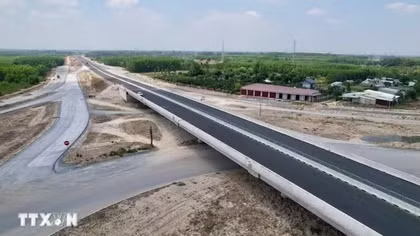
Developing quality connective infrastructure and logistics is crucial to lower trade costs and boost Vietnam’s further integration in both global and domestic markets. This will require a new approach to planning and additional investments in strategic connective assets, a new World Bank report concludes.

The latest Vietnam Development Report, Connecting Vietnam for Growth and Shared Prosperity, launched today, together with one of its background papers Vietnam: Connecting Value Chains for Trade Competitiveness, provide a comprehensive overview of Vietnam’s transport connectivity and how it supports three critical national development goals of integration, inclusion and resilience.
Connectivity is Key to Vietnam’s Deeper Integration ảnh 1
Connectivity is Key to Vietnam’s Deeper Integration

“The rapidly changing patterns of international trade and domestic consumption coupled with increasing natural disaster risks will have implications on Vietnam’s future connectivity needs,” said Ousmane Dione, World Bank Country Director for Vietnam. 

“Upgrading connectivity, not just physical infrastructure but also transportation and logistics services, with the right policies and investments will help Vietnam go a long way towards achieving deeper integration, promoting inclusion and building resilience.”

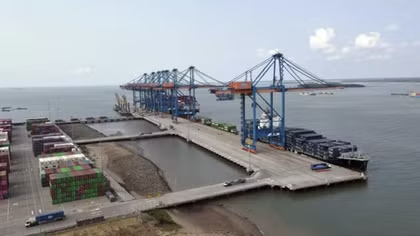
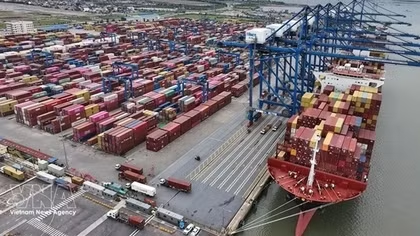
The report finds the uneven development of transport infrastructure across the country, capacity bottlenecks at major gateways, and a major imbalance in supply and demand. The country’s trade flows are concentrated at one quarter of total border gates—two airports, five seaports and five border-crossing points—which collectively handled 86 percent the value of total trade in 2016. As trade grows, so does congestion around these international gateways and border-crossing points.

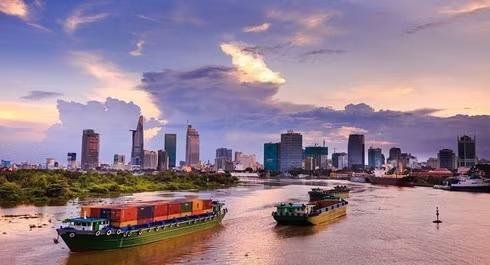
Within the country, the movement of goods is conducted mainly on the road network, which carries three-quarters of total cargo volumes. Vietnam’s extensive network of natural waterways is under-utilized because its ports and landing stages are ill-suited to accommodate larger volumes of cargo. The use of container-based cargo, which enables efficient intermodal transfers, is relatively limited. Meanwhile, Vietnam’s 2,600-km railway network remains stuck at a low state of development.

The report highlights the steps Vietnam can take to address the fragmented state of connectivity to better facilitate international trade.

Reconfigure the network of international gateways by bringing a network perspective in planning and developing gateways, moving away from the current decentralized planning.

Re-orient transport and spatial planning to support critical value chains by creating a new ecosystem of trade and transport links that will be critical to facilitating supply chains, the movement of inputs and final products.  

Create “economic densities” along new corridors by encouraging development of the land surrounding high-value transport nodes for high productivity activities.

The report also sheds light on an often-overlooked issue of how domestic transport and logistic systems are lagging increasingly sophisticated demands from middle-class consumers. As income rises, there is a greater demand for higher standards of services—such as safety, punctuality, freshness, and traceability of traded goods—as well as for competitive prices.

Despite these demand shifts, longstanding supply chains remain intact, particularly for food. A majority of consumers still prefer sourcing foods from traditional markets. “Cold chains”, refrigerated transportation and storage of perishable foods from farms to consumers, are fragmented and mostly serve the export market. Such underdeveloped food supply chains result in food losses estimated to be equivalent to 2 percent of Vietnam’s GDP, high incidence of food-borne diseases and environmental pollution, according to the report.

The rapid development of e-commerce also generates growing needs for new types of logistics services including door-to-door connectivity and last-mile delivery, especially for low-value, small-size parcels. This brings further challenges to Vietnam’s already built-up, congested cities.

The report proposes key measures to develop transport and logistics services to better integrate domestic markets.

Upgrade connectivity “software” by creating an enabling regulatory environment and providing financial incentives to support the growth of logistics service providers and promoting the adoption of technology.

Overhaul market infrastructure and logistics in cities by mainstreaming spatial planning of market infrastructure and logistics facilities into future urban planning.

The report also suggests solutions to improve the resilience and reliability of the transport system and deliver on “last-mile” inclusion in lagging areas with better connectivity.

The Vietnam Development Report is a series of flagship analytical and policy reports produced by the World Bank in Vietnam. This edition of the report has received support from the Government of Australia, through the Second World Bank Group-Australia Strategic Partnership (ABP2). 
PSNews

Other News

Private economic sector poised for breakthrough growth

Private economic sector poised for breakthrough growth

More than a year after the Politburo's Resolution No. 68-NQ/TW on private sector development came into effect, expectations now extend beyond increasing the number of enterprises. The goal is to build a stronger business community with greater resilience, larger ambitions and the capacity to compete in global supply chains.

Vietnam remains ASEAN growth leader in 2026 despite global headwinds: WB

Vietnam remains ASEAN growth leader in 2026 despite global headwinds: WB

Vietnam is expected to remain one of ASEAN’s fastest-growing economies in 2026, supported by resilient exports, strong investment inflows and an ambitious reform agenda, despite mounting global uncertainties, according to the World Bank’s latest Vietnam Economic Update released on May 15.

Ministry establishes monitoring framework for carbon market

Ministry establishes monitoring framework for carbon market

Under a new circular, the exchange of greenhouse gas emission quotas and carbon credits is conducted on the domestic carbon credit exchange through the carbon trading system, which is interconnected with the national registration system.

Biofuel ready for nationwide rollout

Biofuel ready for nationwide rollout

For biofuels, particularly E10, to develop successfully, stronger and more coordinated policies are needed, especially pricing mechanisms capable of creating a sufficiently attractive gap between E10 and mineral-based petrol, an expert has said.

Vietnamese farm produce promoted at African investment, trade forum

Vietnamese farm produce promoted at African investment, trade forum

The 12th Africa Forum for Investment & Commerce (AFIC 12) opened in Algiers, the capital of Algeria, on May 9, drawing around 2,000 participants, including officials, economists, businesses, financial and development organizagtions from 43 African countries and international partners, including Vietnam.

Int'l medical, pharmaceutical expo opens in Hanoi

Int'l medical, pharmaceutical expo opens in Hanoi

The exhibition, which runs until May 9 at the Hanoi International Centre for Exhibition, showcases advanced products and technologies across a range of fields, including pharmaceuticals, drug manufacturing machinery and equipment, medical devices, hospital and clinic services and dental equipment.

Mega projects to transform Ho Chi Minh City urban landscape

Mega projects to transform Ho Chi Minh City urban landscape

Leading the charge in this massive building spree is the new central city square in the core of the Thu Thiem new urban area. Spanning more than 20 ha, it’s the crown jewel of the Central Square and new administrative center complex.

Vietnam establishes itself as one of region’s most dynamic manufacturing and supply bases

Vietnam establishes itself as one of region’s most dynamic manufacturing and supply bases

The country’s stable political and economic environment provides a critical foundation for long-term sourcing strategies. At the same time, Vietnam has demonstrated a strong ability to scale up manufacturing, supported by a continuously expanding industrial base capable of meeting both high-volume demand and increasingly complex technical and quality requirements.

Vietnamese pomelos gain broader access to Australian market

Vietnamese pomelos gain broader access to Australian market

The update by Australia’s Department of Agriculture, Fisheries and Forestry to its Biosecurity Import Conditions system (BICON) on April 10, officially setting out import conditions for Vietnamese pomelos, is regarded as a major milestone in market access efforts.

Vietnam's industry spearheads transition to circular economy

Vietnam's industry spearheads transition to circular economy

The circular economy is no longer just a policy choice. It has become an inevitable trend for delivering sustainable and green growth, sharpening competitiveness at home and abroad, and meeting Vietnam’s net-zero emissions target by 2050. It is now a prerequisite to sustain long-term economic expansion, particularly in industrial production and supporting industries.

Nearly 100 tonnes of Vietnamese fruits, vegetables airlifted to UAE

Nearly 100 tonnes of Vietnamese fruits, vegetables airlifted to UAE

Vietnamese fresh produce and processed foods are increasingly recognised for their quality, with items such as cashew nuts, coffee and spices gaining popularity among Middle East consumers. In 2025, Vietnam’s farm produce exports to the UAE exceeded 445 million USD, up nearly 24% year-on-year.