Cuisine culture in the Plain of Reeds

The gastronomy of the south and the Plain of Reeds in particular was created and enriched during the centuries-old history of the region. The dishes are simple but reflect the local lifestyle.

The Plain of Reeds is blessed with diverse flora and fauna. Because it’s a submerged region, the Plain of Reeds has an abundance of fish and the locals are masters in cooking fish dishes. 

Pham Van Tran, a culture and tourism researcher in Dong Thap province, said, “The Plain of Reeds is a basin. Local cuisines embrace specificities of a wild land. They are natural while the cooking technique is less important than the diversity of local ingredients”.

With abundant fish, local chefs have created a variety of fish dishes including grilled, steamed, and boiled fish, and fish sauce. 
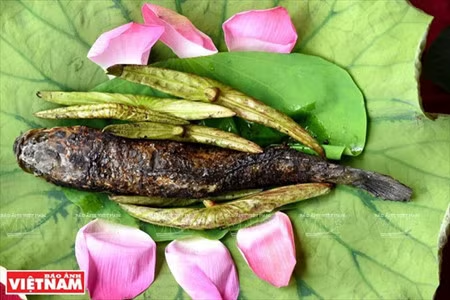
Bamboo-stick-grilled fish is the most popular. After being cleaned, fish are fixed on bamboo sticks with one end planted in the ground and then grilled over rice straw. 

After 5 to 7 minutes, grilled fish are ready to be served with salt or tamarind fish sauce. Linh fish is a local specialty. The fish is only available in the monsoon season. It can be prepared in various ways. 

Tu Be, a local fisherman, said, “Al old expression is “cheap as Linh fish”, but that is no longer the case today. The price can reach 200,000 dongs per kilo. They are marinated with peanuts, salted fish or vinegar, or a sour-sweet broth is prepared with them. "

Mr. Tu Be says Linh fish cooked with Dien Dien or water lily flowers are the most popular and are only available during the monsoon season. Mam kho is another specialty of the Plain of Reeds. It is a mixture of eels, rice crabs and wild vegetables.

The culinary culture of the Plain of Reeds expresses the creativity and open-mindedness of its inhabitants, without too much dependence on the culinary technique or the abundance of local products. 

Researcher Pham Van Tran said, "The cuisine of Dông Thap Muoi testifies to the efforts of our ancestors during the early days of clearing the rich lands of the South. They came from other parts of the country bringing along their cultural traditions. We must preserve and enhance this gastronomic heritage of the Plain of Reeds in order to promote culture and tourism and protect the biodiversity of the local ecosystem. "

VOV5

Other News

Vietnam secure berth at FIFA U17 World Cup 2026 for first time

Vietnam secure berth at FIFA U17 World Cup 2026 for first time

Vietnam national U17 football team secured a place at the FIFA U17 World Cup 2026 for the first time after defeating United Arab Emirates national U17 football team 3-2 on in the final Group C match of the AFC U17 Asian Cup 2026 in Saudi Arabia on early May 14 (Vietnam time).

Vietnam’s most beautiful railway station twins with French counterpart

Vietnam’s most beautiful railway station twins with French counterpart

A twinning agreement between Da Lat Railway Station in Vietnam and Trouville-Deauville Railway Station in France was signed at the French Embassy in Vietnam on May 7, creating new opportunities for cooperation in station management and operations, as well as cultural and tourism promotion between the two sides.

Hanoi gains two more craft villages in World Crafts Cities network

Hanoi gains two more craft villages in World Crafts Cities network

The recognition of Chuyen My and Son Dong craft villages as members of the World Crafts Cities network represents international acknowledgement of the cultural value, artisanal techniques, creativity and sustainable vitality of Vietnam’s traditional craft villages, he said.

Thang Long - Hanoi Festival 2026 to return in September

Thang Long - Hanoi Festival 2026 to return in September

Co-hosted by the municipal People’s Committee, the Department of Culture and Sports, and domestic and foreign agencies, the whole spectacle is meant to honour the city’s millennia-old heritage while reafffirming its strategy of establishing culture as a development engine.

Spreading Vietnamese cultural identity in digital space

Spreading Vietnamese cultural identity in digital space

In the context of deep international integration, cultural identity serves as both a “shield” against assimilation and a defining marker of a nation’s image. Protecting and promoting uniquely Vietnamese cultural values has therefore become a pressing task, particularly in an increasingly complex digital environment.

ITE HCMC 2026 to promote Vietnam’s tourism on global map

ITE HCMC 2026 to promote Vietnam’s tourism on global map

With its large scale, the ITE HCMC 2026 aims to promote tourism cooperation between Vietnam and priority markets such as Northeast Asia, Western Europe, North America, Southeast Asia, and Oceania while also boosting visitor arrivals from the Indian market

Vietnamese puppetry seeks renewal amid preservation challenges

Vietnamese puppetry seeks renewal amid preservation challenges

Although widely regarded as a cultural “speciality” attracting tourists, Vietnamese puppetry is facing multiple challenges in preservation and development, requiring renewed efforts to both safeguard its identity and adapt to contemporary cultural currents.

Project on digital transformation in cultural sector approved

Project on digital transformation in cultural sector approved

By 2030, the project targets the establishment of shared digital platforms across 100% of cultural sectors. All digitised cultural heritage will be standardised under the national data framework and shared in accordance with regulations, while 80% of public digital heritage assets are expected to receive digital identifiers to clarify ownership and management, encouraging organisations and individuals to do the same and support market development.

Vietnam eyes becoming region’s leading tourism destination

Vietnam eyes becoming region’s leading tourism destination

Vietnam has in recent years undergone a notable transformation in its tourism development strategy, placing a strong emphasis on nature-based and eco-tourism. This shift is not merely aligned with global trends, but represents a necessary step towards safeguarding valuable natural resources, while appealing to a growing segment of environmentally conscious travellers.