- Hanoi promotes traditional trade villages
- Ha Giang to build Mong ethnic culture and tourism village
- Foreign tourists to Vietnam in September grow 28 percent
Currently, the country has more than 5,000 craft villages, including more than 4,000 traditional villages and 1,748 of which were recently recognised, with over 200 different types of craft products. They not only have high usable and economic values but also contain cultural values, being a part of national cultural heritages.
Chairman of Vietnam Craft Villages Association Luu Duy Dan said that “A traditional craft village implies an economic environment and a village with specific cultural identities, society and technology. Craft villages' culture is associated with the festive activities imbued with folk identities and human civilisation.”
 |
This form of tourism also contributes to preserving and promoting unique cultural values of Vietnamese villages as well as helps craft villages introduce and sell their products and constantly innovate themselves to meet demands of the society.
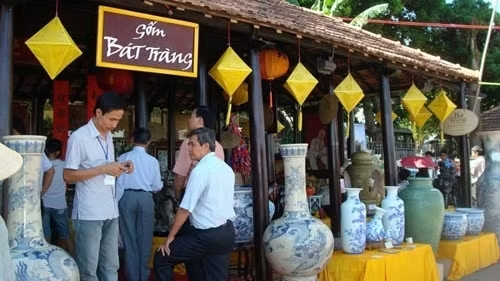
Many craft villages around the country are accelerating tourism development to attract visitors. For example, several craft villages in major cities have become famous destinations that were chosen for tours by numerous travel companies such as Bat Trang pottery, Van Phu silk, Son Dong statuary sculpture, Quat Dong embroidery, Phu Vinh rattan and Ha Thai lacquer.
Local authorities have paid much attention to the construction investment of infrastructure and services, welcoming thousands of visitors each year. Aware of the importance of craft village tourism, many cities and provinces, including Bac Ninh, Thai Binh, Thua Thien Hue, Da Nang and An Giang have implemented a range of activities introducing local craft villages and their products via the internet and at tourism events.
Despite holding great potential, craft village tourism has not been effectively utilised or received adequate investment to become attractive destinations. According to Vice Chairman of Vietnam Craft Villages Association Nguyen Vi Khai, there has not been any long-term development strategy and professional human resources for craft village tourism have not been well trained.
Although craft villages’ products are rich in quality, their competitiveness is weak and only a select few of them have become national and international-level brands. Many localities have failed to set-out reasonable mechanisms and policies to develop craft villages, and haven’t attached special importance to infrastructure and services supporting tourism. In addition, the environment of craft villages is seriously polluted while waste water drainage systems remain in poor condition.
Many tourism experts and representatives of travel companies emphasised that to serve tourism activities, craft villages need to meet the strict requirements and criteria of tourism. In addition to visiting production facilities, visitors can participate in the process of creating a product as well as enjoy the villages’ landscapes and learn more about local customs and festivals.
Director of Hanoi Tourism Department Do Dinh Hong said that Hanoi is setting out the criteria for craft village tourist sites under the international standards with main function areas including parking systems, culinary areas for visitors, technical infrastructure for services, entertainment, water drainage and treatment and lighting systems, places for community cultural activities, areas to introduce and sell traditional products and museums.
Investment in these villages requires the attention of the State, ministries, branches and local authorities, particularly in the culture, sports and tourism sector. When the awareness of the role and position of craft villages in the country’s socio-economic development is raised, the State will have improved mechanisms and policies to develop this tourism form as well as support production facilities and enterprises in the villages, particularly traditional villages, in enhancinge trade promotion and the application of science and technology, as well as in mobilisinge capital.
In the context of globalisation and international integration, domestic products will face stiff competition in the coming time; therefore the villages themselves need to create their own attraction through unique products to become famous brands.
Through tours, craft villages can learn more about the aesthetic tastes of visitors from different countries to innovate technology for production as well as change and renovate designs of their unique products, particularly handicraft products.
In addition, it is highly necessary to focus on caring for and honouring elderly artisans and create favourable conditions for them to train the younger generations.