Fear of carmakers exiting Vietnam re-emerges

The domestic automobile market reaped its highest growth ever last year and is about to enter the stage of motorization, whereas it is wondered if assemblers would withdraw from Vietnam when tariffs on auto imports from ASEAN fall to zero in 2018.

For the first time in its 20-year history, the domestic auto market achieved sales of 300,000 units in 2016, a figure said to be large enough for local manufacturers to consider raising the ratio of local content.

Data from JATO, a site offering statistics and analyses on 52 markets around the world based in the UK, reveals that the growth of Vietnam’s auto market was only second to Singapore last year.

It is said that the local auto market is entering the stage of motorization, when car ownership needs shoot up. Would the forecast about automobile assembly joint ventures staging an exodus from Vietnam when the tariffs on imports from ASEAN fall to zero in 2018 become a reality?

Takimoto Koji, head of Japan External Trade Promotion Organization (JETRO) in HCMC, heated up the topic, saying auto assemblers might switch to import. 

The slow development of supporting industries at home coupled with the small size of the local market might prompt assemblers to revise their strategies when import duties go down, he explained.

Currently, the popular car brands like Toyota, Honda and Ford hold overwhelming market share. Most of these carmakers have at least one factory in Thailand or Indonesia, or both.

To attract manufacturers to pour capital into Vietnam like Thailand and Indonesia, it is a must to have a huge market and well-developed supporting industries, which however are the two weaknesses of Vietnam.

The size of Vietnam’s automotive market is now about 250,000 units per year, way below other countries in the region such as Thailand with two million vehicles a year. Meanwhile, an automobile production line with efficient operations must reach 200,000 units a year, said Takimoto.

Despite the sales record of 300,000 units in 2016, there are two brands selling around 50,000 vehicles each, while the remainder was shared by many domestic assemblers and other importers.

Meanwhile, the Industrial Policy and Strategy Institute (IPSI) remarks that, compared to Thailand and Indonesia, Vietnam is far behind in terms of supporting industries. IPSI’s previous calculations show that the cost of automobile production in Vietnam is about 23% higher than in these two countries.

More to leave than to stay

Analysts and automakers predict that while some major enterprises may continue assembling their best-selling models, the rest will likely switch to import and distribution of CBU vehicles.

Takimoto said there were signs of some assemblers shifting to importing vehicles from other countries in the region, instead of buying parts for assembly in Vietnam for a higher profit.

Even some auto assemblers and manufacturers have hinted at the possibility of switching to importing cars if duties on CBU imports from ASEAN countries fall to 0% in 2018. In fact, a number of firms have been doing so for the past two years.

Even Toyota Vietnam, despite its very good business results last year and its current role as the market leader, seems to be cutting down on the number of its locally-assembled models and switching to import.

Honda on its official entry into Vietnam chose Civic as the first model to be assembled at a plant in Vinh Phuc for its many competitive advantages. However, after about 10 years, Honda Vietnam is now importing Civic cars from Thailand.

Some other passenger car brands like Mitsubishi, Suzuki and Isuzu are also importing more than the volume assembled in Vietnam.

Saigon Times

Other News

Private economic sector poised for breakthrough growth

Private economic sector poised for breakthrough growth

More than a year after the Politburo's Resolution No. 68-NQ/TW on private sector development came into effect, expectations now extend beyond increasing the number of enterprises. The goal is to build a stronger business community with greater resilience, larger ambitions and the capacity to compete in global supply chains.

Vietnam remains ASEAN growth leader in 2026 despite global headwinds: WB

Vietnam remains ASEAN growth leader in 2026 despite global headwinds: WB

Vietnam is expected to remain one of ASEAN’s fastest-growing economies in 2026, supported by resilient exports, strong investment inflows and an ambitious reform agenda, despite mounting global uncertainties, according to the World Bank’s latest Vietnam Economic Update released on May 15.

Ministry establishes monitoring framework for carbon market

Ministry establishes monitoring framework for carbon market

Under a new circular, the exchange of greenhouse gas emission quotas and carbon credits is conducted on the domestic carbon credit exchange through the carbon trading system, which is interconnected with the national registration system.

Biofuel ready for nationwide rollout

Biofuel ready for nationwide rollout

For biofuels, particularly E10, to develop successfully, stronger and more coordinated policies are needed, especially pricing mechanisms capable of creating a sufficiently attractive gap between E10 and mineral-based petrol, an expert has said.

Vietnamese farm produce promoted at African investment, trade forum

Vietnamese farm produce promoted at African investment, trade forum

The 12th Africa Forum for Investment & Commerce (AFIC 12) opened in Algiers, the capital of Algeria, on May 9, drawing around 2,000 participants, including officials, economists, businesses, financial and development organizagtions from 43 African countries and international partners, including Vietnam.

Int'l medical, pharmaceutical expo opens in Hanoi

Int'l medical, pharmaceutical expo opens in Hanoi

The exhibition, which runs until May 9 at the Hanoi International Centre for Exhibition, showcases advanced products and technologies across a range of fields, including pharmaceuticals, drug manufacturing machinery and equipment, medical devices, hospital and clinic services and dental equipment.

Mega projects to transform Ho Chi Minh City urban landscape

Mega projects to transform Ho Chi Minh City urban landscape

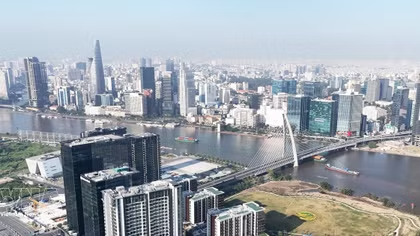
Leading the charge in this massive building spree is the new central city square in the core of the Thu Thiem new urban area. Spanning more than 20 ha, it’s the crown jewel of the Central Square and new administrative center complex.

Vietnam establishes itself as one of region’s most dynamic manufacturing and supply bases

Vietnam establishes itself as one of region’s most dynamic manufacturing and supply bases

The country’s stable political and economic environment provides a critical foundation for long-term sourcing strategies. At the same time, Vietnam has demonstrated a strong ability to scale up manufacturing, supported by a continuously expanding industrial base capable of meeting both high-volume demand and increasingly complex technical and quality requirements.

Vietnamese pomelos gain broader access to Australian market

Vietnamese pomelos gain broader access to Australian market

The update by Australia’s Department of Agriculture, Fisheries and Forestry to its Biosecurity Import Conditions system (BICON) on April 10, officially setting out import conditions for Vietnamese pomelos, is regarded as a major milestone in market access efforts.

Vietnam's industry spearheads transition to circular economy

Vietnam's industry spearheads transition to circular economy

The circular economy is no longer just a policy choice. It has become an inevitable trend for delivering sustainable and green growth, sharpening competitiveness at home and abroad, and meeting Vietnam’s net-zero emissions target by 2050. It is now a prerequisite to sustain long-term economic expansion, particularly in industrial production and supporting industries.

Nearly 100 tonnes of Vietnamese fruits, vegetables airlifted to UAE

Nearly 100 tonnes of Vietnamese fruits, vegetables airlifted to UAE

Vietnamese fresh produce and processed foods are increasingly recognised for their quality, with items such as cashew nuts, coffee and spices gaining popularity among Middle East consumers. In 2025, Vietnam’s farm produce exports to the UAE exceeded 445 million USD, up nearly 24% year-on-year.