Deputy Prime Minister and Foreign Minister Pham Binh Minh attended the 19th ASEAN Plus Three Foreign Ministers’ Meeting, the eighth East Asia Summit (EAS) Foreign Ministers’ Meeting and the 25th ASEAN Regional Forum (ARF) in Singapore on August 4.

These meetings took place within the framework of the 51st ASEAN Foreign Ministers’ Meeting (AMM-51) that officially opened in Singapore on August 2 with the participation of foreign ministers from ten member countries of the Association of Southeast Asian Nations (ASEAN).
Deputy PM and FM Minh applauded efforts to expand cooperation of ASEAN 3 (China, the Republic of Korea (RoK), Japan) in such areas as digital connectivity, e-commerce and smart urban in order to narrow development gap, and promote micro, small-and medium-sized enterprises, food security as well as responses to natural disasters and diseases.
He affirmed that Vietnam will continue to constructively participate in cooperation activities of ASEAN 3.
Minh and other delegates at the event reiterated the important role played by ASEAN 3 in promoting peace, stability, security and prosperity, looking towards building a community in East Asia in the long run.
They noted that trade turnover between ASEAN and China, the RoK and Japan in 2017 made up 32 percent of the ten-member group’s total, and 27 percent of tourists to ASEAN came from Northeast Asian nations.
The ministers voiced their support for free multilateral trade and equality in the region, and agreed on initiatives to step up collaboration between ASEAN and the three countries in food security, education, culture, exchange between residents, health care and issues relating to youths and the elderly.
During the eighth EAS Foreign Ministers’ Meeting, Minh said efforts and resources should be focused on fully implementing the Manila Action Plan for 2018-2022 and backing the adoption of the statement on cooperation in response to emerging transnational issues at the 13th EAS.
He held that the EAS members have potential for maritime cooperation and connectivity, which also match the interests and demands for collaboration in the region.
The official shared concern of the EAS countries over militarisation activities that have eroded trust and increased tensions in the East Sea.
At the event, ministers from ASEAN and its eight partners of China, Japan, the RoK, India, Australia, New Zealand, Russia and the US consented to enhance result-oriented cooperation in a range of realms like environment-energy, education, finance, health care-diseases, natural disaster management, connectivity, economy-trade, food security and maritime affiliation.
Some expressed their deep concern over the recent militarisation activities in the East Sea and demanded no actions that would complicate the situation and unilaterally change the status quo in the area.
All disputes should be addressed peacefully in line with international law, especially the 1982 UN Convention on the Law of the Sea (1982 UNCLOS), and on the basis of respect for legal and diplomatic processes, they said.
Addressing the 25th ARF, Deputy PM and FM Minh suggested the ARF focus on effectively materialising the Hanoi Action Plan and make more renovations in operational method in order to flexibly adapt to regional and international changes.
He used this occasion to announce Vietnam’s initiatives to host an ARF workshop on enhancing cooperation among law enforcement forces at sea, and another on applying the UNCLOS 1982 and international legal tools to cope with marine challenges.
The 25th ARF brought together foreign ministers from the ASEAN member countries and its ten dialogue partners (Australia, Canada, China, the EU, India, Japan, New Zealand, the Republic of Korea, Russia, and the US), along with Papua New Guinea, the Democratic People’s Republic of Korea, Mongolia, Pakistan, Timor-Leste, Bangladesh and Sri Lanka.
At the forum, the ministers agreed to adopt the ARF statement on disaster relief cooperation, the list of the ARF’s activities in 2018 and 2019, and the ARF’s work plans on maritime security and disaster relief in 2018-2020.
Discussing the regional and global situation, they underscored the importance of a rule-based international order and the role of multilateral organisations.
The ministers also voiced concerns over emerging security challenges, including terrorism, trans-national crimes, marine security, cyber security, and natural disasters.
They reaffirmed the significance of maintaining and promoting peace, security, stability, and freedom of navigation and aviation in the East Sea, and settling disputes based on international law and the 1982 UNCLOS as well as respect for diplomatic and legal processes.
They said concerned parties should not use or threaten to use force, and not carry out militarisation activities, while fully and effectively implementing the Declaration on the Conduct of Parties in the East Sea (DOC), towards reaching a Code of Conduct in the East Sea.
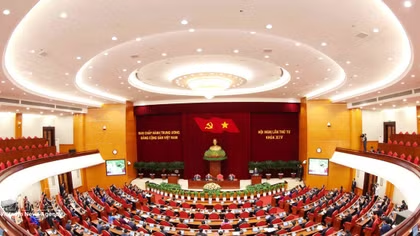
The fourth plenum of the 14th Central Committee of the Communist Party of Vietnam (CPV) continued its second working day in Hanoi on October 6.
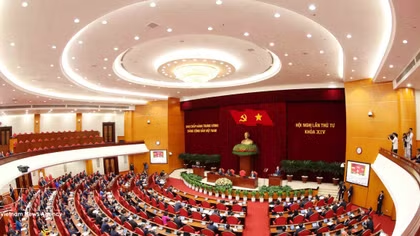
Delegates held group discussions on the CPV Central Committee resolution calling for stronger building and rectification towards a clean, strong and comprehensive Party and political system able to meet the country's development needs in the new era.
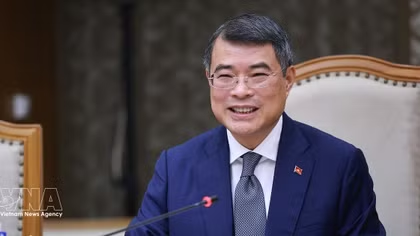
Prime Minister Le Minh Hung will lead a high-level Vietnamese delegation on official visits to Laos and Cambodia from October 8 to 10.
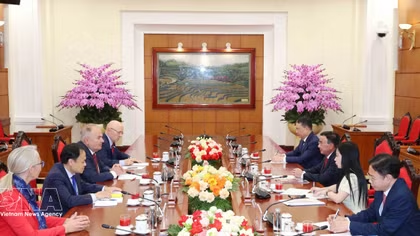
The Communist Party of Vietnam always values its solidarity and friendship with the Hungarian Workers' Party and communist and workers' parties worldwide, which helps build political trust and supports Vietnam's relations with other countries, said key Party leader Tran Cam Tu.
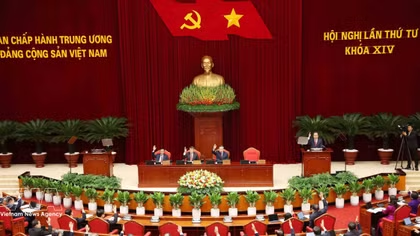
In his opening remarks, General Secretary and President To Lam said that the 14th National Party Congress set out major orientations and strategic goals, while the second and third plenums adopted important policies on Party building, personnel, development and national defence. The fourth plenum must focus on creating conditions for effective implementation while preparing the theoretical, organisational and human resources foundations for the country’s long-term development.
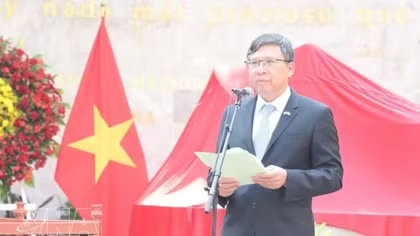
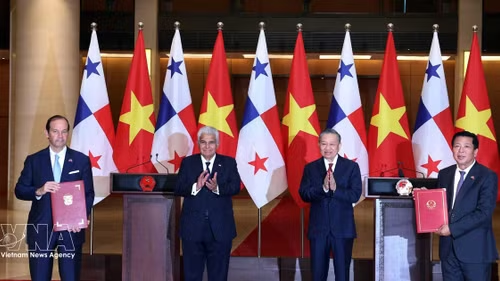
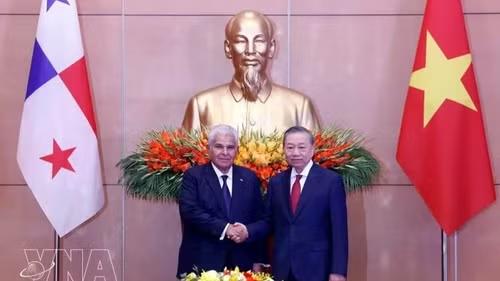
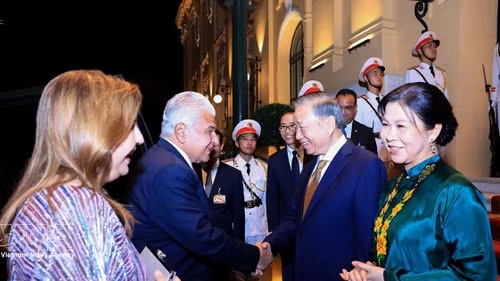
Vietnamese Ambassador to Mexico and Panama Nguyen Van Hai noted that the visit is particularly significant as the first high-level exchange between the two countries in nearly 15 years, following then-President Ricardo Martinelli’s visit to Vietnam in 2012, and came shortly after the 50th anniversary of diplomatic relations in 2025.
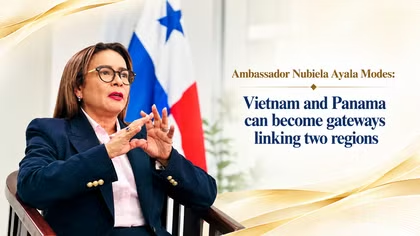
"Panama can serve as a strategic platform for Vietnamese companies seeking greater access to Latin America and the Caribbean, while Vietnam represents an important gateway for strengthening Panama’s engagement with Southeast Asia", Ambassador Nubiela Ayala Modes confirmed.
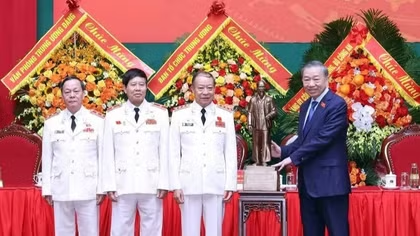
The Vietnam Association of Former People's Public Security Officers must truly serve as a common home that fosters comradeship and solidarity among former public security officers and those who have contributed to the cause of safeguarding security and social order, said top leader To Lam.
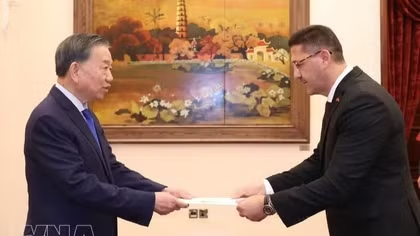
General Secretary and President To Lam receives newly accredited ambassadors
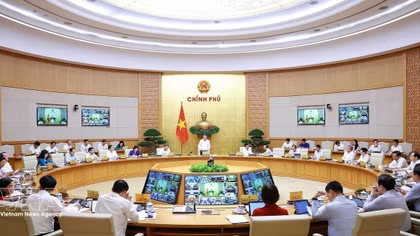
Localities nationwide hailed effective and flexible directions delivered by the Government so far this year, resulting in positive nine-month socio-economic growth, and reaffirmed their commitment to achieving targets set for the whole 2026 at an online Government-locality conference on October 3.
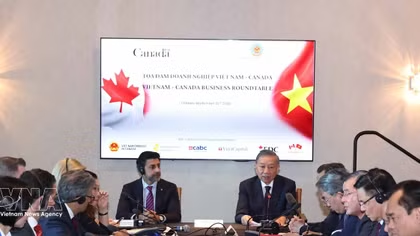
The elevation of bilateral ties to a Strategic Partnership shows that Vietnam and Canada increasingly view each other not simply as trading partners, but as long-term partners in addressing economic, technological and regional challenges.
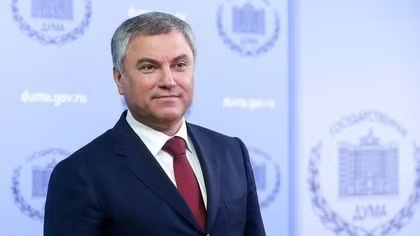
National Assembly President Tran Thanh Man on October 1 sent a congratulatory letter to Vyacheslav Volodin on his re-election as Chairman of the State Duma of the Federal Assembly of Russia.
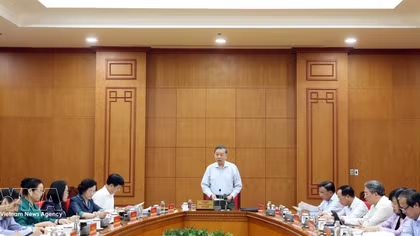
The top leader applauded the efforts of ministries, sectors, localities, social organisations, coaches, athletes, experts in developing physical education and sports in recent times, stressing that Resolution No. 08 has provided an important political foundation for sports development over the past 15 years, while Conclusion No. 70 set important orientations for the new period.
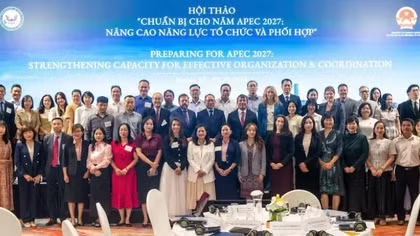
PSNews - Vietnam is recognised by its partners as an influential member of the Asia-Pacific Economic Cooperation (APEC) forum, with expectations that it will continue to demonstrate leadership when it hosts APEC for the third time in 2027, according to Standing Deputy Minister of Foreign Affairs Nguyen Minh Vu.
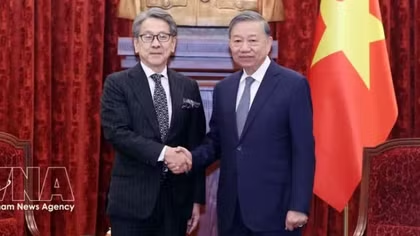
General Secretary and President Lam urged JBIC to continue promoting the substantive implementation of projects under the Asia Zero Emission Community (AZEC), and step up discussions on potential cooperation within the framework of the POWERR Asia (Partnership on Wide Energy and Resources Resilience Asia) initiative, including the development of strategic energy reserves.
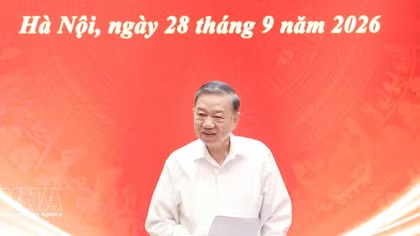
Overhauling the Party’s leadership methods is an objective, inevitable and urgent requirement to elevate the Party’s governing capacity and combat strength and keep the political system effective in the new development era.
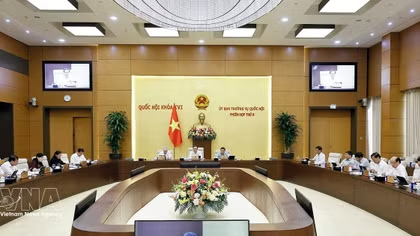
During the session, the NA Standing Committee will give opinions on a number of draft laws, namely the revised Land Law, the revised Housing Law, the revised Law on Real Estate Business, the Law on Legal Normative Documents, and the consolidated Law on the State Budget.
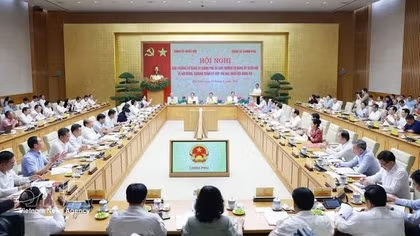
National Assembly President Tran Thanh Man coordination must go beyond finishing the agenda to improve the quality of NA decisions and Government enforcement; deal with policies rather than just paperwork, especially in the fight against corruption and other negative phenomena; and pin down final responsibility for each product, not just progress.
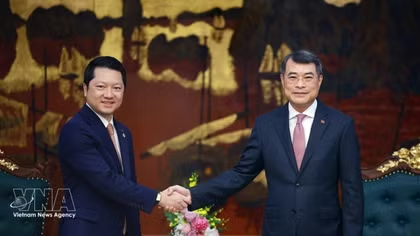
Prime Minister Le Minh Hung asked the two countries' inspection agencies to build on their achievements by regularly exchanging information and experience, maintaining delegation exchanges, and coordinating inspections in areas related to bilateral economic, trade and investment cooperation.
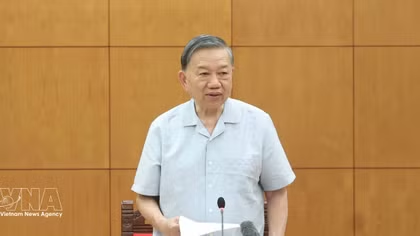
General Secretary and President To Lam demanded a sweeping review rather than piecemeal amendments to individual laws, so that people's rights are protected on a continuing basis.