- Vietnamese efforts to improve local business climate slowing
- Vietnamese businesses look to further optimize opportunities from CPTPP
- Family businesses optimism about growth prospects: PwC
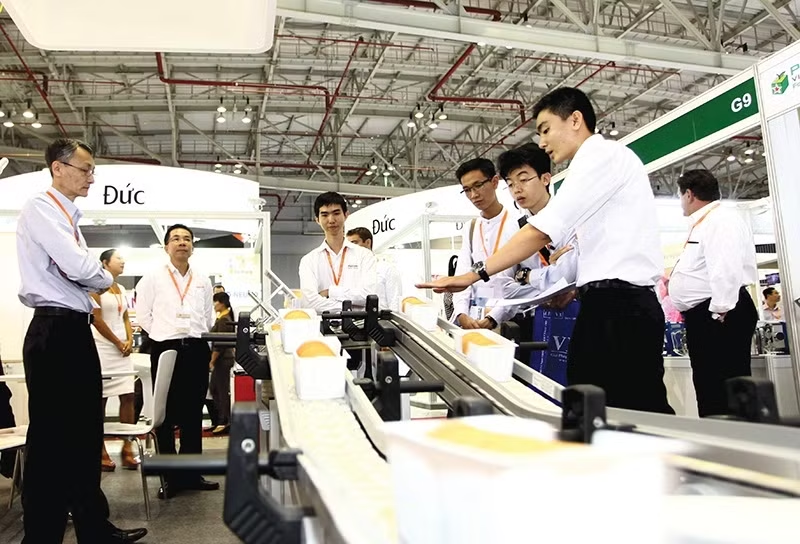
In its fresh analysis for April, global analysts FocusEconomics expects Vietnam to grow 7.4% this year, taking the lead in Southeast Asia in economic growth – where the rate will be 5.3% for the region as a whole.
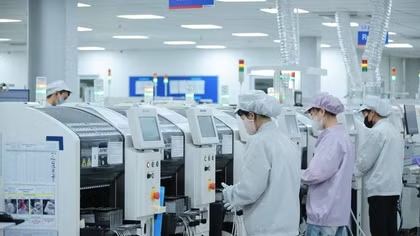
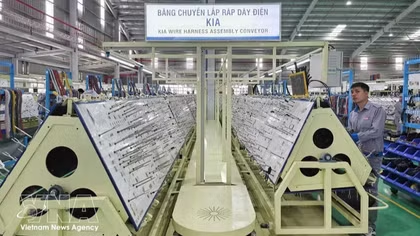
“This year, economic activity is forecast to accelerate rapidly, with growth set to outstrip regional peers on improving domestic and foreign demand dynamics,” FocusEconomics said, adding industrial output will grow 9.4% in 2021. “The underlying strength of Vietnam’s industrial sector remains intact despite COVID-19: Vietnam is an attractive low-cost base for manufacturing firms, including those looking to relocate from China due to the US-China trade tensions.”
According to the analysts, one of the key drivers for Vietnam’s economic growth in general is foreign direct investment (FDI) which is looking for new potential markets including Vietnam.
Deputy Minister of Planning and Investment Tran Quoc Phuong told VIR that despite causing a serious aftermath in Vietnam, the health crisis seems not to be able to prevent FDI inflows to the nation in the long term, with the manufacturing industry continuing to be a big magnet.
“Many big foreign groups and companies are eyeing the Vietnamese market, which has generally succeeded in controlling COVID-19 – this has strengthened their confidence in the market,” Phuong said. “The pandemic is only slowing down the FDI inflows into the country. Many projects are temporarily halted, and will be strongly implemented when the pandemic eases.”
For example, it is expected that representatives of Samsung Vietnam will continue travelling to some provinces to seek locations for its potential projects which will help enrich its investment portfolio in the country.
General director of Samsung Vietnam Choi Joo Ho recently worked with authorities of the northeastern province of Quang Ninh, saying that Samsung is focusing investment in the northern provinces of Bac Ninh, Thai Nguyen, and Ho Chi Minh City, with total capital of over US$17.5 billion in addition to a US$230-million research and development centre under construction in Hanoi.
A representative from Quang Ninh Investment Promotion Centre told VIR, “We expect that Samsung will invest in a project in Quang Ninh. Ho has visited the province’s Dong Mai Industrial Park, which is currently home to 18 projects registered at over US$350 million. Everything is ready for Samsung investment and we hope to continue working with Samsung.”
In early February, LG declared to add about US$750 million to its LG Display Vietnam facility in the northern port city of Haiphong, raising its total investment capital to US$3.25 billion.
A key driver
Senior economic expert Nguyen Mai told VIR that during its national construction and development, FDI attraction has become a bright colour in the Vietnamese economic picture as it has been an important and stable impetus for the economy over the past three decades and more.
As of March 20, Vietnam had nearly 33,300 valid foreign-invested projects registered at US$393.3 billion. Some 19 out of 21 economic sectors have been home to FDI, with processing and manufacturing achieving US$230 billion registered FDI (58.5% of the economy’s total), property business US$60.77 billion (15.4%), and electricity production and distribution US$33.56 billion (8.5%).
As of March 20, total registered foreign investment reached US$10.13 billion, an on-year climb of 18.5%. Total disbursement in the first three months of 2020 is estimated to be US$4.1 billion, up 6.5% on-year.
Foreign-invested enterprises (FIEs) have been providing jobs for 4.5 million direct local labourers and millions of indirect labourers. They create over 50% of industrial production value, while helping the country develop a modern financial and banking system.
According to the General Statistics Office, in the first quarter of 2021, FIEs’ total export turnover, including crude oil exports, hit US$59 billion, up 28.5% on-year and holding 76% of Vietnam’s total export revenue. This is demonstrated by a rise in exports largely created by FIEs, such as mobile phones and spare parts (over 99% mainly by Samsung), equipment (over 93%), and footwear (nearly 82%), and textiles and garments (nearly 63%).
Moreover, also in the first three months of 2021, FDI occupied 25% of Vietnam’s total development investment, 55% of industrial output, 18% of the state budget revenue, and 20% of GDP.
“FIEs have helped Vietnam engage further in international integration since doi moi and the opening door policy were launched, supporting Vietnam to get out of international embargo and recover its relations with many nations and international organisations. Moreover, FIEs have also helped Vietnam enhance its status and prestige in the region and the wider world,” Mai said.
New orientation
Under the resolution of the recent 13th National Party Congress, the Party specified a number of strategic breakthroughs for the country to become a developing country with modernity-oriented industrial development by 2025 when per capita GDP will be US$4,700-US$5,000; a developing nation by 2030 with modern industrial development and upper-middle income; and a developed economy with high income by 2045 – meaning a GDP of US$2.5 trillion with per capita income of about US$18,000 a year.
To this end, one of the strategic breakthroughs will be “creating a good system of laws, mechanisms, and policies, while establishing a favourable, healthy, and fair investment and business climate for all economic sectors, with the promotion of innovation and the mobilisation, management, and effective use of all resources for development – especially land, finance, and public-private partnerships.”
This breakthrough would mean FIEs will have opportunities to perform in a more transparent and equal investment and business climate.
The Party has determined that FDI is an important part of the national economy with a big role to play in mobilising investment capital, technology, modern governance, and expanding export markets.
“A shift is to be made from attracting FDI in quantity to quality. Priorities are to be for projects with high technology and high added values, and with modern governance models, high spillover effects, connecting with domestic businesses,” stated a report passed at the 13th National Party Congress.
Marko Walde, chief representative, Delegation of German Industry and Commerce in Vietnam, explained that FIEs including German ones are contributing significantly to Vietnam.
“Over 500 German companies in the country have created around 47,000 qualified jobs. They also show optimism about Vietnam’s economy in the medium and long term,” Walde said. “Under our AHK World Business Survey, half of the survey participants expected a further development of their companies in Vietnam in 2021.”
In addition, he recommended, there is still room for improvement, as in this survey, German investors in Vietnam pointed out major risks to their development here, namely economic policy framework (68%), trade barriers/preference (32%), legal certainty (27%), exchange rate (23%), and shortage of skilled workers (18%).
Andrew Barnes, deputy head of mission from the Australian Embassy in Vietnam, also commented that for Vietnam to attract more FDI and achieve its dreams over the next decade, “good public policy is also an important contributor to improving Vietnam’s business environment”.
“For example, initiatives such as the Law on Enterprises of 2020 and the Law on Supporting Small- and Medium-sized Enterprises of 2017 have enabled Vietnamese private sector to increase their contribution to national economic prosperity,” Barnes said at last week’s launch of the report on business environment improvement programme assessment by businesses.
This study is supported by Australia’s Aus4Reform Program, aimed to help Vietnam boost administrative reforms.
“Of course, the government can only do so much, and the business community has a critical role to play in informing government authorities of improvements to policy settings to reduce unnecessary regulation and support the business environment and economic growth,” Barnes added.