Four ways to help transform Ho Chi Minh City into a financial hub

With key financial reforms, Ho Chi Minh City has the potential to follow the model of Tokyo, Shanghai, Mumbai, and other cities which came to global financial prominence.
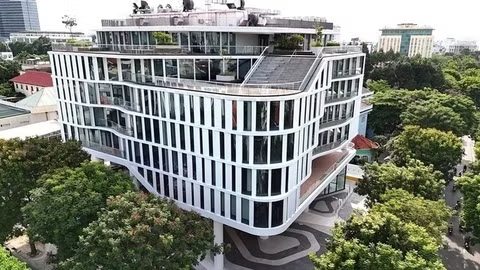
four ways to help transform ho chi minh city into a financial hub hinh 0

Next Dubai?

Ho Chi Minh City (HCMC) joins a growing list of cities from Colombo to Kuala Lumpur that have announced intentions to become international intermediators of capital.

For many of these aspiring financial hubs, Dubai is the model. In the 2000s, Dubai emerged as a global financial center. The impact has been considerable. At the turn of the millennium, the United Arab Emirates had a GDP of $104 billion. By 2018, its economy had not only quadrupled in size but had become less dependent on oil with financial services a major driver of the growth.

Dubai, moreover, achieved this position largely through strength of will. It wasn’t one of the pillars of the world economy like New York or London. It did not benefit from a colonial legacy that bequeathed English law and language skills. Historical happenstance—like Chicago’s dominance of US midwestern agriculture which led to commodity trading or Switzerland’s political neutrality which led to private wealth management—were secondary.

Dubai’s success story, however, is hard to repeat. First, it had some geographic advantages, such as being the hub of a global airline and having neighbors with oil savings ready for investment.

Second, it did not have any obvious regional peers for financial services and was able to fill a vacuum that scarcely still exists given the subsequent proliferation of aspiring financial centers.

Third, its political will was exceptional and extended to amending the Emirati Constitution in 2004 to provide the legal framework that a global financial center would require.

Finally, it was willing to spend. The United Arab Emirates invested in regulatory changes, expatriate salaries, physical infrastructure, and tax incentives. Many countries have more basic needs to fund before considering such largesse.

Key characteristics

The better approach for most countries, including Vietnam, is to first focus on becoming a national financial center. Vietnam has huge investment needs. For infrastructure alone, the annual investment demand is estimated at $18 billion to $20 billion. If HCMC can become an increasingly effective intermediator—raising capital efficiently not only from domestic but international sources—it will not only drive the development of Vietnam’s real economy but also develop the skills and experience necessary to move from a national financial center to an international one. 

A national and later global financial center will require investments in physical infrastructure as well as education and training, but policy reforms are the sine qua non. Indeed, global financial centers across the world share some common characteristics.

Firstly, comprehensive legal frameworks. International investors need clear laws that are predictably enforced. Vietnam currently has several important laws that need to be strengthened or introduced including the Law on Securities, the Law on Credit Institutions, and a law on public-private partnerships to attract more investment into domestic securities, banking, and infrastructure.

The second one is solid market infrastructure. Investors are drawn to markets where they can complete trades efficiently and cost-effectively. Vietnam is lagging in several key areas. Real time gross settlement and delivery-versus-payment are under development.

The netting regime does not meet international standards and forces foreign banks to hold extra capital against exposures in Vietnam. Also, Vietnam does not have a market-determined, short-term benchmark interest rate, which is a cornerstone for so many other components of a modern capital market.

Another essential characteristic is monetary policy independence. Investors want predictability. The implication is that monetary policy decisions must be made with a certain degree of independence. This includes foreign exchange rate flexibility, interbank interest rate stability, and inflation targeting.

Fourthly, robust regimes for anti-money laundering and combating the financing of terrorism are needed. Vietnam has committed itself to implementing the Financial Action Task Force’s recommendations on anti-money laundering and combating the financing of terrorism. These are critical to ensure that foreign banks and investors can transact safely in the domestic market.

Vietnam’s growth trajectory only amplifies HCMC’s opportunity. By 2050, Vietnam is projected to be among the 20 largest economies in the world. If HCMC in coordination with the central government can implement these key financial reforms, it has the potential to follow the model of Tokyo, Shanghai, Mumbai, and others which came to global financial prominence by first funding the development of their own domestic economies.
VOV

Other News

Private economic sector poised for breakthrough growth

Private economic sector poised for breakthrough growth

More than a year after the Politburo's Resolution No. 68-NQ/TW on private sector development came into effect, expectations now extend beyond increasing the number of enterprises. The goal is to build a stronger business community with greater resilience, larger ambitions and the capacity to compete in global supply chains.

Vietnam remains ASEAN growth leader in 2026 despite global headwinds: WB

Vietnam remains ASEAN growth leader in 2026 despite global headwinds: WB

Vietnam is expected to remain one of ASEAN’s fastest-growing economies in 2026, supported by resilient exports, strong investment inflows and an ambitious reform agenda, despite mounting global uncertainties, according to the World Bank’s latest Vietnam Economic Update released on May 15.

Ministry establishes monitoring framework for carbon market

Ministry establishes monitoring framework for carbon market

Under a new circular, the exchange of greenhouse gas emission quotas and carbon credits is conducted on the domestic carbon credit exchange through the carbon trading system, which is interconnected with the national registration system.

Biofuel ready for nationwide rollout

Biofuel ready for nationwide rollout

For biofuels, particularly E10, to develop successfully, stronger and more coordinated policies are needed, especially pricing mechanisms capable of creating a sufficiently attractive gap between E10 and mineral-based petrol, an expert has said.

Vietnamese farm produce promoted at African investment, trade forum

Vietnamese farm produce promoted at African investment, trade forum

The 12th Africa Forum for Investment & Commerce (AFIC 12) opened in Algiers, the capital of Algeria, on May 9, drawing around 2,000 participants, including officials, economists, businesses, financial and development organizagtions from 43 African countries and international partners, including Vietnam.

Int'l medical, pharmaceutical expo opens in Hanoi

Int'l medical, pharmaceutical expo opens in Hanoi

The exhibition, which runs until May 9 at the Hanoi International Centre for Exhibition, showcases advanced products and technologies across a range of fields, including pharmaceuticals, drug manufacturing machinery and equipment, medical devices, hospital and clinic services and dental equipment.

Mega projects to transform Ho Chi Minh City urban landscape

Mega projects to transform Ho Chi Minh City urban landscape

Leading the charge in this massive building spree is the new central city square in the core of the Thu Thiem new urban area. Spanning more than 20 ha, it’s the crown jewel of the Central Square and new administrative center complex.

Vietnam establishes itself as one of region’s most dynamic manufacturing and supply bases

Vietnam establishes itself as one of region’s most dynamic manufacturing and supply bases

The country’s stable political and economic environment provides a critical foundation for long-term sourcing strategies. At the same time, Vietnam has demonstrated a strong ability to scale up manufacturing, supported by a continuously expanding industrial base capable of meeting both high-volume demand and increasingly complex technical and quality requirements.

Vietnamese pomelos gain broader access to Australian market

Vietnamese pomelos gain broader access to Australian market

The update by Australia’s Department of Agriculture, Fisheries and Forestry to its Biosecurity Import Conditions system (BICON) on April 10, officially setting out import conditions for Vietnamese pomelos, is regarded as a major milestone in market access efforts.

Vietnam's industry spearheads transition to circular economy

Vietnam's industry spearheads transition to circular economy

The circular economy is no longer just a policy choice. It has become an inevitable trend for delivering sustainable and green growth, sharpening competitiveness at home and abroad, and meeting Vietnam’s net-zero emissions target by 2050. It is now a prerequisite to sustain long-term economic expansion, particularly in industrial production and supporting industries.

Nearly 100 tonnes of Vietnamese fruits, vegetables airlifted to UAE

Nearly 100 tonnes of Vietnamese fruits, vegetables airlifted to UAE

Vietnamese fresh produce and processed foods are increasingly recognised for their quality, with items such as cashew nuts, coffee and spices gaining popularity among Middle East consumers. In 2025, Vietnam’s farm produce exports to the UAE exceeded 445 million USD, up nearly 24% year-on-year.