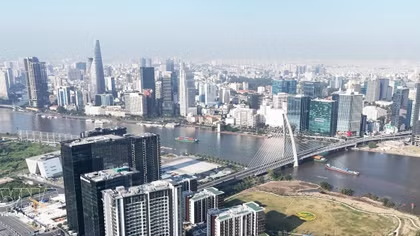
- Hundreds of tasty dishes presented at 2017 International Food Festival
- Vietnam, EU seek to accelerate FTA signing
- Potential impact of EU-Vietnam FTA
Tran Thanh Hai, Deputy Director of the Ministry of Industry and Trade’s (MoIT) Import-Export Department, told Vietnam News Agency (VNA) that from 2018 onward, 85% of Vietnamese exports will be subject to significantly lowered tariff levels of zero to 5%.
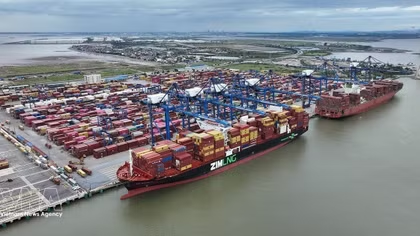
As part of the Government’s policy to increase economic self-reliance and promote sustainable imports and exports, exports of Vietnamese goods to FTA markets grew strongly in 2017, contributing US$213.8 billion to the year’s turnover of US$408 billion, per the MoIT’s data.
 |
Hai was optimistic that Vietnamese businesses will benefit more from bilateral and multilateral FTAs with partners such as China’s Hong Kong, Japan and the Republic of Korea (RoK).
Nonetheless, Hai admitted that the process of raising Vietnamese exports’ value might not be as easy as expected. Since each FTA is tailor-made to suit member countries’ needs, they have different levels of commitments and standards.
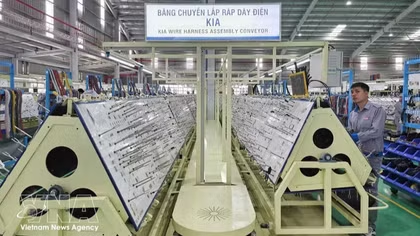
For example, he was greatly concerned by the fact that a Vietnamese automobile company would only be able to enjoy a zero percent tax rate when exporting to ASEAN countries if their products have at least 40 percent of components originating in Vietnam.
Therefore, Hai suggested domestic enterprises focus on meeting standards set by the Vietnam-Korea FTA (VKFTA) and the ASEAN-Japan Comprehensive Economic Partnership Agreement (AJCEP), since they offer more special tariff treatments at fewer standard requirements than others.
The origin rules would encourage the country to produce locally, rather than importing materials and parts. But this could prove a long and difficult process for Vietnamese firms, he added.
Buy less, sell more?
Le Tien Truong, Vice Chairman of the Vietnam Textile and Apparel Association (Vitas), told VNA that textiles and garments exports growth rate to European market may not get an immediate boost from the Vietnam-EU Free Trade Agreement (EVFTA), due to preferential rules of origin.
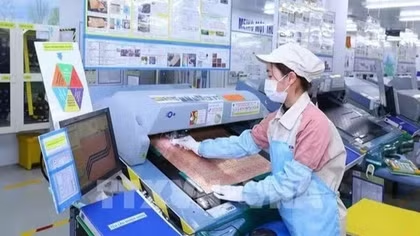
Currently, the Vietnamese textile and apparel industry has to import 70 percent of its raw materials, 42% of which come from China and the rest from ASEAN and the RoK.
On the other hand, starting in 2018, many preferential import tariffs to Vietnam will be progressively eliminated to 0%, provided the imported goods meet the MoIT’s provisions on origin of goods and Certificate of Origin (CO) and be listed in the 17 FTAs of which Vietnam is a member.
Pham Tuan Anh, Deputy Head of the International Relations Department under the Ministry of Finance, told the Ministry of Planning and Investment’s online portal last week, that import tariffs reduction and elimination must be carefully carried out, lest it harm the State budget and domestic production activities.
Imports eligible for zero tariffs mainly come from ASEAN-related trade agreements, though pacts signed with Japan, China, RoK and the Eurasian Economic Union also boast a significant amount, according to 2017 year-end reports from the General Department of Vietnam Customs (GDVC).
For example, the VKFTA requires Vietnam eliminate 704 import tariffs lines in 2018, while the AKFTA demands 477 tariff lines eliminated and 588 for the ASEAN-China Bilateral Trade Agreement (ACFTA).
Similarly, the Vietnam’s Special Preferential Tariff Schedule for the Implementation of the ASEAN Goods Trade Agreement between 2018 and 2022 indicates a drop of 0.9% in average tariff levels across all imports from 2017’s number, as calculated by the GDVC.
Since these reductions were made public once the FTAs were signed, the MoF and the Vietnamese business community had ample time to prepare, said Tuan Anh.
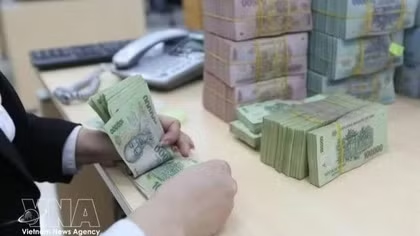
Despite fears that cutting import taxes will lead to a drop in State budget revenue, the GDVC reported overall income of VND293 trillion (US$13 billion) from import tax in 2017 alone, with a 2018 target of VND295 trillion (US$13.1 billion), he added.
Though Vietnam had a trade deficit with China, ASEAN and the RoK, the country’s annual export turnover to these markets was growing strongly, up 60.6%, 24.5% and 31% respectively in 2017, Tuan Anh said.
Therefore, Vietnam’s FTAs would help promote economic growth, attract foreign investment, increase State budget revenue, create jobs and solve social security issues, instead of harming import-export balance, he said.
A helping hand
Surrounded by immense opportunities and challenges requiring initiative and flexibility, domestic enterprises should improve product quality, increase competitiveness and develop business plans to meet these FTAs’ requirements.
Bui Kim Thuy, Deputy Head of Origin of goods Division, MoIT’s Import-Export Department, said in recent time, the ministry had made efforts to cut administrative procedures to help domestic enterprises take advantage of tariff preferences and rules of origin.
She listed a significant improvement in administrative procedures for issuing certificates of origin, which helps enterprises spend less time and costs via online registration.
Still, Thuy admitted that Vietnamese enterprises had not shown a desirable level of interest in the issue, due to lack of awareness.
She hoped that if domestic businesses understand and follow these FTAs’ rules of origin, they will be able to take advantage of upcoming opportunities to enhance added value and ensure sustainable growth.