German Economy Accelerates in Q1 Despite Rising Political Turmoil in EU

Higher industrial output and a solid foreign trade surplus contributed to an acceleration of the German economy in the first quarter, offsetting fears of political turmoil in the Eurozone, stemming from the anti-EU sentiment in France and Italy.

As the winds of isolationist nationalism are rising in France and Italy, the Eurozone's second- and third-largest economies, Europe's powerhouse and economic leader Germany has seen growth improve this year. 

Driven by a solid foreign trade surplus, the economy of Germany is challenging the international competitiveness of the US, not to mention France and Italy. 
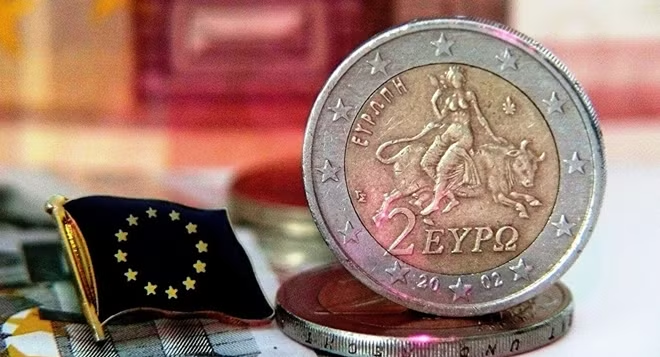
Photo: Pixabay
Photo: Pixabay 

Despite rising political fears inside the EU ahead of the French presidential election, Germany remains the ultimate economic driver in the high-risk environment of the Eurozone's economy.

The German Finance Ministry said on Friday that economic growth in the country is expected to have accelerated in 1Q17. The German GDP added some 1.9pc in 2016, its best result in five years, having expanded by 0.4 percent in 4Q of 2016 alone. Its increase in tax revenues early this year is interconnected with the ongoing economic acceleration. 

"The German economy continues to be on the up," the Finance Ministry said in its monthly statement, having also said that the upbeat output data, an increase in factory orders and a consolidation in the labor market all point to an acceleration in 1Q17.  

The ongoing Brexit process, the political concerns of a possible Frexit and Itexit, as well as the United States' agenda of economic isolationism and protectionism, however, keep the German growth outlook subdued somewhat as investors remain highly cautious.  

In the first quarter of this year, German federal tax revenues increased by 6.8 percent annualized, far above the earlier expectations of just 2.9pc for the entire twelve months. Subsequently, this allows the federal government to increase its infrastructure investment and housing development, among other things, without adding to government debt.  

This, however, resulted in an increase in the Deutsche Bund value, hitting the yield and natural interest rates, making it harder for the European Central Bank (ECB) to plan a normalization in monetary policies.  

Meanwhile, in France, where anti-EU sentiment is on the rise, claims that the German trade surplus is hurting French economic interests are becoming louder. French presidential candidate Emmanuel Macron said that the entire Eurozone is disadvantaged by buoyant German exports.  

"Germany benefits from the imbalances within the Eurozone and achieves very high trade surpluses," Macron, a fairly moderate candidate in comparison with the explicitly anti-EU Marine Le Pan, said. "Those aren't a good thing either for Germany or for the economy of the Eurozone. There should be a rebalancing."

Now, Germany is hardly interested in a rebalancing of any sort as industrial exports are driving its growth. Even the US has repeatedly expressed the sentiment that German exports in manufactured goods are hard to compete against, and the Trump administration said that the euro is 'grossly undervalued'. 

German Finance Minister Wolfgang Schauble, however, denied the allegations of Germany taking advantage of other nations in foreign trade, saying that strong international market demand is driving German exports rather than 'unfair' trade practices of any sort.  

German trade practices are "normal in an open economy," the German Finance Ministry said. "They are the expression of diverse comparative advantages held by different national economies and their associated specialties." 

The global trade disagreements and intra-EU political risks might, however, hold back the acceleration of the German economy in the near-term. Still, even if France and Italy leave the Eurozone and the EU altogether, the German current account surplus is poised to remain at its current levels or higher, mainly because the euro will have devalued even more after the Frexit and/or Itexit shocks. 

A resulting euro/dollar parity could actually propel German economic growth even higher, and the monetary policy tools of the Frankfurt-based ECB would allow for a more balanced and focused Eurozone.  

Sputnik News

Other News

Private economic sector poised for breakthrough growth

Private economic sector poised for breakthrough growth

More than a year after the Politburo's Resolution No. 68-NQ/TW on private sector development came into effect, expectations now extend beyond increasing the number of enterprises. The goal is to build a stronger business community with greater resilience, larger ambitions and the capacity to compete in global supply chains.

Vietnam remains ASEAN growth leader in 2026 despite global headwinds: WB

Vietnam remains ASEAN growth leader in 2026 despite global headwinds: WB

Vietnam is expected to remain one of ASEAN’s fastest-growing economies in 2026, supported by resilient exports, strong investment inflows and an ambitious reform agenda, despite mounting global uncertainties, according to the World Bank’s latest Vietnam Economic Update released on May 15.

Ministry establishes monitoring framework for carbon market

Ministry establishes monitoring framework for carbon market

Under a new circular, the exchange of greenhouse gas emission quotas and carbon credits is conducted on the domestic carbon credit exchange through the carbon trading system, which is interconnected with the national registration system.

Biofuel ready for nationwide rollout

Biofuel ready for nationwide rollout

For biofuels, particularly E10, to develop successfully, stronger and more coordinated policies are needed, especially pricing mechanisms capable of creating a sufficiently attractive gap between E10 and mineral-based petrol, an expert has said.

Vietnamese farm produce promoted at African investment, trade forum

Vietnamese farm produce promoted at African investment, trade forum

The 12th Africa Forum for Investment & Commerce (AFIC 12) opened in Algiers, the capital of Algeria, on May 9, drawing around 2,000 participants, including officials, economists, businesses, financial and development organizagtions from 43 African countries and international partners, including Vietnam.

Int'l medical, pharmaceutical expo opens in Hanoi

Int'l medical, pharmaceutical expo opens in Hanoi

The exhibition, which runs until May 9 at the Hanoi International Centre for Exhibition, showcases advanced products and technologies across a range of fields, including pharmaceuticals, drug manufacturing machinery and equipment, medical devices, hospital and clinic services and dental equipment.

Mega projects to transform Ho Chi Minh City urban landscape

Mega projects to transform Ho Chi Minh City urban landscape

Leading the charge in this massive building spree is the new central city square in the core of the Thu Thiem new urban area. Spanning more than 20 ha, it’s the crown jewel of the Central Square and new administrative center complex.

Vietnam establishes itself as one of region’s most dynamic manufacturing and supply bases

Vietnam establishes itself as one of region’s most dynamic manufacturing and supply bases

The country’s stable political and economic environment provides a critical foundation for long-term sourcing strategies. At the same time, Vietnam has demonstrated a strong ability to scale up manufacturing, supported by a continuously expanding industrial base capable of meeting both high-volume demand and increasingly complex technical and quality requirements.

Vietnamese pomelos gain broader access to Australian market

Vietnamese pomelos gain broader access to Australian market

The update by Australia’s Department of Agriculture, Fisheries and Forestry to its Biosecurity Import Conditions system (BICON) on April 10, officially setting out import conditions for Vietnamese pomelos, is regarded as a major milestone in market access efforts.

Vietnam's industry spearheads transition to circular economy

Vietnam's industry spearheads transition to circular economy

The circular economy is no longer just a policy choice. It has become an inevitable trend for delivering sustainable and green growth, sharpening competitiveness at home and abroad, and meeting Vietnam’s net-zero emissions target by 2050. It is now a prerequisite to sustain long-term economic expansion, particularly in industrial production and supporting industries.

Nearly 100 tonnes of Vietnamese fruits, vegetables airlifted to UAE

Nearly 100 tonnes of Vietnamese fruits, vegetables airlifted to UAE

Vietnamese fresh produce and processed foods are increasingly recognised for their quality, with items such as cashew nuts, coffee and spices gaining popularity among Middle East consumers. In 2025, Vietnam’s farm produce exports to the UAE exceeded 445 million USD, up nearly 24% year-on-year.