 |
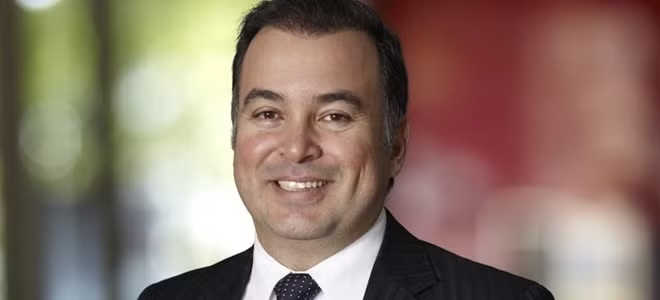
| Tunc Akyurt, CEO of GKFX |
As the regulatory landscape across Europe has changed, companies are looking for better ways to realize operational efficiencies. A couple of weeks ago, we reported on the latest steps undertaken by GKFX, an FCA-regulated brokerage which has been housing both retail and professional clients.
After an internal review, the company decided that it is refocusing its London-headquartered subsidiary into a new direction. At the same time, the firm also unveiled that it is moving its retail and elective professional clients to its Malta-regulated subsidiary, AKFX.
The strategic changes are driven by the company’s drive to restructure its business after the new ESMA regulations. The company’s CEO Tunc Akyurt shared an insight into what was the company’s strategy after the latest changes in EU regulations took place last year.
ESMA-Driven Industry Changes
GKFX’ CEO Tunc Akyurt explained that by the time discussions commenced on regulatory changes with ESMA, GKFX initiated its plan to implement a change in its commercial strategy and business model. The company’s goal was to stay in line with the changing regulatory environment and make the best use of it from it.
As the new regulatory requirements took hold, the company started to steer its retail client base into a new trading brand for GKFX Europe, AKFX. The firm is regulated by the Malta Financial Services Authority (MFSA) and is also servicing the elective professional clients of the company.
“We are aware that in the marketplace there is an understanding that higher leverage always means a shorter life-span for a retail trader’s account and higher revenue. However, Global Kapital Group takes a different perspective. ESMA contributed to the market’s consolidation, a better reputation for all local regulators running under ESMA’s supervision, and ultimately enhanced customer protection,” Akyurt explained.
Global Diversification
At the same time, the GK Group of companies has been actively diversifying its markets. The firm’s CEO shared that the brokerage currently has a vast presence in the Far East with a subsidiary in Indonesia called GK INVEST and a brand new branch in Cambodia with GKFX CAMBODIA.
GKFX is also represented in Thailand, Vietnam, Malaysia, and China through its partnerships with the GKFX PRIME brand. The group is providing its services for Spanish, German, and Italian customers with GKFX EUROPE, which is the trading brand of the MFSA-regulated company AKFX Financial Services.
As previously reported, starting from the 1st of June, the GKPRO brand under the FCA license will be exclusively servicing professional and institutional customers.
“We decided not to onboard new retail and elective professional clients to GKFX UK. Given this change in the segmentation strategy of GKFX, we decided to re-brand GKFX UK as GKPRO. We recently started to ask our UK based retail and elective professional clients to migrate their accounts to our MFSA-regulated company AKFX Financial Services Ltd, which is also a member of Global Kapital Group.
Institutional Business
Recent changes in the industry drove a push into the institutional side of the business with GKFX also pivoting and expanding its services in this area. Relative to the rest of the company’s business, institutional services represent around 30 percent out of the firm’s total business, the firm’s CEO shared.
Within the segment, the company states that it is already servicing asset managers, FX brokers, with funds and corporations also being interested. The company is particularly strong in Turkey, where it started its business.
After the regulatory changes in the country a bit over two years ago have effectively shut down the retail market, institutional clients have picked up the slack.
“During the last couple of years we increased the number of institutional clients using our liquidity pools and collaborating with us as a hedging venue. As a result, while retail business got smaller, our institutional business in Turkey became stronger,” Akyurt explained.
Industry Trends and Corporate Focus
After taking over as Group CEO in charge of the global brokerage business in March 2019. Tunc Akyurt has been refocusing the firm’s efforts on sustainable growth and strengthening of the governance structure and compliance.
“We are exploring new market opportunities and evaluating various license acquisition opportunities in different markets. Our total staff size across all countries under the Global Kapital Group is now over 1000 employees. GK Group has operational locations across 15 different countries around the world,” Akyurt shared.
As the new regulatory changes in Europe took effect, the company has also increased the quality and quantity of staff especially employed in the compliance departments, taking on a local supervisory board members and implementing changes to its product portfolio to enable stricter adherence to regulations.
“In Europe we believe ESMA will build up a stronger level of trust in the coming years and both the existing equity stock investors and the new ones will have interest in the FX industry which has the technology to offer multiple assets via one single digital platform. The number of clients to be acquired will increase gradually,” Akyurt concluded.