Great National Solidarity consolidated

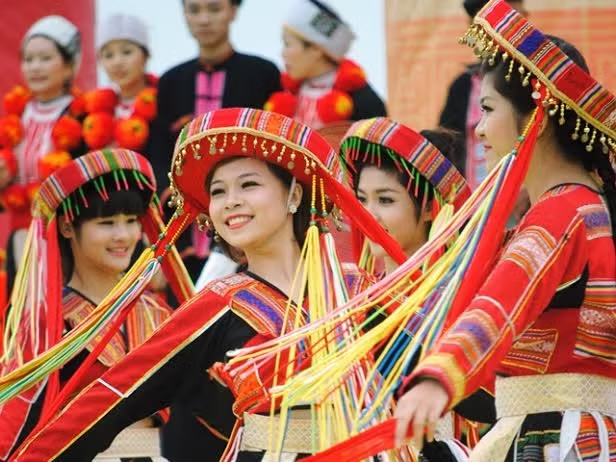
Vietnam is a country with 54 ethnic groups, most of whom live in remote, mountainous areas near Vietnam’s northern and western border. The Vietnamese Party and State consider resolving ethnic issues a key to social consensus and great national solidarity creation.

To mark the 87th anniversary of the Vietnam Fatherland Front on November 18, VOV editor has this report.

Vietnam’s view on national solidarity

Immediately after its establishment on February 3, 1930, the Communist Party of Vietnam adopted a policy of uniting patriotic forces and social classes to liberate the nation from colonial oppression.

On November 18, 1930, the Vietnam National United Front, now the Vietnam Fatherland Front, was established. Embracing the idea of promoting the people’s mastery, the Vietnamese Party and State have worked to consolidate the great national solidarity for national liberation, unification, and construction.

In the current course of national development, national unity means the widespread cooperation of social classes, ethnic people, religious groups, and Vietnamese communities inside and outside Vietnam on the basis of shared fundamental interests and national independence combined with socialism to achieve the goal of a wealthy people, and a strong, fair, democratic, and civilized society.  

Article 9 of the Constitution defines the Vietnam Fatherland Front as a political alliance organization, a voluntary federation of political organizations, social-political organizations, social organizations, and outstanding individuals representing the various social classes, strata, ethnic groups, religions, and overseas Vietnamese. 

The Front is a political platform for the people' administration expressing the people's will and aspirations, gathering the great national unity, practising democracy, promoting social consensus and oversight, contributing to building the Party and State, and conducting people diplomacy for national construction and defense.

The Vietnam Fatherland Front has helped the State to improve the people’s living standards through movements and programs such as poverty reduction, paying debts of gratitude, and helping victims of natural disasters.

National unity policy during integration process

During the current globalization process, the Vietnamese Party and State have incorporated religion into ethnicity policy.  Respecting freedom of religion and belief helps bridge divisions and eliminate discrimination against ethnic groups.

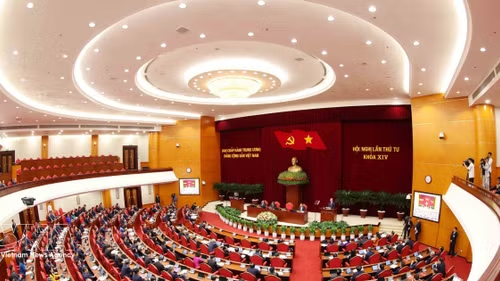
Every year, senior leaders pay visits to residential areas to observe Great National Solidarity Day. They hold dialogues with the people, listen to their aspirations, and addressed their concerns. 

People’s petitions and complaints are settled. Provocations by hostile forces and attempts to sabotage national unity and divide the Party from the people are dealt with.

Vietnamese leaders understand that only through solidarity, can national reform and development be successful.
VOV

Other News

National Assembly Chairman urges renovation in leadership, working style

National Assembly Chairman urges renovation in leadership, working style

The NA's Committee for Cultural and Social Affairs has moved fast to reshuffle its organisation after the 14th National Party Congress and the election of deputies to the 16th NA, updating its work agenda to match new directives set out in the resolutions of the 14th National Party Congress and the first Congress of the NA Party Organisation for the 2025–2030 term.

Vietnam treasures ties with Croatia: PM

Vietnam treasures ties with Croatia: PM

Vietnam and Croatia should strive to double bilateral trade turnover from the current level of 161 million USD; study the establishment of a Joint Committee on Economic Cooperation to create a long-term, stable, and effective framework for collaboration, said Prime Minister Le Minh Hung.

President Ho Chi Minh's enduring legacy highlighted at Venezuela commemoration

President Ho Chi Minh's enduring legacy highlighted at Venezuela commemoration

Vice President of the United Socialist Party of Venezuela (PSUV) Jesús Faria expressed deep admiration for President Ho Chi Minh and Vietnam’s indomitable struggle for national independence. He described President Ho Chi Minh as an immortal symbol of 20th-century national liberation movements, whose legacy continues to inspire leftist parties, progressive movements, and peoples across Latin America, including Venezuela.

Vietnam proposes key cooperation orientations at BRICS Foreign Ministers' Meeting

Vietnam proposes key cooperation orientations at BRICS Foreign Ministers' Meeting

Deputy Foreign Minister Nguyen Minh Hang shared Vietnam’s approach to building an independent and self-reliant economy linked to deep international integration, while proposing several key areas for enhanced cooperation between BRICS and partner countries at the Expanded BRICS Foreign Ministers' Meeting that opened on May 14 in India.

Vietnam asks parties to respect its sovereignty over Truong Sa

Vietnam asks parties to respect its sovereignty over Truong Sa

PSNews - The spokesperson stated that the dispatch of personnel by relevant parties to features belonging to Truong Sa without Vietnam’s permission constitutes a violation of Vietnam’s sovereignty under international law. She stressed that such actions run counter to the Declaration on the Conduct of Parties in the East Sea (DOC) as well as ongoing efforts by countries to negotiate a Code of Conduct in the East Sea (COC).

Hanoi to host ASEAN Future Forum 2026 in mid-June

Hanoi to host ASEAN Future Forum 2026 in mid-June

PSNews - Vietnam’s proposals placed the highest priority on ensuring a peaceful and stable environment conducive for continued sustainable development and improving the well-being and happiness of the ASEAN people. They were praised by member states and incorporated into the core contents of the ASEAN Leaders’ Statement on the response to the Middle East crisis.

Vietnam promotes cooperation with United Nations on crime prevention

Vietnam promotes cooperation with United Nations on crime prevention

Vietnam highly values the support of the United Nations Office on Drugs and Crime (UNODC) in strengthening national capacity in crime prevention and criminal justice, drug control, and addressing emerging challenges, particularly cybercrime, said Ambassador Vu Le Thai Hoang.

Party, State leader calls for consolidation of central steering committees on legal, judicial reform

Party, State leader calls for consolidation of central steering committees on legal, judicial reform

Consolidating the central steering committees for institutional and legal reform and for judicial reform is necessary in order to streamline organisational structures without reducing responsibilities, while ensuring clear accountability, measurable outputs and concrete results. Following the restructuring, the body will be renamed the central steering committee for institutional improvement and law enforcement, with the Party General Secretary and State President serving as its head.

Vietnam strives for substantive outcome at NPT review conference

Vietnam strives for substantive outcome at NPT review conference

At the meeting this week, Ambassador Viet briefed the UNGA President on developments during the first two weeks of the conference. He stressed that the current international geopolitical landscape poses numerous complex challenges, while reaffirming Vietnam’s determination, together with other member states, to promote substantive and balanced outcomes at the conference.

Top leader of Vietnam receives Vientiane official in Hanoi

Top leader of Vietnam receives Vientiane official in Hanoi

The host leader stressed that cooperation between localities, particularly between the capitals of Hanoi and Vientiane, plays an especially important role as a pioneering force in effectively implementing the foreign polices of the two Parties and States, while also serving as a bridge between politics and development, as well as between strategy and concrete action.