Hanoi’s 100-year master plan must put people at centre: PM

According to Prime Minister Pham Minh Chinh, the philosophy of the plan must place people at the centre and as the driving force of development, and Hanoi should aim to become a prosperous, civilised and modern city that preserves its cultural identity.

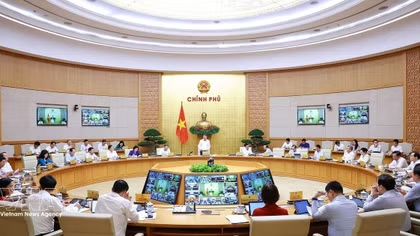
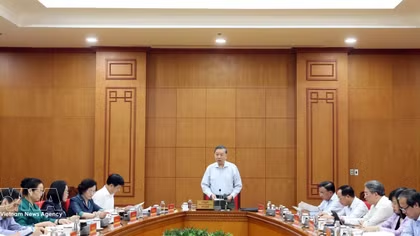
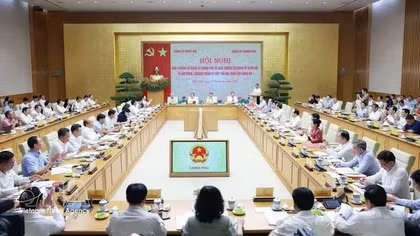
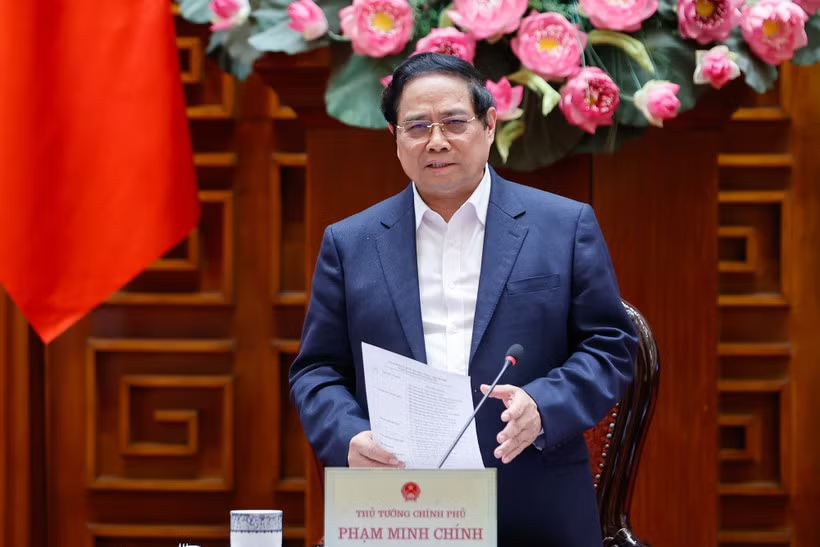
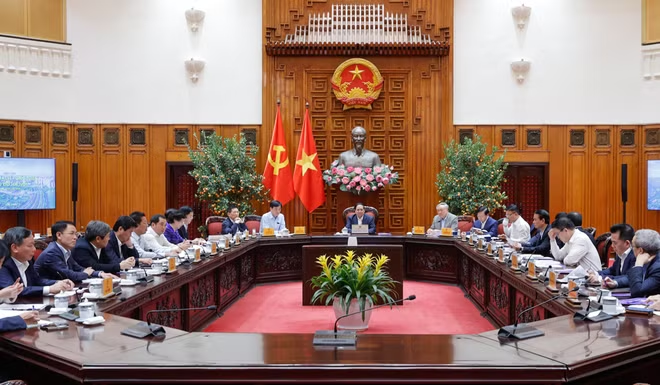
Prime Minister Pham Minh Chinh on March 14 chaired a meeting between the permanent Government members and leaders of Hanoi to review and provide feedback on the draft Hanoi Capital Master Plan with a 100-year vision.
Hanoi’s 100-year master plan must put people at centre: PM -0
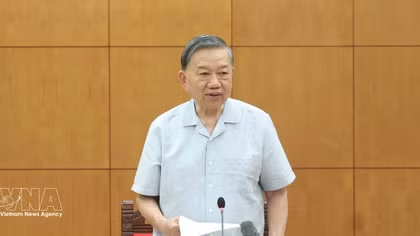
Prime Minister Pham Minh Chinh addresses the meeting meeting between the permanent Government members and leaders of Hanoi to review and provide feedback on the draft Hanoi Capital Master Plan with a 100-year vision on March 14. (Photo: baochinhphu.vn)

The meeting was attended by Politburo member and Secretary of the Hanoi Party Committee Nguyen Duy Ngoc, deputy prime ministers, leaders of ministries and central agencies, and representatives of the Hanoi municipal government.

At the meeting, PM Chinh praised Hanoi’s efforts in simultaneously developing three major strategic documents, namely a draft Politburo resolution on the capital’s development in a new era, a draft revised Capital Law to be submitted to the National Assembly, and the Hanoi Capital Master Plan.

He described the Politburo resolution as the political foundation, the revised Capital Law as the legal foundation, and the master plan as the spatial foundation for development.

The PM stressed that the master plan must reflect Vietnamese wisdom, culture and identity while serving as a key driver for the capital’s future development and that of the entire region and the country.

According to the Government leader, the philosophy of the plan must place people at the centre and as the driving force of development, and Hanoi should aim to become a prosperous, civilised and modern city that preserves its cultural identity.

He also highlighted the need for a multi-centre, multi-layer, green and smart urban structure that harmonises people, culture, society and nature, preserving the traditional character of “villages in the city and city in villages.”

Among the strategic priorities he outlined were comprehensive urban renewal, modernisation of rural areas, smart services, advanced industry, expanded underground infrastructure, optimised land use, airport-driven economic development, restoration of rivers and ecosystems, improved environmental management and traffic solutions, and stronger development of cultural and creative industries.
Hanoi’s 100-year master plan must put people at centre: PM -0
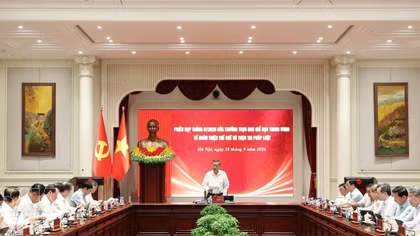
Prime Minister Pham Minh Chinh chaired a meeting between the permanent Government members and leaders of Hanoi to review and provide feedback on the draft Hanoi Capital Master Plan with a 100-year vision on March 14. (Photo: baochinhphu.vn)


The PM also suggested that Hanoi consider building a planning exhibition centrr to publicly display the capital’s master plan, enhance oversight and attract investment while serving as a tourism attraction.

To ensure feasibility, he emphasised the need to prioritise projects with strong spillover effects and mobilise diverse financial resources, including public-private partnerships, BOT and BT models, transit-oriented development mechanisms, bond issuance, and dedicated funds such as social housing funds.

He reaffirmed that domestic resources would play the decisive and long-term role, while international resources would serve as an important catalyst in implementing the capital’s development vision.

According to reports and opinions at the meeting, Hanoi previously developed two parallel planning systems - the Capital Plan under the 2017 Planning Law and the Hanoi General Plan under the 2024 Urban and Rural Planning Law, which led to overlaps and inconsistencies between socio-economic development strategies and spatial planning. Several long-standing issues such as traffic congestion, flooding and environmental pollution have yet to be fully resolved, leading to inefficient use of resources.

To adapt to the two-tier local government model, the trend of smart urban development and increasing regional and international connectivity, Hanoi is now focusing on building a single comprehensive master plan for the capital with a long-term vision of 100 years. The plan aims to establish a unified legal foundation and create new development momentum for the city.

The initiative follows Resolution No. 258/2025/QH15 adopted by the National Assembly on December 11, 2025, which allows the formulation of an integrated capital master plan combining the Capital Plan and the Hanoi General Plan.

The planning timeline includes short-term development through 2035, medium-term goals to 2045, long-term orientation to 2065, and a strategic vision for the next 100 years.

The draft plan proposes 11 breakthrough solutions, including strengthening regional connectivity, building a “core–satellite” urban model with Hanoi as the central city driving development across the Capital Region, the Red River Delta and the Northern Key Economic Region, and expanding urban railway systems alongside transit-oriented development (TOD).

Other key priorities include developing new growth poles to ease population pressure in the inner city, building smart, green and sustainable urban systems, comprehensive urban renewal, multi-layer spatial development, unlocking the development potential of the Red River as a symbolic axis of the capital, expanding airport infrastructure, addressing environmental pollution, and establishing land reserves to support long-term growth.

The plan identifies nine development poles, nine major centres and nine key development corridors, connected through ring roads and economic corridors to strengthen regional and international links, including connections to border gates and seaports. It also outlines cultural and heritage landscapes along the Da River, Red River and Duong River, as well as a western green heritage belt linking natural attractions and historical sites./.
VNA

Other News

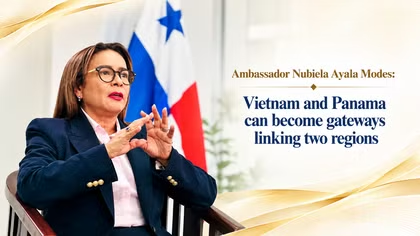
Vietnam and Panama can become gateways linking two regions

Vietnam and Panama can become gateways linking two regions

"Panama can serve as a strategic platform for Vietnamese companies seeking greater access to Latin America and the Caribbean, while Vietnam represents an important gateway for strengthening Panama’s engagement with Southeast Asia", Ambassador Nubiela Ayala Modes confirmed.

Localities committed to achieving 2026 growth targets

Localities committed to achieving 2026 growth targets

Localities nationwide hailed effective and flexible directions delivered by the Government so far this year, resulting in positive nine-month socio-economic growth, and reaffirmed their commitment to achieving targets set for the whole 2026 at an online Government-locality conference on October 3.

Creating new drivers for Vietnam-Canada cooperation

Creating new drivers for Vietnam-Canada cooperation

The elevation of bilateral ties to a Strategic Partnership shows that Vietnam and Canada increasingly view each other not simply as trading partners, but as long-term partners in addressing economic, technological and regional challenges.

Top leader asks for sports development to build national strength

Top leader asks for sports development to build national strength

The top leader applauded the efforts of ministries, sectors, localities, social organisations, coaches, athletes, experts in developing physical education and sports in recent times, stressing that Resolution No. 08 has provided an important political foundation for sports development over the past 15 years, while Conclusion No. 70 set important orientations for the new period.

Vietnam mobilises resources to affirm its leadership role in APEC 2027

Vietnam mobilises resources to affirm its leadership role in APEC 2027

PSNews - Vietnam is recognised by its partners as an influential member of the Asia-Pacific Economic Cooperation (APEC) forum, with expectations that it will continue to demonstrate leadership when it hosts APEC for the third time in 2027, according to Standing Deputy Minister of Foreign Affairs Nguyen Minh Vu.

Top Vietnamese leader receives Chairman of Japan Bank for International Cooperation

Top Vietnamese leader receives Chairman of Japan Bank for International Cooperation

General Secretary and President Lam urged JBIC to continue promoting the substantive implementation of projects under the Asia Zero Emission Community (AZEC), and step up discussions on potential cooperation within the framework of the POWERR Asia (Partnership on Wide Energy and Resources Resilience Asia) initiative, including the development of strategic energy reserves.

NA, Government's Party committees meet on legislature's second session agenda

NA, Government's Party committees meet on legislature's second session agenda

National Assembly President Tran Thanh Man coordination must go beyond finishing the agenda to improve the quality of NA decisions and Government enforcement; deal with policies rather than just paperwork, especially in the fight against corruption and other negative phenomena; and pin down final responsibility for each product, not just progress.

Prime Minister receives Cambodian Minister of Inspection

Prime Minister receives Cambodian Minister of Inspection

Prime Minister Le Minh Hung asked the two countries' inspection agencies to build on their achievements by regularly exchanging information and experience, maintaining delegation exchanges, and coordinating inspections in areas related to bilateral economic, trade and investment cooperation.

Urgent action needed to address law enforcement as weak link: Top leader

Urgent action needed to address law enforcement as weak link: Top leader

General Secretary of the Communist Party of Vietnam Central Committee and President To Lam on September 28 called for urgent and fundamental improvements in law enforcement, stressing that legislation and its enforcement must form a unified whole and ultimately serve development, protect legitimate rights and interests, and strengthen public trust.

Vietnamese, Cambodian inspectors reinforce collaboration

Vietnamese, Cambodian inspectors reinforce collaboration

The Government Inspectorate of Vietnam broadly accepted the Cambodian ministry's proposals to maintain, renew and make more effective regular meetings between professional units and training establishments, and increase exchanges of senior, expert and specialised working-group delegations.