According to experts, Vietnam’s real estate market will continue to charm foreign investors thanks to high liquidity and alluring profit-making prospects.
The latest report by CBRE, a leading real estate advisory firm, showed that a total of 8,800 new condos were put on sale in Hanoi’s realty market over the first quarter this year, 6,600 units of which have already found buyers.
CBRE also forecast a 9-per cent jump in the volume of condos sold thí year compared to 2017, reaching 28,000 units.

The plentiful supply aims to keep up with current burgeoning market demand, particularly from the soaring number of city dwellers, most of whom are young people.
In addition, young people in big cities like Hanoi often consider buying their own houses with their work savings or after getting married, leading to rising housing demand.
Favoured options are apartment units rather than landed properties due to both financial and comfort factors.
That is because many developers are trying their best to provide prospective buyers with the utmost comfort by launching fully-furnished apartment building projects which feature a diverse range of accompanying facilities.
This helps young professionals relax amongst the hustle and bustle of the city with available convenient facilities. In addition, landed properties often carry a more costly price tag compared to apartment units, putting financial pressure on young buyers.
What is more, there is a surging growth in the middle-class population of Hanoi, which is set to continue rising amid the country’s rapid economic development. In combination with burgeoning demand for condos, buying prices and rental costs are expected to rise as well.
The value of property chiefly depends on key factors such as transport convenience, geographical position, and accompanying amenities.
The investment opportunities at projects which satisfy these factors, therefore, are very appealing to foreign investors, particularly considering the record-high property prices in many foreign markets in the region.
Well aware of the trend, Terence Chan, director of Golden Emperor, one of Hong Kong’s leading outbound real estate firms, said that large-scale infrastructure projects and strong foreign capital flow are among the factors that have led to the booming economic development in Hanoi and stimulated the real estate market.
In the condo sector, Gamuda Land with its award-winning condo project – the ZEN Residence (Gamuda Gardens in Hanoi’s Hoang Mai district) – holds distinct advantages complemented by a smart infrastructure system that connects with major roads.
“By virtue of a well-conceived development plan, the ZEN Residence will grow into a charming residential community, promising to deliver foreign investors a high leasing profit rate at about 7 per cent per annum,” Chan said.
Looking back on 2017 and the first half of 2018, Hanoi’s condo market has attracted many foreign investors after they have penetrated the Vietnamese market.
At present, foreign investors from Singapore, Hong Kong, Japan, and South Korea have reported a rapidly growing presence in the Vietnamese real estate market, whereas previously, their attention was mainly confined to simply seeking investment opportunities. Besides, their investments have also expanded outside of the commercial real estate sector into the private housing segment.

Under Document No. 10065/VPCP-KGVX, the Deputy PM agreed with proposals by the Ministry of Home Affairs for a one-day holiday for Vietnamese Culture Day in 2026, and a seven-day Tet holiday and a four-day National Day holiday in 2027.
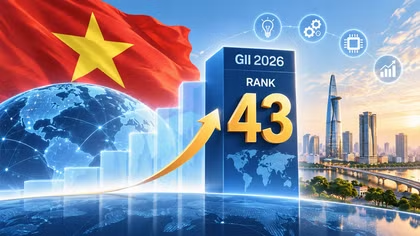
By 2030, Vietnam aims to rank among the world’s top 40 in the GII; raise total social investment in R&D to at least 2% of GDP, with non-State funding accounting for over 60%; increase international scientific publications by an average of 10% annually; and raise the number of patent applications and granted patents by an average of 16-18% annually.
The State Bank of Vietnam set the daily reference exchange rate at 25,624 VND/USD on October1, down 3 VND from the previous day.

Quang Ninh's GRDP grew 15.04% in the third quarter, also leading the country.
Vietnam needs flexible incentives and specialised green financial instruments, stronger inter-sectoral coordination, improved local governance capacity and a more complete MRV data system, said Ramla Khalidi, Resident Representative of the United Nations Development Programme (UNDP) in Vietnam.
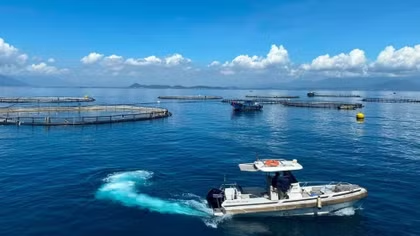
As the country enters a new development phase with greater demands for stronger marine-economy growth, institutional bottlenecks have emerged and need to be addressed.
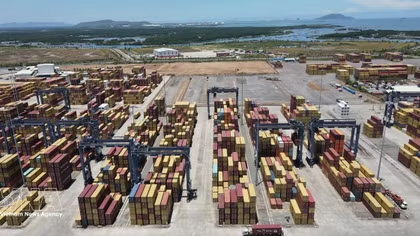
Experts from the Institute of Vietnam and World Economy under the Vietnam Academy of Social Sciences noted the quality of recent growth as the high growth rate has been recorded against an increasingly higher comparative base.

Vietnam's Halal exports remain modest at around 900 million USD a year, accounting for less than 1% of the global market. Most exports are still raw agricultural and seafood products. Only around 1,000–1,300 Vietnamese businesses obtained or maintained Halal certification during 2024–2026.
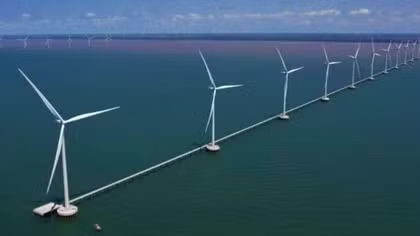
Vietnam needs a comprehensive policy framework to remove legal and procedural bottlenecks and create conditions for offshore wind power projects to access long-term investment capital, helping to unlock the country’s substantial offshore wind potential, said insiders.
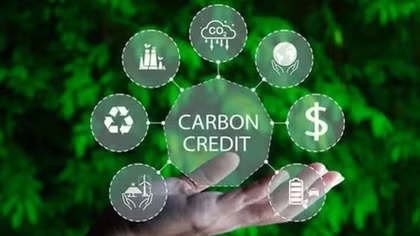
Under a decision of the municipal People’s Committee on establishing an inter-agency working group, departments and agencies are responsible for identifying facilities subject to greenhouse gas inventories, developing emissions-reduction plans and studying projects capable of generating carbon credits.
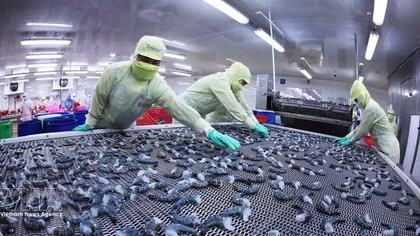
According to data from the Vietnam Customs cited by the Vietnam Association of Seafood Exporters and Producers (VASEP), shrimp exports reached 478.5 million USD in August, up 4.2% from the same month last year. The eight-month total stood at 3.3 billion USD, representing a year-on-year increase of 12%.
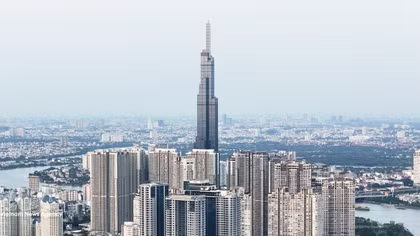
Vietnam is seen as a potential market, with considerable room for growth in real estate, particularly commercial property, compared with some regional markets. Strong Vietnam-Russia ties and opportunities to establish foreign-invested enterprises are also considered favourable for Russian investors.
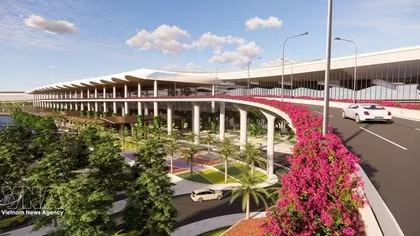
For 2021-2030, the Civil Aviation Authority of Vietnam proposed bringing forward the investment in a parallel taxiway system and a connecting taxiway north of Runway No. 2 at Phu Quoc International Airport, in order to connect with the aircraft maintenance and repair facility (hangar) planned for the northern area of the airport.
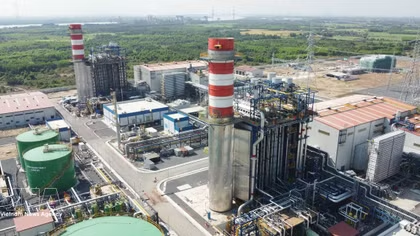
For LNG-fired power to fulfill its role in Vietnam’s energy transition, bottlenecks in institutions, infrastructure, electricity pricing, PPAs, power dispatch and financing must be addressed together.
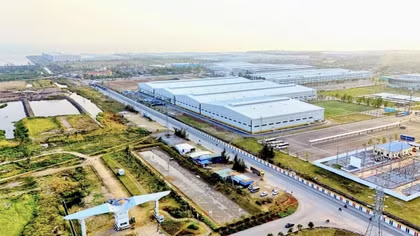
From policy and infrastructure to industrial real estate, Vietnam’s FDI advantages are broadening towards a more integrated production ecosystem, offering investors a stronger combination of conditions for high-value, technology-intensive and long-term projects.
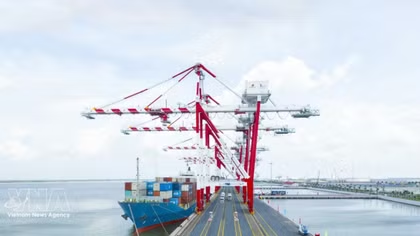
As trade expands, systemic bottlenecks across transport networks, warehousing, ports, border gates, and industrial zones are becoming more apparent. Experts emphasise the need to shift from a fragmented, project-by-project approach toward strategic management structured around trade corridors and integrated supply chains.
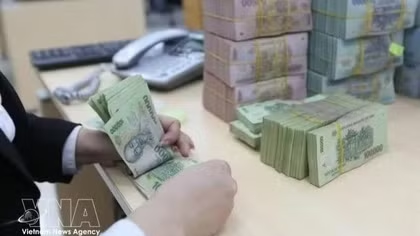
The company will buy non-performing loans from credit institutions and foreign bank branches, recover and dispose of debts and collateral, restructure loans and support lenders in resolving bad debts.
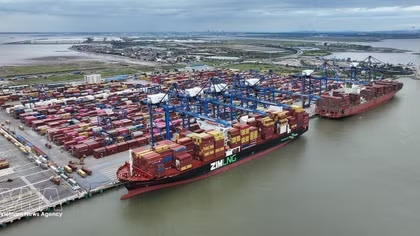
Do Ngoc Hung, Trade Counsellor and head of the Vietnam Trade Office in the US, said what stands out is not only the growth in trade volume but also the increasingly deep economic ties between the two countries.
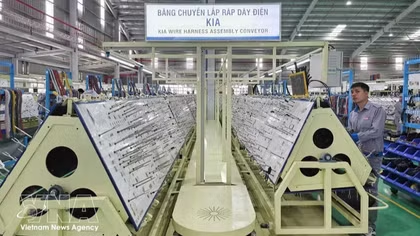
According to the Ministry of Finance, State budget revenue in the first eight months of 2026 was estimated at 2.02 quadrillion VND (77.7 billion USD), equivalent to 80% of the annual estimate and up 16% year-on-year. Domestic revenue reached 1.75 quadrillion VND, accounting for 86.6% of total revenue and rising 16.6%.

Hanoi aims to achieve average annual export growth of at least 12% during 2026-30, with the city seeking to diversify export markets, boost high-tech and value-added products and reduce reliance on traditional markets.