Harmful Vietnamese festival practices banned

Traditional festivals comprising violent activities and causing chaos are to be stopped or changed, authorities and cultural managers said at a conference in Hanoi on January 10.

The Ministry of Culture, Sports and Tourism organised the conference to review festivals held over the last year. The conference was joined by representatives from a number of festivals’ organising boards and departments of culture nationwide.

Last year, the ministry banned buffalo-fighting festivals in Lao Cai, Yen Bai, Nghe An and Quang Nam provinces because they involved violence that may have a bad influence on the community, especially children, said Minister of Culture, Sports and Tourism Nguyen Ngoc Thien.
“We mobilised local people to change the way their festivals are organised if there are actions harmful to the environment, causing disorder and encouraging violence,” he said.

“We are committed to organise festivals which preserve cultural values and fine traditions. Through the festivals, we also promote an image of a beautiful and civilised country and the unique and diversified culture of the ethnic groups.”
“The festivals are organised to meet spiritual and entertainment demands of the people and educate the younger generation to preserve the tradition.”

Le Thi Minh Ly, member of the National Council for Cultural Heritage, agreed that factors that are not suitable to modern society and current lifestyle trends can be changed. However, she stressed that the authorities should respect, share and discuss with the community in the organistion of festivals.

“Due to the war and changes throughout history, the organisation of traditional festivals was interrupted for decades,” she said.

“That’s the reason why some traditional values of the festivals are lost and some new details are added.”

“The authorities should work closely with the cultural researchers and people – owners of the festivals, to organise them in the most suitable way.”

Nguyen Van Anh, vice director of Bac Ninh province’s Department of Culture, Sports and Tourism, said many traditional festivals in Bac Ninh have been changed following the ministry’s directions. The Dong Ky Village Festival is a prime example.

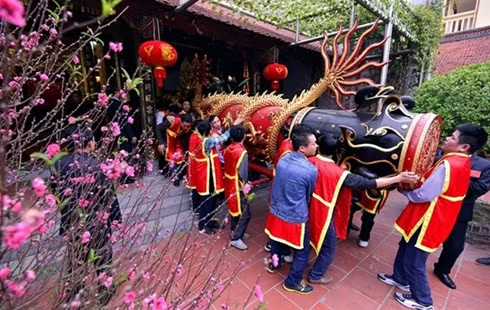
Thousands of people gather at Dong Ky village to participate in the local firecracker festival in springtime every year. The festival was first held to honour General Thien Cuong who helped the legendary Hung Kings fight against invaders and was later considered the tutelary god of the village. After winning the fight, the general celebrated their victory with two huge firecrackers.

“Ever since the government banned the use of firecrackers, local people have made firecracker models to perform the ritual,” said Anh. “Instead of setting off firecrackers, we carry the giant firecrackers during a procession.” 

Anh also revealed that Dong Ky villagers have donated a giant decorated firecracker, which plays the leading role in the procession, to the National Museum of History. In the future, the firecracker would be displayed at the museum to introduce the skill of the Dong Ky craftsmen and the traditional festival of the local people.

VNA

Other News

Vietnam secure berth at FIFA U17 World Cup 2026 for first time

Vietnam secure berth at FIFA U17 World Cup 2026 for first time

Vietnam national U17 football team secured a place at the FIFA U17 World Cup 2026 for the first time after defeating United Arab Emirates national U17 football team 3-2 on in the final Group C match of the AFC U17 Asian Cup 2026 in Saudi Arabia on early May 14 (Vietnam time).

Vietnam’s most beautiful railway station twins with French counterpart

Vietnam’s most beautiful railway station twins with French counterpart

A twinning agreement between Da Lat Railway Station in Vietnam and Trouville-Deauville Railway Station in France was signed at the French Embassy in Vietnam on May 7, creating new opportunities for cooperation in station management and operations, as well as cultural and tourism promotion between the two sides.

Hanoi gains two more craft villages in World Crafts Cities network

Hanoi gains two more craft villages in World Crafts Cities network

The recognition of Chuyen My and Son Dong craft villages as members of the World Crafts Cities network represents international acknowledgement of the cultural value, artisanal techniques, creativity and sustainable vitality of Vietnam’s traditional craft villages, he said.

Thang Long - Hanoi Festival 2026 to return in September

Thang Long - Hanoi Festival 2026 to return in September

Co-hosted by the municipal People’s Committee, the Department of Culture and Sports, and domestic and foreign agencies, the whole spectacle is meant to honour the city’s millennia-old heritage while reafffirming its strategy of establishing culture as a development engine.

Spreading Vietnamese cultural identity in digital space

Spreading Vietnamese cultural identity in digital space

In the context of deep international integration, cultural identity serves as both a “shield” against assimilation and a defining marker of a nation’s image. Protecting and promoting uniquely Vietnamese cultural values has therefore become a pressing task, particularly in an increasingly complex digital environment.

ITE HCMC 2026 to promote Vietnam’s tourism on global map

ITE HCMC 2026 to promote Vietnam’s tourism on global map

With its large scale, the ITE HCMC 2026 aims to promote tourism cooperation between Vietnam and priority markets such as Northeast Asia, Western Europe, North America, Southeast Asia, and Oceania while also boosting visitor arrivals from the Indian market

Vietnamese puppetry seeks renewal amid preservation challenges

Vietnamese puppetry seeks renewal amid preservation challenges

Although widely regarded as a cultural “speciality” attracting tourists, Vietnamese puppetry is facing multiple challenges in preservation and development, requiring renewed efforts to both safeguard its identity and adapt to contemporary cultural currents.

Project on digital transformation in cultural sector approved

Project on digital transformation in cultural sector approved

By 2030, the project targets the establishment of shared digital platforms across 100% of cultural sectors. All digitised cultural heritage will be standardised under the national data framework and shared in accordance with regulations, while 80% of public digital heritage assets are expected to receive digital identifiers to clarify ownership and management, encouraging organisations and individuals to do the same and support market development.

Vietnam eyes becoming region’s leading tourism destination

Vietnam eyes becoming region’s leading tourism destination

Vietnam has in recent years undergone a notable transformation in its tourism development strategy, placing a strong emphasis on nature-based and eco-tourism. This shift is not merely aligned with global trends, but represents a necessary step towards safeguarding valuable natural resources, while appealing to a growing segment of environmentally conscious travellers.