Ho Chi Minh City targets high-quality FDI inflows

The goal of 11 billion USD in FDI this year comes amid rising registered capital and the emergence of billion-USD projects that are injecting fresh momentum into the investment landscape.

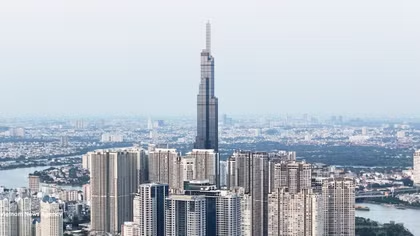
Ho Chi Minh City has set a target of attracting 11 billion USD in foreign direct investment (FDI) in 2026, prioritising high technology, logistics, and financial – commercial centre projects. The goal comes amid rising registered capital and the emergence of billion-USD projects that are injecting fresh momentum into the investment landscape.

Rising capital flows into data infrastructure

Hoang Vu Thanh, Acting Director of the municipal Department of Finance, said total FDI inflows in the first two months of 2026, including newly registered projects, capital adjustments, and capital contributions or share purchases, reached nearly 979.6 million USD, up 28.4% year-on-year.
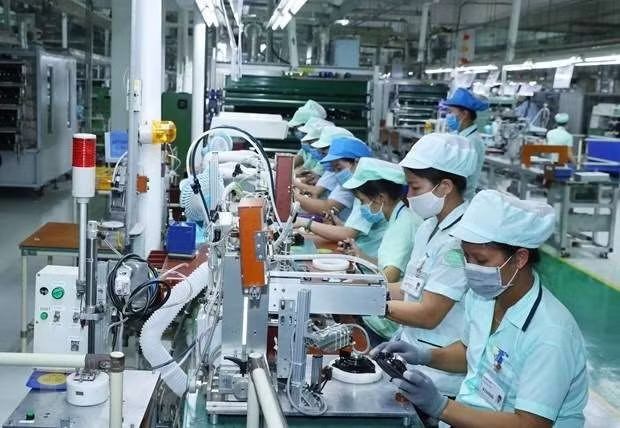
Ho Chi Minh City targets high-quality FDI inflows -0
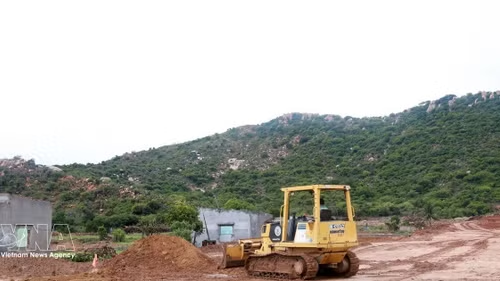
Ho Chi Minh City targets a 15% increase in newly licensed projects, construction permits given, and land-use right certificates granted compared to 2025. Photo: VNA

The city granted investment registration certificates to 286 new projects, with total registered capital exceeding 242.8 million USD. Meanwhile, 59 existing projects raised their capital, recording a net increase of 480.6 million USD. In addition, 305 transactions involving foreign investors contributing capital, purchasing shares, or acquiring stakes in domestic enterprises were recorded, with total registered capital of approximately 256.2 million USD.

This structure indicates that capital inflows are driven not only by new projects but also by the expansion of existing operations, reflecting sustained investor confidence. Additional capital is particularly significant as it is typically associated with operationally effective projects that demonstrate long-term prospects.

A notable highlight is the sharp rise in investment in data infrastructure. In February 2026, UAE-based technology group G42, in partnership with a consortium of Vietnamese investors, signed a long-term framework agreement to develop a large-scale data centre system in Vietnam, with planned investment totalling up to 2 billion USD.

In addition, a US investor is advancing a similar data centre project with an estimated investment of around 2 billion USD.

Nguyen Van Duoc, Chairman of the municipal People’s Committee, noted that these investors have pledged to disburse approximately 60% of total capital, equivalent to 1.2 billion USD, by the second quarter of 2026.

The early and substantial disbursement commitment underscores investors’ readiness and determination to implement their projects, providing a concrete basis for the city to realise its full-year FDI target.

Ho Chi Minh City currently leads the country in cumulative valid FDI capital, with 142.9 billion USD across 20,756 active projects. This scale not only reflects the attractiveness of its investment environment but also affirms its role as a key economic and financial hub within regional production and service networks.

Selective investment attraction

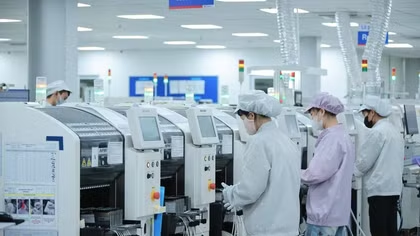
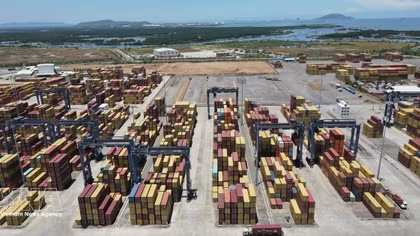
This year, Ho Chi Minh City is targeting selective FDI attraction, focusing on high technology, digital transformation, logistics, and financial – commercial centres which are characterised by high added value, technological spillovers, and global supply chain connectivity. The Vietnam International Financial Centre in the city and the Cai Mep Ha Free Trade Zone are viewed as pivotal projects in this strategy.

At the same time, the southern metropolis is accelerating the expansion of its Hi-Tech Park, developing smart and eco-industrial parks and export processing zones, preparing clean land sources, and ensuring stable digital and energy infrastructure. These measures are designed to anticipate shifts in global production and supply chain restructuring amid evolving geopolitical and trade dynamics.

Institutional reform is central to achieving the 11 billion USD target. In 2026, the city plans to eliminate or simplify 100% of unnecessary, overlapping, or unclear investment and business conditions, and abolish all business conditions for sectors not subject to conditional investment under the Law on Investment.

Notably, it aims to reduce administrative procedure processing times and compliance costs by 50%. Procedures will be restructured based on digital data, eliminating the requirement for individuals and businesses to resubmit documents that have already been digitised, while avoiding the issuance of impractical new regulations or standards. Effective implementation of the Government’s Resolution 66/2025/NQ-CP on data-based administrative reform is considered a critical lever to improve investor experience.

The city also targets a 15% increase in newly licensed projects, construction permits given, and land-use right certificates granted compared to 2025. A dedicated task force will continue to review and remove obstacles for stalled projects and land areas, expediting progress on projects with hindrances cleared in 2025 and resolving outstanding issues.

A new feature of the 2026 investment promotion strategy is the planned establishment of specialised working groups to engage directly with major global technology corporations and strategic investors. This tailored approach will enable the city to proactively propose competitive and internationally benchmarked incentives to attract large-scale, high-tech projects.
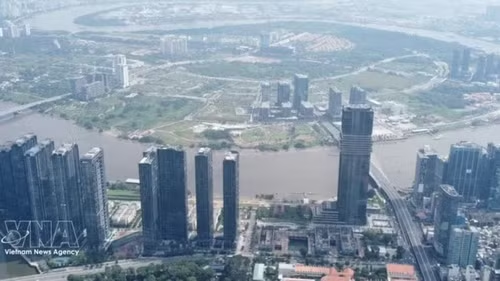
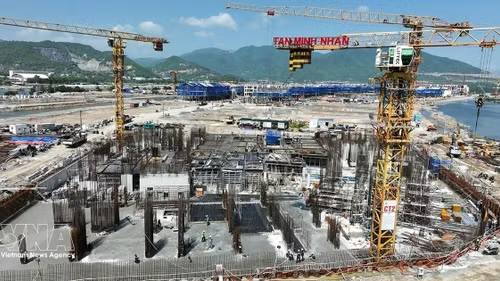
VNA

Other News

Vietnam accelerates innovation to boost growth, competitiveness

Vietnam accelerates innovation to boost growth, competitiveness

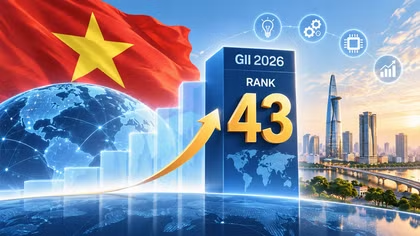
By 2030, Vietnam aims to rank among the world’s top 40 in the GII; raise total social investment in R&D to at least 2% of GDP, with non-State funding accounting for over 60%; increase international scientific publications by an average of 10% annually; and raise the number of patent applications and granted patents by an average of 16-18% annually.

Vietnam sees high growth prospects

Vietnam sees high growth prospects

Experts from the Institute of Vietnam and World Economy under the Vietnam Academy of Social Sciences noted the quality of recent growth as the high growth rate has been recorded against an increasingly higher comparative base.

Vietnam seeks bigger share of global Halal market

Vietnam seeks bigger share of global Halal market

Vietnam's Halal exports remain modest at around 900 million USD a year, accounting for less than 1% of the global market. Most exports are still raw agricultural and seafood products. Only around 1,000–1,300 Vietnamese businesses obtained or maintained Halal certification during 2024–2026.

Hanoi sets up inter-agency mechanism to operate carbon market

Hanoi sets up inter-agency mechanism to operate carbon market

Under a decision of the municipal People’s Committee on establishing an inter-agency working group, departments and agencies are responsible for identifying facilities subject to greenhouse gas inventories, developing emissions-reduction plans and studying projects capable of generating carbon credits.

Shrimp exports reach 3.3 billion USD in eight months

Shrimp exports reach 3.3 billion USD in eight months

According to data from the Vietnam Customs cited by the Vietnam Association of Seafood Exporters and Producers (VASEP), shrimp exports reached 478.5 million USD in August, up 4.2% from the same month last year. The eight-month total stood at 3.3 billion USD, representing a year-on-year increase of 12%.

Russian investors explore opportunities in Vietnam's real estate market

Russian investors explore opportunities in Vietnam's real estate market

Vietnam is seen as a potential market, with considerable room for growth in real estate, particularly commercial property, compared with some regional markets. Strong Vietnam-Russia ties and opportunities to establish foreign-invested enterprises are also considered favourable for Russian investors.

Phu Quoc airport planning adjusted to serve APEC 2027

Phu Quoc airport planning adjusted to serve APEC 2027

For 2021-2030, the Civil Aviation Authority of Vietnam proposed bringing forward the investment in a parallel taxiway system and a connecting taxiway north of Runway No. 2 at Phu Quoc International Airport, in order to connect with the aircraft maintenance and repair facility (hangar) planned for the northern area of ​​the airport.

Policy, infrastructure emerge as new advantages in FDI attraction

Policy, infrastructure emerge as new advantages in FDI attraction

From policy and infrastructure to industrial real estate, Vietnam’s FDI advantages are broadening towards a more integrated production ecosystem, offering investors a stronger combination of conditions for high-value, technology-intensive and long-term projects.

Logistics upgrade vital to 1-trillion-USD trade target: experts

Logistics upgrade vital to 1-trillion-USD trade target: experts

As trade expands, systemic bottlenecks across transport networks, warehousing, ports, border gates, and industrial zones are becoming more apparent. Experts emphasise the need to shift from a fragmented, project-by-project approach toward strategic management structured around trade corridors and integrated supply chains.

Ample room for Vietnam, US to deepen cooperation

Ample room for Vietnam, US to deepen cooperation

Do Ngoc Hung, Trade Counsellor and head of the Vietnam Trade Office in the US, said what stands out is not only the growth in trade volume but also the increasingly deep economic ties between the two countries.

Flexible fiscal policy helps drive economic growth

Flexible fiscal policy helps drive economic growth

According to the Ministry of Finance, State budget revenue in the first eight months of 2026 was estimated at 2.02 quadrillion VND (77.7 billion USD), equivalent to 80% of the annual estimate and up 16% year-on-year. Domestic revenue reached 1.75 quadrillion VND, accounting for 86.6% of total revenue and rising 16.6%.

Electronic components are produced at a factory in Hanoi. (Photo: VNA)

Hanoi's imports surge 41% in first eight months of 2026

Hanoi aims to achieve average annual export growth of at least 12% during 2026-30, with the city seeking to diversify export markets, boost high-tech and value-added products and reduce reliance on traditional markets.