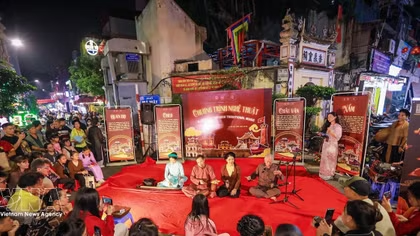
- Hoi An lit up with lanterns
- Hoi An to celebrate lunar New Year’s full moon day
- The 2nd Cam Ha - Hoi An Kumquat Festival
During a recent interview with Tuoi Tre (Youth) newspaper, Nguyen Su, former Party chief of Hoi An City, Quang Nam Province, discussed ways to preserve the city’s intrinsic values and idyllic ambiance during the current growth in sustainable tourism.
The city, home to the UNESCO-recognized Hoi An Ancient Town, has skyrocketed in popularity and become one of the most alluring tourist destinations in Vietnam, thanks in-part to glowing reviews on prestigious travel websites.
 |
Visitors to Hoi An are stunned by area’s pristine landscape, serene ambiance, hospitable culture, and sustainable tourism development.
A major chunk of the credit for the tourism boom lies with Su and certain administrative reforms carried out during his tenure, including those aimed at maintaining public order in the city which was instrumental to enriching the town’s touristic value.
During his time in office, Su managed to help transform Hoi An into a must-visit destination and highly-livable locality.
In 2012 the former secretary was honored with a Phan Chau Trinh Cultural Foundation award, meant for local artists and culture researchers, for his commendable contributions towards improving Hoi An City’s well-being.
During the Tuoi Tre interview, Su addressed various problems that have followed in the wake of Hoi An Ancient Town’s tourist boom.
The importance of orginality
“It’s an upbeat sign that vacationers have flocked to the town in recent years. Tourism revenues account for almost 70 percent of the city’s income,” Su said.
“The town’s rich culture, humanitarian values, rustic lifestyle, and the neighborly attitude of its residents greatly appeals to visitors, especially foreigners,” he noted.
Su added that vacationers do not flock to Hoi An for its relics, which are admittedly not as imposing and grandiose those elsewhere in the country. Instead, much simpler pleasures seem to magnatize tourists towards the town.
“Visitors love strolling through the ancient town and experiencing its traditional ambiance, shopping for souvenirs at the local market, immersing in the pastoral countryside and waters, and meeting locals,” he elaborated.
These alluring highlights keep holidaymakers returning to the city, with many staying for a week or even a month, he stressed.
“A resort town cannot do without its own originality. The more modern and ‘flat’ the world becomes, the greater the need for a country or city to highlight its unique features. Tourism has boomed as people grow tired of the same old things and begin crave something different,” the former leader underscored.
“The municipal administration can be receptive to economic development, but it’s essential that they strive to keep its identity-rich culture and ecology thriving.”
“Without these elements, which take generations to rebuild, Hoi An will wither,” he warned.
Things need doing
Su therefore urged the contemporary administration take measures to reorganize street vending activities, stop street vendors from cheating tourists or soliciting them to buy their wares, and ensure order in the tourist hub to retain its public image.
“The Hoi An ancient town, an extremely fragile area, has stood firm in everyone’s heart throughout the course of time thanks to efforts by its residents and local administration to keep its heritage untainted.”
He also called for the authorities and dwellers to join hands in protecting the local environment in the face of coastal erosion and the rampant, haphazard construction of certain tourist facilities.
“The move adopted by the local administration to gather dwellers in residential areas is well-reasoned in principle, but by doing so, they are breaking away the deep-rooted sentimental, neighborly attachment, which has become a significant concept unique to the locality,” he elaborated.
“We cannot blame tourist overcrowding for what is going on. We need to create new products based on long-standing values that enrich the heavily touristic town’s appeal and avoid losing its identity.”
“It’s vital that every Hoi An citizen take great pride in their hometown, and be willing to condemn undesirable activities in their neighborhoods,” he stressed.
Su also urged local authorities take drastic measures towards tackling acts that mar the local tourism industry including scams, rip offs, theft, and pick- pocketing.
“What makes Hoi An most appealing, particularly to European and American tourists, is its serenity and peacefulness, as well as locals’ genuine hospitality. They do not use exaggerated and fake amiability to talk tourists into buying their goods or services,” Su pointed out, adding that outsiders could potentially ruin the fragile trust between tourists and sellers.
“Non-local peddlers have recently moved in. An awareness of offering good services with an attitude that helps ensure stable tourism development needs to be raised among them.”
Under his term, despite an annual influx of tourists, the local government stringently imposed curbs on the development of large-scale tourism services or facilities.
Along with its ancient quarter, the government and locals are working hard to keep the nearby sea, islands, and rustic scenery pristine.
While in office, Su turned the “Ancient quarter night” program, a culture and art initiative, from a monthly to a weekly event.
During the event the sparkling small streets in Hoi An, lined with century-old yellow-walled houses, most businesses hang special Hoi An colored lanterns, a tradition which has begun to earn acclaim on the world tourism stage.
“Some advised me to have the celebration run overnight to pamper Westerners with nocturnal pleasures, but I was set on having it closed at fixed time and retaining our identity.”
“Exotic experiences which are a far cry from their own appeal most to visitors, particularly foreigners. Tourism is not only about earning profits, but also about promoting the locality’s image, culture and traditions. That’s what counts,” he noted.
Su recalled that his idea of launching the event was initially met with protest from many locals, but later opponents to the plan began to accept its communal benefits.
“The hallmark event has thrived over the past 20 years and enriched the town’s appeal, apart from its imposing, ancient edifices; serene, harmonious surroundings, which send vacationers back to the 17th century; and the unique harmony between Vietnamese, Japanese, and Chinese culture and architecture,” he added.
Though he has retired, Su constantly receives feedback from concerned residents, which he passes on to the current administration for their consideration.