Though foreign direct investment (FDI) in mining has been minimal, most projects are bogged down in contractual disputes or tax issues, causing headaches to local authorities.

After exploiting 6.9 tonnes of gold worth more than VND5 trillion ($217.4 million) at the Bong Mieu mine, one of the two largest gold mines in Southeast Asia, Canada’s Besra Group has fled without returning the site to its original state as required by the law, leaving behind unpaid debts of dozens of millions of US dollars.
Le Van Thang, who used to be a foreman at Bong Mieu Gold Mining Co., Ltd. and now works for a local company as a security guard at the Bong Mieu mine is sadly looking at the rusting, empty facilities, while saying: “Bong Mieu went bankrupt and the investor has left, but their disastrous mess remains. Life has not returned to normal.”
The Bong Mieu mine was the most modern gold facility in the country when it was opened in the central province of Quang Nam in 2005 amidst high-sounding promises of enriching local state coffers and creating jobs for the locals.
However, Bong Mieu Gold Mining’s financial statement paints a very different picture, reporting VND1.26 trillion ($54.78 million) of debts and VND1 trillion ($43.48 million) in accumulated loss, which exceed its total equity by VND966 billion ($42 million). As of November 2017, the company’s debts include tax arrears, unpaid social insurance, and loans to around 100 creditors.
Despite officially going bankrupt, Bong Mieu Gold Mining has not closed the mine or restored the site due to a lack of finances, providing an opportunity for locals to enter the area to illegally exploit and glean gold dust, poisoning the local rivers and streams.
In another case, Indonesian firm PT Vietmindo Energitama also fell short of expectations when it was accused of illegally exploiting 80,000 tonnes of high-quality coal in the northern province of Quang Ninh. In addition, Vietmindo’s ongoing contractual dispute with local contractor Tan Viet Bac (TAVIBA) also made headlines after a scuffle at the mining site.
The dispute revolves around Vietmindo’s unilateral termination of its contract with TAVIBA, claiming that the latter had been continuously failing to fulfil its contractual obligations. Protesting the termination, TAVIBA blocked major roads at the mining site with its vehicles, machinery, and equipment for the past 10 months. The company also submitted increasing compensation demands, from VND60 billion ($2.6 million) to VND400 billion ($17.39 million). The dispute has brought about damage to both sides and caused a headache for local authorities. Vietmindo even declared to permanently stop the mining project before the scheduled ending time in 2021. The declaration is even considered a ploy to pressurise the province and government officials and goes against Vietmindo’s statement at a recent press event that it had submitted a proposal to extend the time of exploitation at the mine by 20 years.
Another leading factor behind investors breaking their promises in Vietnam is price fluctuation, highlighted by the example of the Ban Phuc Nickel mine project invested by Ban Phuc Nickel Mines LLC (BPNM), a subsidiary of Canada-based Asian Mineral Resources Ltd. (AMR).
The Ban Phuc nickel mine contains more than 200,000 tonnes of nickel and 18,000 tonnes of copper reserves in highly concentrated and disseminated sulfur ore. Immediately after going into operation in 2013, the entire volume of nickel-copper sulfur ore was used to produce and export 9.5 nickel concentrate. As of November 2016, the company had exported 42 shipments of pure nickel ore, paying the state VND929 billion ($40.39 million) as export tax.
However, the company suspended exploitation and processing at the Ban Phuc Nickel field from September 2016 to the end of September 2018 because it claimed the revenue generated by the project was not enough to offset operating costs.
Eventually, in May last year, AMR entered into an agreement to divest its 90 per cent ownership in Ban Phuc Nickel Mine to Ta Khoa Mining Ltd., a company established by AMR’s longstanding in-country senior manager, Stephen Ennor.
“This transaction will allow AMR to achieve an orderly exit from Vietnam and move forward to focus on exploring new investment opportunities in resource-based companies or other potential strategic options,” stated the company website.
Difficult experiences

Le Chi Thanh, deputy chairman of the Quang Nam’s People Committee, admitted that Bong Mieu gold mine was a painful lesson in managing foreign-invested projects in the province. “The Mineral Law should be revised for stricter and more effective management of mineral activities such as granting exploration licences,” said Thanh.
Meanwhile, at the recent forum to review the implementation of policies governing the Vietnamese mining industry, experts said that although the Mineral Law 2010 as well as the Law on Environmental Protection clearly stipulate the responsibilities of mining organisations and individuals to restore the environment and pay a deposit for environmental restoration, as well as their specific responsibilities for environmental rehabilitation and restoration in the course of mineral mining and the revaluation of public property before closing mines, there are no feasible mechanisms to sanction mining organisations and individuals who fail to implement proper mine closure plans.
Trinh Anh Hung, a lawyer from the Quang Nam Bar Association, called for more transparency in tax management as well as allocating responsibilities among state authorities for tax losses incurred from mining exploration.
“Bankruptcy does not mean that the tax debt disappears. The company representative must be responsible for unresolved tax arrears,” he stressed, adding that when a firm leaves with unsolved tax debt, the first responsibility should belong to the local tax department and the finance ministry.
Urgency to revise legislation
Dr Oliver Massmann, general director of Duane Morris Vietnam LLC, said that a modern mining project would have a positive impact by creating a large number of jobs, promoting local goods, and bringing new orders to service providers, while at the same time improving infrastructure.
“To sum it up, there are essentially three solution concepts. First, existing mining legislation could be revised and made more transparent, clearer. Investor-friendly rules could be created. Second, state co-ordination with law enforcement can be established to ensure the consistent and effective application of the relevant rules. Third, a fair tax system for the government and investors likewise should be created,” Massmann suggested.
Currently, the Vietnamese mining industry remains largely undeveloped with most operations being insufficient and causing harm to the environment. However, there remains great potential in the industry due to the abundance of unexploited mineral resources. The discovery of new minerals can be significantly facilitated by foreign investment. This provides an opportunity to use modern, efficient, sustainable, and secure technologies, which could have a huge impact on the nation’s economic growth and would lead to a reduction in public debt.
Massmann added that Vietnam should persistently and resolutely follow its policy of restricting the export of raw materials to the utmost, with clear and consistent communication by state management agencies to urge businesses to invest in intensive processing to increase export value. At the same time, the country needs a comprehensive strategy covering the extraction, processing, and use of all mineral resources.
More than a year after the Politburo's Resolution No. 68-NQ/TW on private sector development came into effect, expectations now extend beyond increasing the number of enterprises. The goal is to build a stronger business community with greater resilience, larger ambitions and the capacity to compete in global supply chains.

Vietnam is expected to remain one of ASEAN’s fastest-growing economies in 2026, supported by resilient exports, strong investment inflows and an ambitious reform agenda, despite mounting global uncertainties, according to the World Bank’s latest Vietnam Economic Update released on May 15.

Under a new circular, the exchange of greenhouse gas emission quotas and carbon credits is conducted on the domestic carbon credit exchange through the carbon trading system, which is interconnected with the national registration system.

As many agricultural businesses continue to face challenges in finding stable outlets, modern retail systems are increasingly becoming key distribution channels helping Vietnamese products access the market more professionally.
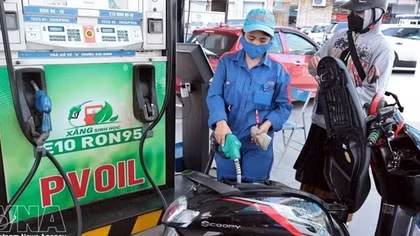
For biofuels, particularly E10, to develop successfully, stronger and more coordinated policies are needed, especially pricing mechanisms capable of creating a sufficiently attractive gap between E10 and mineral-based petrol, an expert has said.
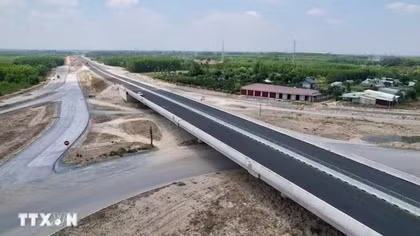
A recent PM directive set a May 10 deadline for ministries, agencies and localities to complete detailed allocations of the 2026 public investment capital plan.

A Party official has urged the Vietnamese business community to improve corporate governance, technological capacity, production standards, workforce quality and international connectivity to strengthen ties with the FDI sector.

The White Book provides a comprehensive overview of Vietnam’s current tax system in line with international practices, including direct taxes, indirect taxes and sector-specific levies.

The 12th Africa Forum for Investment & Commerce (AFIC 12) opened in Algiers, the capital of Algeria, on May 9, drawing around 2,000 participants, including officials, economists, businesses, financial and development organizagtions from 43 African countries and international partners, including Vietnam.
According to Dr. Bui Thanh Minh, Deputy Director of the Office of the Private Economic Development Research Board under the Prime Minister’s Advisory Council for Administrative Procedure Reform, Resolution 68 has helped foster a stronger entrepreneurial spirit through a series of concrete policy measures.

Consolidated first-quarter 2025 statements from Vietcombank, VietinBank and BIDV showed that the Treasury’s total deposit balance at the three lenders rose by nearly 39% compared with the end of 2025.

Vietnam targets 1 million one-person businesses, 5 million business entities, 10,000 tech startups, 45 startup support networks, a position among the world’s top 40 innovation ecosystems, and 1.5 billion USD in venture capital by 2030.

The exhibition, which runs until May 9 at the Hanoi International Centre for Exhibition, showcases advanced products and technologies across a range of fields, including pharmaceuticals, drug manufacturing machinery and equipment, medical devices, hospital and clinic services and dental equipment.

The province is tightening maritime governance, with a focus on May–June 2026 to finalise a more robust legal framework and close loopholes for illegal fishing.
Leading the charge in this massive building spree is the new central city square in the core of the Thu Thiem new urban area. Spanning more than 20 ha, it’s the crown jewel of the Central Square and new administrative center complex.
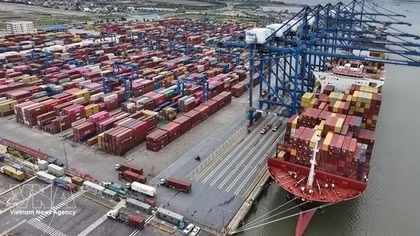
The country’s stable political and economic environment provides a critical foundation for long-term sourcing strategies. At the same time, Vietnam has demonstrated a strong ability to scale up manufacturing, supported by a continuously expanding industrial base capable of meeting both high-volume demand and increasingly complex technical and quality requirements.
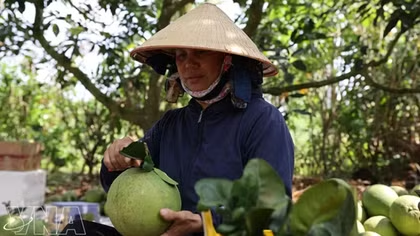
The update by Australia’s Department of Agriculture, Fisheries and Forestry to its Biosecurity Import Conditions system (BICON) on April 10, officially setting out import conditions for Vietnamese pomelos, is regarded as a major milestone in market access efforts.

Structured in two steps and three phases, the roadmap envisions a gradual shift from partial to full relocation of international flights, aligned with infrastructure readiness and the long-term ambition of building a regional aviation hub.
The circular economy is no longer just a policy choice. It has become an inevitable trend for delivering sustainable and green growth, sharpening competitiveness at home and abroad, and meeting Vietnam’s net-zero emissions target by 2050. It is now a prerequisite to sustain long-term economic expansion, particularly in industrial production and supporting industries.

Vietnamese fresh produce and processed foods are increasingly recognised for their quality, with items such as cashew nuts, coffee and spices gaining popularity among Middle East consumers. In 2025, Vietnam’s farm produce exports to the UAE exceeded 445 million USD, up nearly 24% year-on-year.