Tuan Bui, tax partner of Customs and Global Trade services at Deloitte Vietnam, talked with the Vietnam Investment Review (VIR) about some suggestions for Vietnamese logistics firms to prepare to successfully penetrate the EU market.
What will be the main difficulties for Vietnamese logistics firms in taking advantage of the EU-Vietnam Free Trade Agreement (EVFTA)?
The agreement is set to bring about enormous challenges for Vietnamese logistics companies, in addition to the chances it creates.
Europe is home to almost every world-leading logistics company, whose reputations are built by investments in logistics technology, modern fleets, cargo management, and high-quality customer services, as well as support from governments.
With the introduction of the EVFTA, the entry barriers to the Vietnamese logistics market are to be gradually removed for EU firms and thus, Vietnamese companies will be faced with increased domestic competition.
For instance, the EU’s fleets are responsible for the shipping of most goods between Vietnam and the EU while their Vietnamese counterparts play a less important role, mainly due to their scale, outdated technology, and limited range. In addition, due to a lack of presence in the EU, Vietnamese companies tend to miss out on EU exporters as they already have relations with EU logistics firms.
Vietnamese enterprises also have to compete with non-EU counterparts from countries which account for large amounts of foreign investment such as South Korea and Japan since customers from those nations often choose their compatriots.
Besides that, for goods exported to the EU from Vietnam, like agricultural products, local companies might need a logistics system which meets different stringent international standards to ensure the preservation of product quality, particularly for medicine and agricultural products.
As such, Vietnamese logistics companies are under pressure to develop a strong and modern storage and transportation system, which is prevalent among EU firms. Furthermore, while the EVFTA also increases the openness of the EU market, it is unlikely that Vietnamese logistics companies can deeply penetrate and thrive in this territory due to lack of competitiveness and experience.
EU companies are strong in logistics and the big gap between development of EU and Vietnamese companies will intensify competition. Which areas should Vietnamese firms focus on to gain more benefits from the EVFTA?
Vietnamese logistics enterprises must enhance their strengths while overcoming their weaknesses in order to take advantage of the EVFTA and attract more customers.
Accordingly, areas that might require improvement include foreign presence, selection of potential customers, and investment in high-quality labour and quality of customer services. Supply chains in the EU hardly observe any participation from Vietnamese logistics firms, which is opposite to the prominence of European logistics entities in Vietnam.
For instance, Deutsche Post DHL Group, A.P Moller-Maersk, and Schenker are EU logistics companies which have established a strong position in the Vietnamese market and are service providers for numerous Vietnamese enterprises. Consequently, Vietnamese logistics companies should consider expanding their businesses to Europe, which can be achieved by starting to collaborate with their European counterparts to perform low-level processes in both Vietnam and the EU.
One of our suggestions is that they should first consider leasing warehouses, premises, and vehicles to European logistics firms with contracts with EU customers so that the Vietnamese companies can enter the foreign supply chain. Alternatively, Vietnamese entities could boost their competing abilities by shifting the focus to small- and medium-sized customers.
Since European logistics firms in Vietnam mainly target large corporations with considerable margins, small- and medium-sized enterprises remain a lucrative market. However, to fully benefit from this sector, Vietnamese companies must leverage both the quality and the quantity of services to a multinational model as EU customers have a wide variety of demands for logistics services.
Lastly, as assessed by the Ministry of Industry and Trade (MoIT), most of the current logistics workforce in Vietnam is trained and developed from different sources, resulting in inconsistency in labour quality, which in turn hinders the capability of logistics businesses. Accordingly, logistics firms should concentrate on the hiring and training of their personnel – the most valuable asset in any business.
Vietnamese products need to meet the requirements to enjoy tariff reductions under the EVFTA such as certificate of origin and traceability. How will the growth of Vietnam’s export turnover from the EU effect the logistics industry now that the EVFTA is in force?
It cannot be denied that the EVFTA will boost Vietnam’s export turnover to the EU, which will result in strong growth in the logistics industry. The EU has been one of Vietnam’s major export markets with Vietnam’s export turnover to the EU constantly surging from 2000 to 2019.
The emergence of the EVFTA will continue to facilitate the movement of goods and services between the two regions, with export turnover to the EU estimated to rise by 42.7 and 44.37% by 2025 and 2030, respectively, compared to before as provided by the MoIT.
Such events will drive up the demand for logistics services. Accordingly, domestic logistics entities will likely enjoy a period of revenue growth. In addition, it generates an opportunity for businesses to extend their operations into different fields. For instance, it is probable that an increase in exports to the EU will culminate in a surging number of applications for certificate of origin as such documents are crucial in the enjoyment of preferential tariff rates.
As a consequence, Deloitte believes logistics firms should comprehend the regulations in the EVFTA and support clients in this extreme. Furthermore, the enhanced trade relationship resulting from the deal can boost transport demand among the EU, Vietnam, and Southeast Asia, creating a profitable client pool for Vietnamese entities.
Besides that, as import tariffs for vehicles, machinery, and technology for logistics purposes are reduced, Vietnamese logistics companies will enjoy lower capital expenses, creating room to up profitability.
What are your recommendations for the government to improve the competitiveness of its logistics industry?
We believe the Vietnamese government will need to play a role in enhancing the competitiveness of the Vietnamese logistics industry.
Regulations should be issued to encourage Vietnamese companies to increase their presence in the EU and creating and building relationships with EU exporters.
It is vital that Vietnamese entities expand their offerings to EU citizens and establish a multinational business model since their European competitors have operations in almost every region around the globe.
Also, the authorities might stimulate Vietnamese logistics firms to cooperate and share the advantages with one another by encouraging the activities of Vietnamese Logistics Association in order to contribute to a more competitive domestic industry.
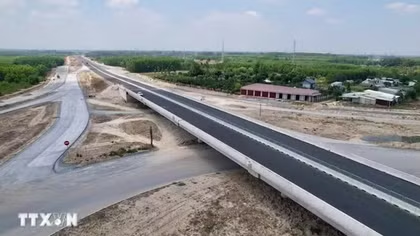
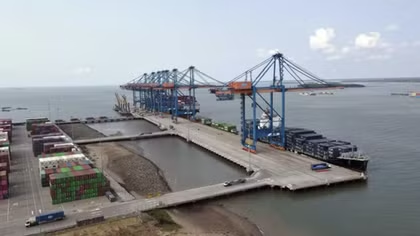
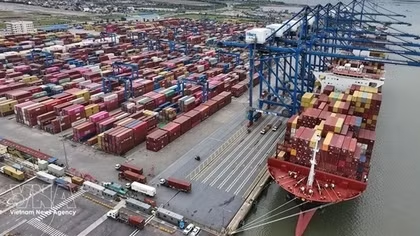
Furthermore, the government could encourage investments in logistics infrastructure, including warehouses, shipping fleets, cargos, and ports to leverage the development of the sector.
For instance, Vietnamese authorities should establish legal regulations with a view to attract investments, either domestically or from foreign nations, for the development of highway and modern seaports.
Such a strategy would significantly diminish the shipping time of logistic firms, assisting in bolstering customer services and creating value in other areas. As Vietnam has been widely known for its long coastline with numerous deep water ports, the construction of mega-ports with larger scale is probable and in line with the contemporary trend in developed countries.
Last but not least, the Vietnamese government can directly support its domestic logistics sector by reducing the expenses associated with domestic transport, namely tolls, or lower taxes for logistics companies satisfying specific conditions.